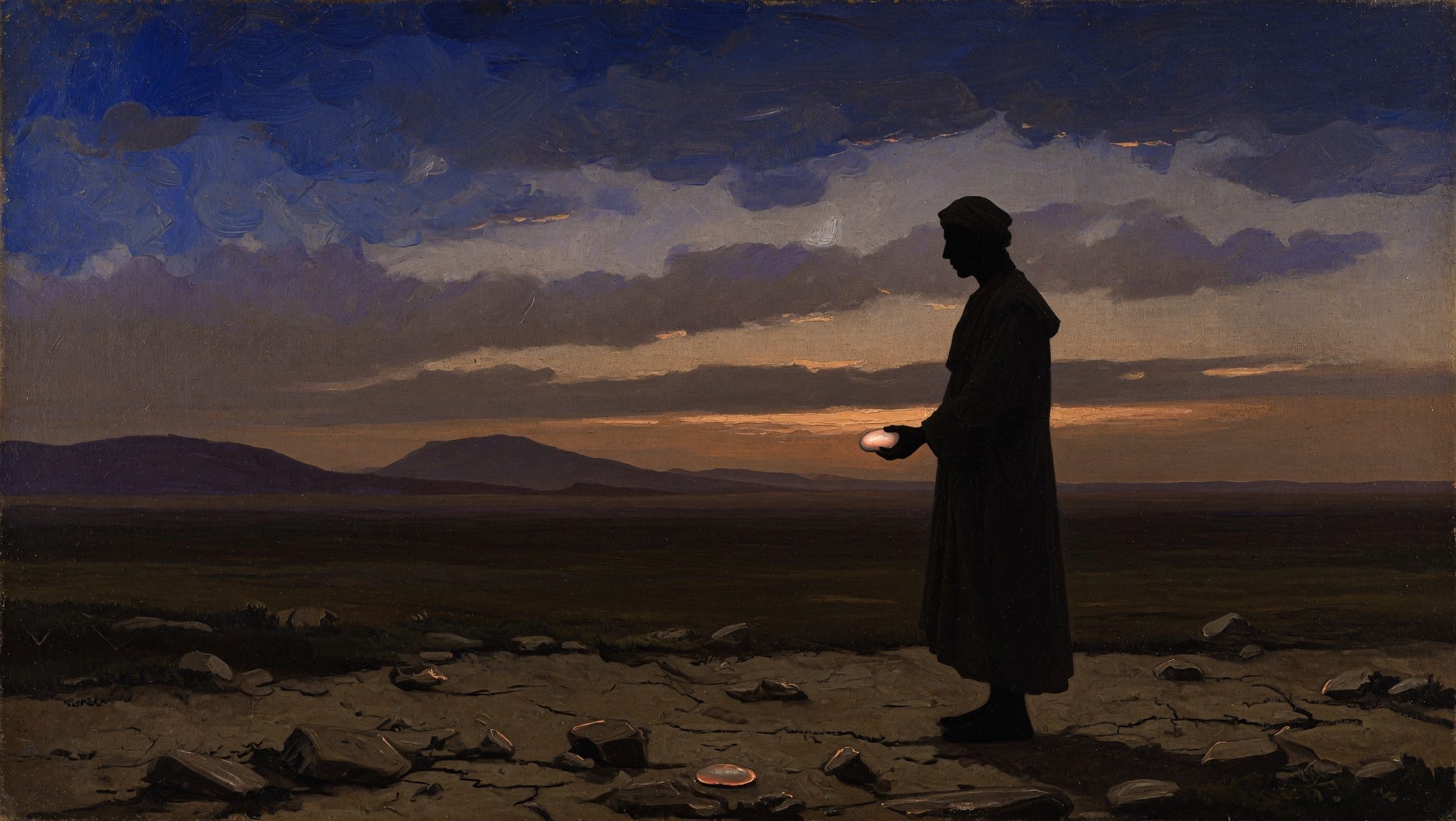
The mortar under his fingernails had been there for two seasons. The blood came off easily.
He washed his hands in the irrigation channel his stepfather had engineered. The water was cold. The channel had been calibrated by a man who measured everything. The blood ran past the mortar without lifting it. He watched the blood go.
He walked across the compound. The compound parted. A thresher stepped off the path without raising her eyes. A potter put his hand on his son’s mouth. An old Nodite woman set down her bone needle and looked at nothing. The gesture was older than the second garden. It was older than any garden.
His mother had told him when he was eleven.
Your father had this too.
He learned to put it down.
You will learn to put it down.
He had been learning for nine years on the morning of the altar.
He had set down a hundred stones. He had set down the one at the river when he was twelve. He had set down the one in the eastern pasture when his brother told him he was wrong about everything and everyone in the second garden knew it.
This one he threw.
You know the story as a child taught it. The brothers. The mark. The exile.
You were not told he had a choice. You were not told he made it for twenty years before he failed.
The morning of the altar smelled of barley and lamb’s blood.
He brought grain. Adam himself had taught, in the first Eden, that the proper offering was the fruit of the field. The records were in the western archive. The priest who refused his grain that morning knew this. The priest’s grandfather had known it. The priest’s grandfather’s grandfather had known it.
“You are right about the teaching,” the priest said. “You have always been right about the teaching. The records say our altar is wrong. We have never opened them on a feast morning.”
“Then change the altar.”
“The altar was built for the men who come. The men who come bring lambs. If I open the records of the first Eden tomorrow, the men who come stop coming. And then there is no altar at all.”
He set the sheaf on the stone anyway. The lamb’s blood ran past it. The golden heads turned dark at the tips and through the middles, as dye moves through fiber. The shepherd’s knot held.
Nobody burned the grain. Nobody moved it.
He walked home with mortar under his fingernails and grain dust on his sleeves.
Three months passed.
Then his brother spoke one thing more than he could put down.
He went to his mother.
He had not asked anyone for anything in twenty years. He had been defiant of his stepfather’s discipline. He had been disdainful of the priest’s altar. He had not prayed since he was nine years old. He had been on his own and being on his own had been honest.
His mother put her hand on his head. The hand that had once glowed violet. The hand that had clawed flagstones when the constructs took her other children. The hand that had held his biological father’s face by a river in the dark.
“What do I do,” he said.
“You ask.”
“Ask who.”
“Whoever can hear a man at the bottom of himself.”
He had spent twenty years refusing to ask. He asked now.
Help me. I do not know how to be anything other than this. I have tried for twenty years and I failed today. I am going to fail tomorrow. I am going to fail for the rest of my life. Just help me.
The room changed. The cold of the stone under his hands stayed cold. The air around his shoulders warmed. The shaking in his fingers stopped. There was a clean cold smell he could not identify. Another person was in the room. He could not see another person.
His mother had not moved her hand.
“You asked,” she said. “Something answered.”
He walked east the same night. He carried seed grain from the field the altar had refused. He carried his mother’s lavender.
He carried something at his right shoulder he could not name.
For sixty-three years he set down stones.
He set them down on the road, when his hand reached for the river bed where a sentry stood with a drawn blade. He set them down in the fields of his father’s people, when an old woman whose son had died in the raids told him his grain was not welcome here. He set them down in the council where the rule said priests ate first. He set them down at the rim of the eastern raids when he walked into the upper Nodite camps unarmed and said the only things a man in his position could say.
He set them down enough that the Elamites and the Adamites did not lose a child to the raids for forty years. He set them down enough that he taught his son to set them down.
His son was twelve when Cain saw the stone in his pocket.
The boy had Cain’s gravity. His mother’s precision. His grandfather’s ease. Three bloodlines in one twelve-year-old body. The same fingers that had reached for stones since age four.
The boy carried the stone for a week. Cain did not speak. The boy did not throw it. The boy placed it on the eastern parapet, in the alcove where the watchmen rested, where the wind would not move it. Cain found it there. He did not move it. The boy never asked him to.
The reaching had passed to the son. The throwing had not.
He died in a field he had cleared with his own hands, planting the last seven stalks of the grain he had carried east sixty-three years earlier. The old woman whose son had died in the raids brought the sheaf to him that morning. She did not speak. She set it down. He did not burn it. He did not lay it on an altar. He planted it.
He did not know if his brother would be there on the other side.
He suspected the answer would not matter where he was going.
His hands were open.
<3EKO
CAIN: EAST OF THE WALL. Concluding the Edenic Trilogy.
The inherited story turned a man who chose into a man who suffered.
This book is the man who chose.
Thank you for reading with an open hand and heart.
I love you.