Four Bikes. One Sound.
Harley-Davidson is on the clock
At 6:42 this morning the president posted about Apple’s Tim Cook.
Cook called him early in the first term about a problem only POTUS could fix.
Then called again. Three or four BIG HELPS over the years. No consultants. No fees. A direct line. The most valuable company in the history of American commerce, whose board has spent a decade keeping its distance from this administration, run by a CEO who picked up the phone and asked for help.
The president wrote what he wrote. Read it twice.
The first read is about Tim Cook.
The second read is about who had to call whom.
Tim Cook is a world-class operator. Inherited the most valuable napkin in American business. Steve drew it on a whiteboard in 1997.
Four squares. Consumer and pro. Desktop and portable.
Cook ran the operational machine behind it for more than a decade. The stock climbed. The buybacks were huge. The supply chain hummed along. Every quarter landed. The apparatus loved him.
But the napkin is gone. Look at Apple today. A half dozen different iPhones, including a Pro, an Air, a 17, a 17e, and a 16. Multiple MacBooks. Five Apple Watches. A VR/AR helmet nobody wanted. Services bundled into services. A streaming service wit its own shows. Steve drew four squares. Tim ran 40+.
The only thing the man preserved was the brand’s permission to keep selling.
And Apple has been riding the iPhone for nearly 20 years. AirPods were the last product that opened a new category. Everything since has been a refinement, an accessory, a services play, or a total failure.
The Vision Pro. The car. The long list of things that were going to be the next iPhone and weren’t. The machine runs. The earnings land. The stock prints. And the guy running the most important American tech company in the world spent a lot of his time on the phone to the White House because he had to.
Steve saw it coming. In 2008 he hired Joel Podolny away from the deanship at Yale’s School of Management and stood up what he called Apple University.
The mandate was specific. Codify what Apple actually knows. Design as reduction. Picasso’s bull. Saying no as the most important discipline in the company. A former Pixar guy was brought in to teach a course where the centerpiece was eleven lithographs Picasso drew of a bull over a single month in 1945, each one simpler than the last, the final drawing a few clean lines you still recognize as a bull because the artist had removed everything that wasn’t bull. That was the lesson. That was their religion.
Steve knew the disease that eats every American brand after the founder is gone. He tried to build antibodies into the culture while he still could.
It worked for a while. Fourteen years of an operator riding a founder’s map. Now the map is running out of road, and Tim Cook is stepping down.
Apple just happens to be the most profitable version of a disease every American heritage brand has. The symptoms are cleaner there because the margins are bigger. The symptoms are uglier when the margins aren’t.
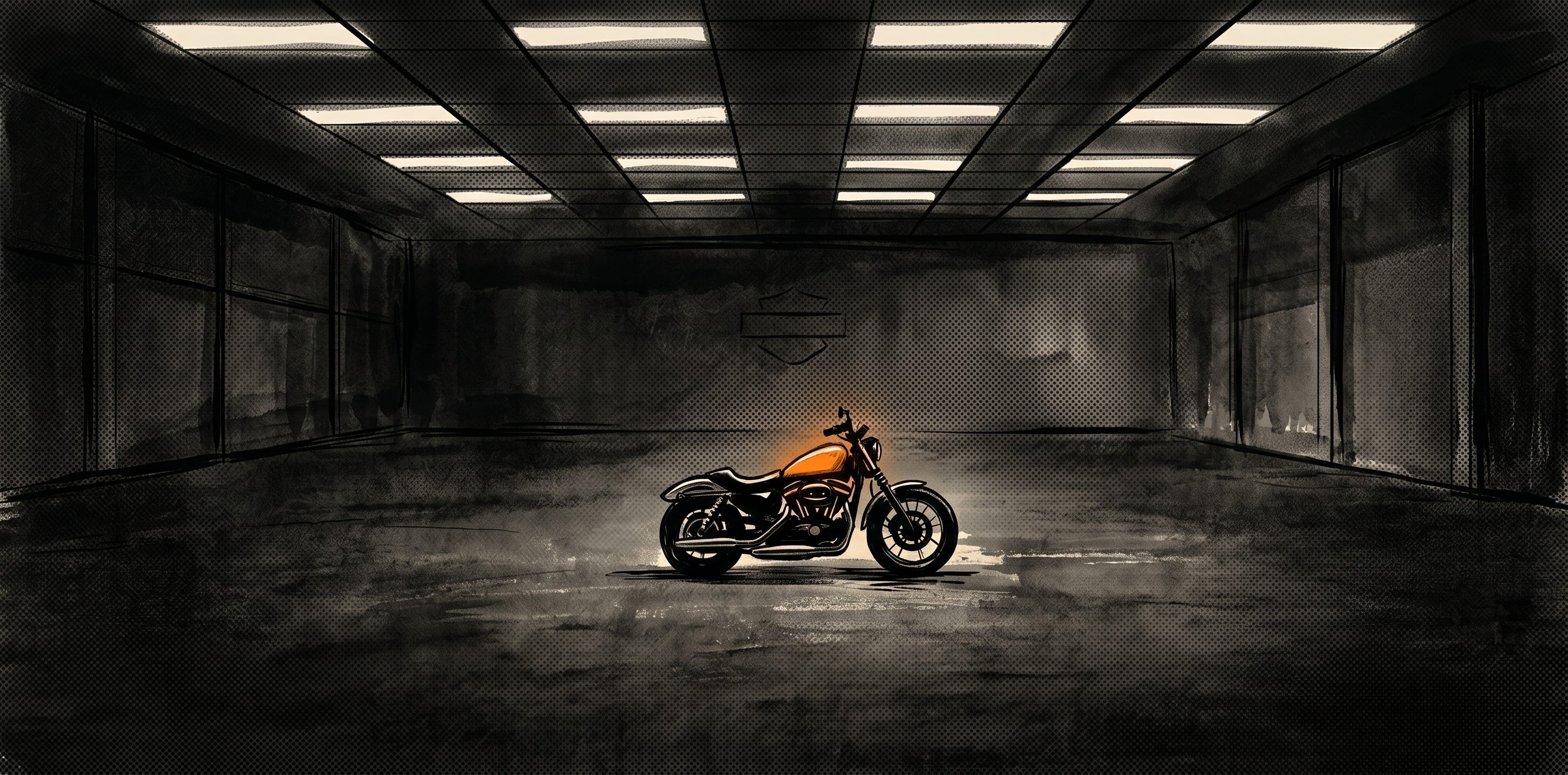
Last month I got a Harley.
A 2019 Sportster Iron 883, from a mechanic who rebuilt the transmission by hand. I put a two-into-one exhaust on it and flipped the mirrors to give it a low-key bobber look. It is the best thing I own.
It shakes. It’s loud. It smells like oil and gasoline and hot metal after an hour on the road. Nothing about it is optimized. Nothing about it is frictionless.
I ride to forget the past and the future.
I never got through Zen and the Art of Motorcycle Maintenance. Tried twice. Pirsig is reaching for something real but the book disappears into its own head and I need the opposite. I need the tool in my hand. I need the sound of the engine telling me if something’s wrong. The practice is the practice.
The thinking about the practice is a different thing.
The mechanical is becoming sacred because the digital ate everything else.
I wrote about this in January. The skills that built America skipped two generations. Grandfathers who could fix anything raised sons who hired someone, who raised sons who didn’t know what was broken.
Trade schools emptying out. Shop class disappearing. The hands going idle.
Now the hands are coming back. Trade school enrollment rising. YouTube channels with a million subscribers for engine rebuilds. Fathers in garages teaching themselves at thirty-five what they should have learned at twelve.
I’m one of them. The Iron 883 is not a nostalgia purchase. It’s a correction.
I’m a thirtysomething. Back in 1985 so was the average Harley buyer.
Today the average buyer is fifty-seven. By the time Harley turns 125 in 2028, it will be over sixty. 132,500 motorcycles sold last year. Down 12% from the year before. Down 32% from 2021. Stock hovering just above twenty dollars.
Harley is no longer the number one motorcycle brand in America. Not even number two. Through the first nine months of last year, Kawasaki passed Honda to take the top spot in US motorcycle sales. Harley ranks third.
Their current entry-level bike costs six months of rent for the young rider who wants in. The competition costs four.
Classic. Company gets great at one thing. Decides to become just okay at 12.
Porsche, 1992.
Too many models. Quality collapsed under complexity. Sales fell from 50,000 units to under 14,000. Wendelin Wiedeking took over. Cut the lineup to two models. Killed forty percent of parts. By 1997 Porsche was the most profitable automaker per unit on earth.
Apple, 1997.
Ninety days from bankruptcy. 350 products. Steve walked in and drew the grid that Joel Podolny would later build an entire university to protect. Four squares. Four products. Everything outside the grid dies. Twelve months later Apple was profitable.
Complexity is the tax success levies on brands that don’t know how to say no.
William Harley and Arthur Davidson built their first motorcycle in a 10x15 foot shed in Milwaukee in 1903. By 1909 they had the V-twin engine that would define the brand for the next century. Two cylinders at forty-five degrees, a shared crankpin, a firing sequence that alternates between 315 and 405 degrees of rotation. That asymmetry is the whole thing.
Potato-potato-potato at idle. That’s the sound.
They made bikes for two world wars. When the war ended, GIs bought surplus military bikes for cheap, stripped them down, chopped off everything unnecessary. That’s where the word chopper comes from. Harley didn’t design the outlaw image. The outlaw image found Harley in a surplus lot.
1953, Brando rides one in The Wild One.
1969, Peter Fonda rides one across America.
By the late sixties Harley owned the outlaw mythology of the American road, and Honda knew it. So Honda ran a campaign that said the exact opposite.
“You meet the nicest people on a Honda.”
It clarified something. Honda was transportation. Harley was identity.
Then AMF (the bowling equipment manufacturer) bought the company and nearly killed it. Mass-produced Harleys the way they mass-produced bowling pins. Fifty percent of motorcycles coming off the line had defective parts.
My uncle told me mechanics started calling them AMF: Ain’t My Fault.
In 1981, 13 employees bought the company back for $65 million.
They didn’t print a flag on a tank. They walked to Washington and asked Reagan to raise import tariffs on Japanese bikes from four percent to 49%.
They got the protection. Then they used it. Retooled the factory floor. Dropped the defect rate from fifty percent to under two. Released the Evolution motor (aka blockhead) in 1985. Launched the Harley Owners Group.
Community became the product, the marketing, and the moat, all at once.
By the mid-90s, Willie G. Davidson (founder’s grandson) designed the Fat Boy, which Arnold rode in Terminator 2, and Harley was the coolest thing in America. Engineering in service of myth.
Then they sold the logo.
Harley cologne. Harley restaurants. Harley birthday cakes at the dealership. The iconic orange bar and shield went on everything that would hold ink. Each license earned a royalty and each royalty buried the motorcycle a little deeper under all the merch.
2007 was peak. 350,000 units. Average buyer age 47. Boomers at peak earnings and peak nostalgia at the same time. The numbers were a countdown dressed as growth.
Then LiveWire. Harley’s electric play. $30K sticker price. $75 million lost on 653 bikes sold in all of 2025. $114,854 lost per unit. People who actually want to ride electric buy something else for half the price.
People who want a Harley want the sound.
Then a CEO from Puma tried to turn Harley into Ferrari. Jochen Zeitz. He ran the company from a ranch in Santa Fe and a wildlife conservancy in Kenya. Shuttered the Milwaukee headquarters. His Hardwire plan shed 20% of touring, cruiser, and trike shipments. Dozens of dealerships closed. Dealer sentiment hit a decade low. Harley’s largest investor called it cultural genocide and launched a proxy fight.
Zeitz collected over $40 million in total comp. Shareholders lost $1.8 billion.
When the EU slapped retaliatory tariffs on American motorcycles in 2018, Zeitz’s answer was to move EU-bound production to Thailand.
The 13 who bought the company back in 1981 walked to Washington for a tariff. Zeitz flew to Bangkok to avoid one.
The pattern isn’t unique to Milwaukee. It’s the condition of every American heritage brand that survived its founder and failed to codify what the founder actually knew.
Ralph Lauren signs off on the collection because his name is on the label. In-N-Out is still family-run four generations in and still refuses to franchise. Craftsman got sold off from Sears and the quality cratered.
Elon ships product across six companies because he doesn’t need the exit. The ones who can operate are the ones who don’t have to answer to anyone above them. Everyone else is a caretaker optimizing for the next earnings call.
The caretaker brand is always cash-rich and imagination-poor.
A heritage brand run by a caretaker is a brand on a ticking clock.
Harley’s new CEO came from Topgolf and Pizza Hut. His first move was an eagle graphic on three bikes and a press release calling it the Liberty Edition for America’s 250th birthday. Midnight Ember paint. Twenty-five hundred units capped globally. $4,000 dollars more than the bike it sits on.
31 motorcycles now on the showroom floor. Nobody under 40 in the building.
Patriotism is what you protect.
A country turning 250 is asking to be recognized for what it made. Harley read the same memo everyone read and chose the souvenir. Eagle graphic. Press release. A press kit with the words heritage and legacy and America scattered the way chain restaurants scatter flags on the Fourth of July.
America at 250 does not need a Liberty Edition. It needs a liberty. The first is a sticker. The second is a manufacturing decision. You can tell which one they are making by the fact that they moved production to Thailand.
The eagle on the tank is the confession. The bike underneath it is the crime.
The Trump administration’s trade policy cost Harley $67 million dollars in 2025. Headlines sounded fatal. Three of four manufacturing centers are already in the United States. 75% of component sourcing domestic. The bill comes from the 25% that isn’t.
And it gets a lot easier when you’re building four motorcycles instead of 31.
The Sportster was the entry point. Harley introduced it in 1957. It became the first Harley. The bike a guy my age bought in 1985 with money he didn’t have because the sound hit him somewhere his brain couldn’t compute. He learned on it. Dropped it. Fixed it in a garage with borrowed tools. Then he moved up. Fat Boy. Road King. Street Glide. He aged with the brand because the brand made room for every stage of his life.
They killed it.
The single greatest customer acquisition tool in the history of American manufacturing. Replaced with the Nightster. Costs more. Appeals to fewer people. Solves a problem nobody had.
Harley doesn’t make a bike for a rider my age. Not one of the 31 is the bike the guy in 1985 bought.
Honda Rebel. Royal Enfield. Triumph Bonneville. Royal Enfield’s exports surged 49% last year. Their bikes cost four to eight thousand dollars. They’re entering North America pointed directly at the segment Harley left empty.
The fix fits on a Steve Jobs-style napkin.
Sportster.
The gateway. Price it under $10K and eat the margin because this bike doesn’t make money. This bike makes lifelong Harley riders. Every young rider who doesn’t yet know they’re a rider. This is their bike. And today it doesn’t exist.
Pan America.
The adventure bike. Already exists, already good. Market it to women. Put it in REI, not just dealerships. A woman who wouldn’t walk into a Harley showroom will walk into an REI.
Softail.
The cruiser. Fat Boy, Heritage, Low Rider. The Harley people picture when they close their eyes. Consolidate six variants into one platform, three trims.
Road Glide.
The flagship. Cross-country. The bike the Sportster buyer graduates to in fifteen years. Two trims. That’s it.
Four motorcycles. Every other SKU, dead. CVO limited editions, trikes, the seventeen Touring variants, eagle graphics, cologne, birthday cakes. Gone. The clothing rack that greets you before the bikes do. Gone. The Liberty Edition, especially, gone. You don’t celebrate 250 years of American manufacturing by price gouging on a bike you tried to move overseas.
That’s the whole job. And it is the one job no exec at Harley wants to do, because 40% of the payroll depends on the products that aren’t the answer.
The sound is the moat.
In 1994 Harley tried to trademark it. Filed the case. Fought it for six years. Dropped it when the legal system couldn’t find a framework for protecting what everybody already knew.
No one can copy the sound without copying the architecture. And the architecture is Harley-Davidson. Every other competitive advantage can be reproduced. The styling. The heritage marketing. The flag on the tank. Indian already reproduces most of it and does it very well. But the firing order is physics. And physics is the moat.
Electric bikes will never make this sound. LiveWire fills in the company’s only moat with company money at a $115K per unit sold. Every manufacturer on earth is searching for a competitive advantage this durable. Harley has one.
They keep putting it in colognes and eagle graphics instead of motorcycles.
Protect the sound. Improve everything around it. Lighter, safer, cheaper, more reliable. The sound stays. The sound is the brand. The sound is what stops a guy my age in a parking lot and puts a primal drumbeat in his chest.
Harley is sitting on 120+ years of the realest thing American manufacturing ever produced. A machine that shakes. An engine you can hear from a few blocks away. An experience that cannot be generated, optimized, or faked. Buried under a million meaningless products.
The rider I’m describing is in parking lots across America. Fabrication shops. Welding class. Every trade school that started filling back up last year because the hands are coming back.
He’s on a Ninja, or a Rebel, or a beat-up dual-sport he bought off Marketplace.
He’s never heard a V-twin at idle from six feet away. He’s never had a bike make his ribs buzz instead of his ears ring. The dealership he passes has a price tag on the entry model that represents half a year of his take-home.
He doesn’t feel excluded. Excluded would mean they know him.
He just feels nothing.
A generation of riders who will age into customers of somebody else.
America turns 250. Harley turns 125 two years later. Apple just swapped the operator who inherited a founder’s map for whoever tries to run the company next. The country is watching every heritage brand it has left run the same test at the same time.
Who still knows what the founder knew? Who has antibodies? Who has anybody left in the building willing to draw the grid and kill everything else?
If the CEO from Topgolf draws four squares on a whiteboard and has the nerve to kill everything outside them, Harley lives. The sound does the rest.
But if he just launches more eagle graphics and calls it heritage, the kids keep riding west.
Four bikes. One sound. That’s the memo.
<3EKO
One more thing.
The piece you just read is about what happens when the map runs out and the operators forget what the founders knew.
Later this week I drop a new book about the first man who was handed a map nobody else could read.
MOSES: SINAI REACTION. Book 13 of the Unsealed Archives.
Every version I know treats Moses as a prophet. This one treats him as an engineer. Pharaoh’s adopted grandson. The best structural mind in Egypt. Killed his first man at Pithom. Spent the next forty years doing the math.
Thanks for reading.
I love you.


"Then AMF (the bowling equipment manufacturer) bought the company and nearly killed it."
(They also owned the Electrolux vacuum cleaner company then, too.)
I remember one story from this period. New Harleys on the showroom floor and there being a piece of cardboard placed under it to catch the oil drips from the engine. From a new machine.
.
Wow. What an awesome post. As a 70 year old boomer who is about to drop a new engine in my sweet little manual transmission 2004 Scion xB, I salute every sentence!