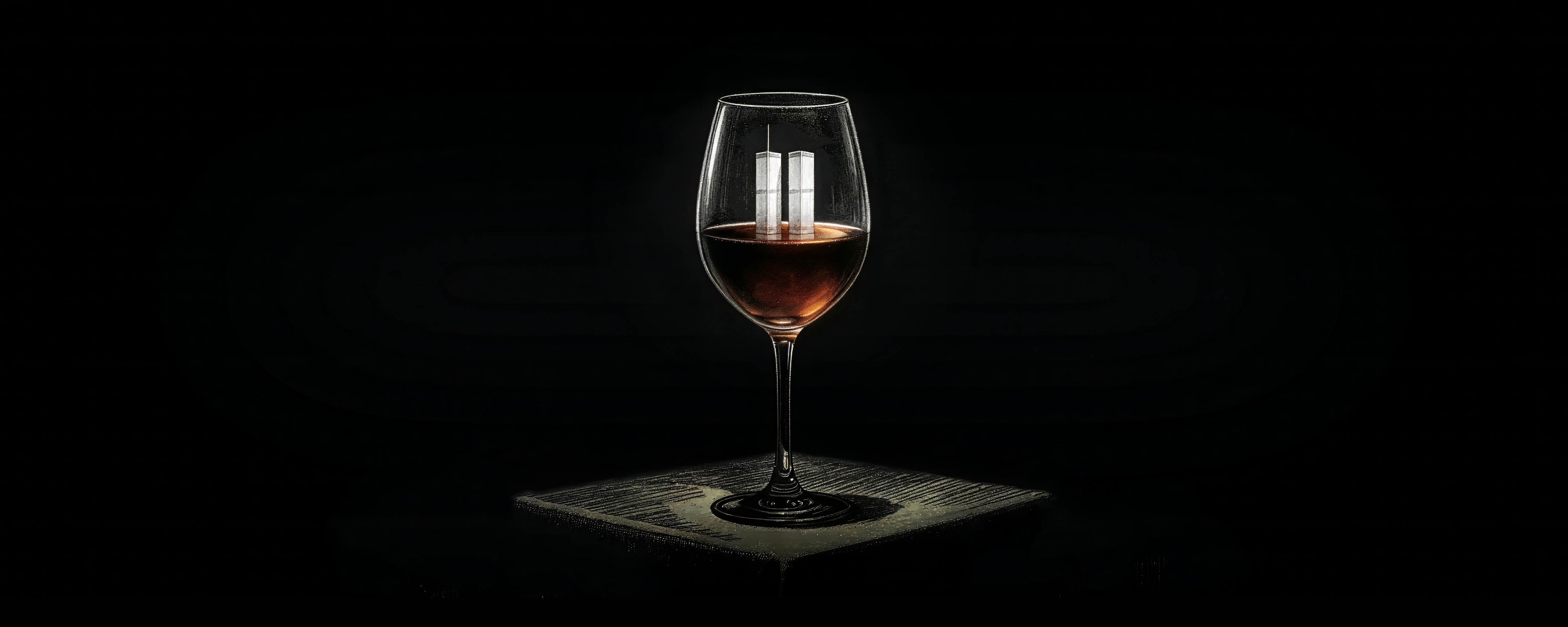
If you bring forth what is within you, what you bring forth will save you. If you do not bring forth what is within you, what you do not bring forth will destroy you.
The Arrival
He locked the bike to a parking meter on Fifty-Fourth Street and stood there with his hand on the seat, the leather hot from July. A woman passing on the sidewalk glanced at him, then looked again. The jaw.
No sign on the building. No awning. A brass number above a door that could have belonged to a dentist’s office or a private bank or nothing at all.
The door opened before he touched it.
A man in a dark jacket led him down a hallway lit by fixtures that predated electricity. Gas lamps converted to bulbs. The brass was original, green at the seams. Whoever renovated this building had run the new lines without touching the brass.
He noted the exits. One behind him, one ahead.
The dining room was small. Dark wood paneling. Silver that caught the light from candles. A tablecloth so white it looked surgical. One place setting. His.
The man at the table stayed seated. Hands on the cloth, fingers open, palms down. Bare wrists. Bare hands. Dark suit cut for his body alone. Early fifties. Lines around the eyes. Nothing else.
“You biked.”
“I bike everywhere.”
“In that suit.”
“Brooks Brothers survives a lot.”
The man’s mouth moved. What was left of a smile after the rest of the face had finished with it.
John sat. Placed his napkin. One wine glass, already poured. No plate across from him.
“Most people who want to tell me about my father just send a letter.”
“I don’t write letters.”
“No. I imagine you don’t.”
John looked at the table. His place setting. The empty space across from it. “You’re not eating.”
“No.”
“Should I be concerned that I’m the only one with a plate?”
“If I wanted you dead, Mr. Kennedy, you would not have made it to the table.”
John picked up his fork. Cut a piece of bread. Chewed it.
The man let the silence hold. Then ended it.
“You’re running something in September.”
“I’m always running something.”
“The cover.”
“We’re not announcing the September cover yet.”
“No.” The man’s fingers moved for the first time. A quarter-inch adjustment on the cloth. “You wouldn’t be.”
“How do you know about the September cover?”
“I’ve known about your magazine since before you did, Mr. Kennedy.”
“That’s interesting, because I founded it.”
“You published it. The questions are older than your printing press.”
John drank. The wine was French and better than anything he’d ordered in a year.
“I biked here from Tribeca in July heat because your letter was the most interesting thing I’ve read since the last time someone tried to explain my own family to me.” He leaned back. “What are we doing here?”
“You’re quite practiced at this.”
“At what?”
“Reading rooms. Testing the walls. You do it the way your mother taught you. Charming and precise, always with one hand on the exit.”
John stopped chewing.
“You knew my mother.”
“I know what your mother built. A son who can sit in this room and not be impressed by it.”
“She’d agree with you.”
“You are not here because of your magazine.”
“No?”
“You are here because of your father.”
“My father’s been dead for thirty-six years.”
“And you’ve been asking his questions for four.”
“My father asked questions and someone shot him in the head,” John said. “In front of my mother. While she was wearing a pink suit she never took off. Not for the flight home. Not for the swearing in. Not until someone told her she was covered in his blood and she said she knew. She said she wanted them to see what they’d done.”
“Every room I’ve walked into for thirty-six years has been shaped by what happened in Dallas and nobody in any of those rooms has ever told me the truth about why.”
He put his glass down.
“So. Tell me the truth. Or tell me why you can’t. But don’t sit there with your hands on a tablecloth that costs more than my rent and evaluate me like a specimen. I am the son of the man you killed. And I biked here in July because there is a hole in the middle of my life that is shaped like an answer. I intend to fill it.”
The man’s fingers moved on the cloth.
“Yes,” he said. “You are.”
He reached across and poured John’s glass without being asked.
The Beautiful Lie
“Who runs the world?”
“I’m serious. Who runs the world, Mr. Kennedy?”
“Politicians. Banks. Military.”
“Those are the people who manage it. The ones who run it don’t have titles. You know this. Your magazine is the wrong question. You keep expecting a man.”
“What’s behind the curtain?”
“An arrangement. Self-sustaining. The world is run by whoever the world believes is running the world. You don’t need guns. You need consensus on the story.”
“The story.”
“The beautiful lie. Your choices matter. Money buys freedom. The man in the office was elected.” His eyes were bright. “You still think the door unlocks from the inside.”
“Then why am I sitting here listening to you explain it. If the consensus is the cage, telling me makes me harder to keep in it.”
The Gate Keeper studied him.
“That’s a question you’ll have to ask yourself when you leave.”
“I grew up inside this,” John said. “Don’t lecture me on what money is. My family moved it before yours printed it.”
The man’s hands paused on the cloth. A fraction of a second. Then resumed.
“I’d start a foundation,” John said. “My mother’s name. Fund the things she cared about.”
“She would have liked that.”
“Yes.”
“And where does the endowment sit. A bank.” He let the word sit. “The bank lends against it. The interest goes to the men who printed the currency. Your mother’s name. Their floor.” He leaned back. “You’d have built a monument to her on a floor they own.”
John said nothing. He looked at the tablecloth. The silver. The bread he had broken without thinking about where the grain was grown or who harvested it.
“Knowing changes nothing.” A smile. “Most men turn the revelation into a self-pity party. Your breeding demands it.”
“It’s a remarkable thing to say to the son of a president.”
“It is a remarkable thing to say to anyone.”
Bloodline
“Your mother was not selected. That was the strategic error. They selected your father. Magnificent platform. Everything a front-facing asset should be. Then they married him to her, and the code they produced was unstable.”
“What code.”
“Genetic. Consciousness. The architecture requires predictability. Your father was bred for a ceiling. Your mother had no ceiling. She wasn’t one of ours. The code she passed to you was outside the taxonomy.”
He leaned forward.
“I haven’t eaten since 1959.”
“There is really only one bloodline, and then the rest is other. Your mother was other. The genetic architecture of her conception was compromised. But the compromise produced something we did not anticipate. A son who carries both frequencies. Ours and theirs. The hawk and the sparrow in one body.”
“The Rh factor,” John said.
“You know about this.”
“My mother told me. She lost a pregnancy before me. The doctors said her body was attacking the child.”
“The mother’s immune system that attacks its own young. Why would nature build a system that kills its own children? Nature didn’t. The system was engineered. The seam where two incompatible architectures were stitched together.” His fingers stopped moving. “I have been afraid of that mark for forty years. The men I serve called it failure. They did not understand what produced it.”
He watched John’s glass in the candlelight.
“That interests me more than anything your father ever did in office.”
“My three-year-old self was holding a flag at a funeral,” John said. “I don’t remember the day. I remember the photograph. A small boy saluting a box. Every year on the anniversary they replay the footage and someone calls it brave. It wasn’t brave. I was three. I did what my mother told me.”
“I am going to tell you why I wanted you to sit at this table.”
He did not continue. John looked at his own hands. His father’s hands. And below them, his mother’s blood.
Dallas
“Your father believed he could change it from inside. Reshape the order through proximity to power.”
“He couldn’t.”
“No.”
“Your father gave a speech. American University. June ‘63. Coexistence. Nuclear restraint. Then he started moving people. Slowly. But visibly enough.”
“So Dallas was a response.”
“Dallas was maintenance.”
He watched John chew.
“My father had a name for men like you,” John said. “The careful ones. The ones who knew exactly when to stop a sentence. He said you could always tell who served the apparatus by what they refused to say out loud.”
The Gate Keeper’s hand stilled on the cloth.
“He was right.”
John’s glass was in his hand. He didn’t remember picking it up. He set it down and the base hit the table harder than he intended.
“Who authorized it.”
“That question is above my authorization. I stand on a very high rung, John. But I can see rungs above me. I cannot see who stands on them. There was no phone call. A consensus formed the way weather forms. No one person decided. The conditions were sufficient. The maintenance occurred.”
“My uncle. Five years after Dallas. A hotel kitchen in Los Angeles.”
“Your uncle understood it better than your father did. Your father believed he could redirect the current. Your uncle believed he could survive long enough to expose it. He was wrong differently.”
“First time is miscalculation. Second time is failure. Failures get corrected. Your father thought proximity to power was a tool. Your uncle thought proximity to truth was a weapon. Both were right. The arrangement doesn’t fight on those terms. It removes the combatant. Replaces the narrative.”
“My father in a motorcade. My uncle in a kitchen. Both public. Both in front of witnesses who would spend the rest of their lives being told they saw other than what they saw.”
“The witnesses are part of the message. We can kill a president and your eyes won’t be enough. We can override what you saw with what you’re told.”
“My father asked questions and someone shot him in the head,” John said. “And I’ve been asking his questions for four years.”
“Faster than he was.” His eyes moved to John’s glass. Then back.
The Harvest
“You asked a question last March. In an issue that never reached print. About certain government basements in the 1950s. You titled the piece and killed it.”
“How did you know that.”
“Because I read your magazine. All of it. The pieces that publish and the pieces that don’t. The first tells me what you believe is safe. The second tells me what you believe is true.”
“I read the files. The ones that weren’t supposed to exist. The doctors who signed NDAs and then signed death certificates.”
He went still. He studied John with new attention.
“Yes. You have been reading.”
“I’ve been reading for four years. Mostly in bed. Carolyn thinks I’m developing a fetish for government letterhead.” He paused. “Tell me what the files don’t say.”
His hands settled flat on the cloth.
“Dallas was a good year.”
“Energy harvesting,” John said.
“The arrangement doesn’t create events. It creates the conditions for events to emerge. Then it harvests what comes off them. Fear produces demand for security. Security requires money. Money flows upward. But the cycle itself is the point. You’re not running it. It’s running you.”
“It’s running all of us.”
“Why do you do what you do? You create your own reality, but you are highly suggestible. Highly. Even after I lay this out clearly, the architecture, the mechanism, even after I describe it with precision, not one in a hundred thousand will undertake the changes necessary to exempt themselves from it.”
“Because they’re afraid,” John said.
“They’re terrified. Fear is fuel. The machinery was built to burn it. So the machinery manufactures conditions to ensure you remain afraid. War. Economic collapse. Epidemic. Each event is manufactured not because the machinery gains from the specific outcome but because the fear itself is the resource.”
He leaned back.
“Most men stop at the knowledge. They use it to explain their powerlessness. You’re reading for a gap. I’m interested in whether you find it.”
“Why tell me at all.”
“Because a harvested man is a spent resource. A recruited man is a renewable one.”
He reached for his cufflink. The candlelight caught the metal.
“The first one was 1959. Told my wife I’d stop. ‘71. Told my mother. ‘76. They believed me both times. By the time you notice it you can’t remember the alternative.”
“How do you live. Knowing this.”
“The same way a man lives on a farm. You don’t think about the destination of the animals. If you did, you would find a knife or a rope.”
The Sorting
“You still haven’t answered my question.”
“Which question.”
“Whether you are your father’s son or your mother’s.”
“It’s a frame,” John said. “My father challenged what you serve. It killed him. My mother survived by choosing silence. She became the artifact. Everything my father tried to dismantle was rebuilt around her.”
“Yes.”
“Forget father or mother. The question is whether I can be both. Whether I can move toward the order with his clarity and within it with her realism.”
He leaned back and studied John.
“You are more interesting than I expected. That makes this harder.”
“Why.”
“Because predictability is leverage. Your father was brilliant. Brilliant is predictable. It climbs. Your uncle was righteous. Righteous is predictable. It speaks. But you. You might do something the taxonomy wasn’t built to process.”
“Name the taxonomy.”
“The ambitious man asks how to climb. The frightened man asks how to hide. The righteous man asks how to fight. In forty years no one has asked a fourth question.”
“Three options. Climb and become me. Stay outside and go silent. Or stay outside and speak.”
“Those are three,” John said.
“Those are all there are.”
John said nothing.
“The alternative,” the Gate Keeper said at last, “is the machinery without the knowledge. And because there is a possibility. Thin. That a man who understands the choreography can alter its rhythm. Introduce a note that was not in the composition. Whether that note will be preserved or edited out is not his decision. But the note will exist. It will have been played.”
John adjusted his napkin on his lap. The same gesture. The same fold. Mirrored from the table across from him.
The Counter-Frequency
“You understand the fundamental law. Hierarchy. Everything climbs. Power. The signal. All of it. That is the architecture. That is the law.”
“That is the case,” John said. “Isn’t it.”
“Yes. The entire case.”
“Nineteen sixty-two,” John said. “The crisis. October. The most powerful men in the American military pressing the President to make the decision. The one that would have ended everything.”
“My father left the room. Thirteen men staring at the door.”
“My mother found him on the kitchen floor with a woman from the cleaning staff. She was afraid. He was just there.”
“Sitting on a linoleum floor with a woman who cleaned offices for a living, because she was afraid and he was the President and the door was open.”
“My mother told me: that is who your father was. The man on the floor with the cleaning woman. Not the room with the generals. The floor.”
The Gate Keeper was still. His fingers stopped their quarter-inch calibrations.
“That is not how power works.”
“I know.”
“The whole framework climbs. But your father did not climb. He went down. Toward the scared thing. No strategic value. No frequency. No yield. No intelligence product. A cleaning woman crying on a floor.”
“And I have no category for that. Forty years inside the arrangement and I have no category for a man who goes down voluntarily. Toward the small thing. The frightened thing. The thing the system would not bend to collect.”
John picked up his glass. He reached across the table. He set it in front of the Gate Keeper.
The Gate Keeper did not touch it.
“That’s why he’s still here,” John said, “and your name is still a question.”
The Gate Keeper looked at the glass.
The Offer
“Your magazine is beginning to point in directions that will be noticed.”
“You said that already.”
“In a different room.”
“Is this a threat.”
“The magazine is a decoy. What you’re planning after the magazine is what they’re afraid of.”
John was still. He had told one person about that. One. Over drinks at a golf club in Florida, three weeks ago. Nobody else.
“It is a courtesy. I am telling you where the machinery operates. What comes next is not my decision.”
His hands resumed their adjustments on the cloth.
“Stop, John. Just stop.”
A beat.
“Marry her. Have a kid. Two. Buy a house on the water. Fall asleep on the couch during a movie your daughter picked.” He smiled at the candle. “The questions stop asking you.”
A pause.
“It’s a real life. I’m offering you one.”
“You took that deal.”
“I took acceptance in exchange for stability. I positioned my family within the order so they would be valuable to it and therefore protected by it. And I lived.”
“What price.”
“My children were raised by the institution, not by me. They are assets. Well-maintained. Productive. I am proud of them the way a man is proud of a building he designed that someone else lives in.”
He adjusted his cufflink. The candlelight caught the metal.
“There is something you need to hear. The order kills teachers. Your father was a teacher. He was teaching you from before you could understand language. Every conversation. Every gesture. Every night on your bed. It recognized the teaching and removed him. Because enemies can be contained. Teachers replicate. A contained man takes his opposition to the grave. A teacher deposits it in his students and the students carry it forward. That is what the arrangement cannot tolerate.”
“You received the teaching. You are carrying it forward in print, under your own name, with your father’s face. It will move to evacuate you.”
“I cannot protect you.”
“Then I’ll have to do what my father did,” John said. “And go ahead anyway.”
The Exit
John stood.
He took his napkin from his lap. Folded it once. Then again. Set it beside the plate. The fold was precise. The crease ran parallel to the edge of the silver.
The Gate Keeper watched. The napkin. The fold. The placement.
“You’re leaving.”
“Yes.”
“You haven’t answered.”
“I’m going to keep asking,” John said. “But not what you told me tonight.”
His hands went flat on the cloth. Both of them.
“Then you understand what happens.”
“Yes.”
“And you are choosing it.”
“I’m choosing to go home.”
He pushed his chair back. The legs scraped the floor. The sound was too loud for the room. The Gate Keeper’s jaw moved.
John walked toward the door. He stopped. Turned.
The Gate Keeper met his eyes. Three seconds. Neither moved.
The glass John had set in front of him was still untouched.
John walked through the door.
The Night
The door closed behind him without sound.
He stood on the street in the warm dark. The brass number above the entrance caught the light from the corner lamp and held it. Fifty-Fourth Street. The same block where he’d locked his bike three hours ago. The city had not changed.
He walked south.
The pavement was still warm from the day. He could feel it through his shoes. A woman was closing a flower shop across the street, carrying the last bucket inside, water sloshing onto the sidewalk. The flowers were wilting in the heat. She carried them.
A man in a suit came out of a building across the street carrying a briefcase and a paper bag. He walked north. Nobody watched him go.
He unlocked the bike. The seat was cooler now. He stood with his hand on it the way he’d stood when he arrived. The hand had the same bones.
He took out the Nokia. His hand was steady.
“Hey.”
“Hey.” Her voice was warm. Tired. “How was dinner?”
“Long.”
“You okay?”
He looked at the city. The lights. The summer.
“Yeah,” he said. “I’m coming home.”
“Good. I made the bed.”
He almost laughed.
“On my way.”
He put the phone in his pocket and rode south.
He looked back once. The brass number above the door was dark. The river smelled of summer.
July 16, 1999.
<3EKO
A preliminary draft of this story was first published a month ago.
This is the revised version, free for all. Sharing encouraged.
If you want the paperback, head to Amazon.
I love you.


EKO, after the last couple of months reading every essay, it seems that you have a gift for genuinely inhabiting the persona of the individual you are writing about. Uncanny, how you make it feel so real for the reader. We experience an intimate feeling of actually being there in time and place. You've taken your readers on a ride covering multiple centuries with the ease of one who has seemingly been on site, exactly when each story started. You've provided quite an adventure in time travel. Thank you for a great ride. Today's story on John really pulled at the heartstrings of what might have been possible.
I would like to think he survived.