He was trained by the civilization that enslaved his people
He came back 40 years later with a cedar rod
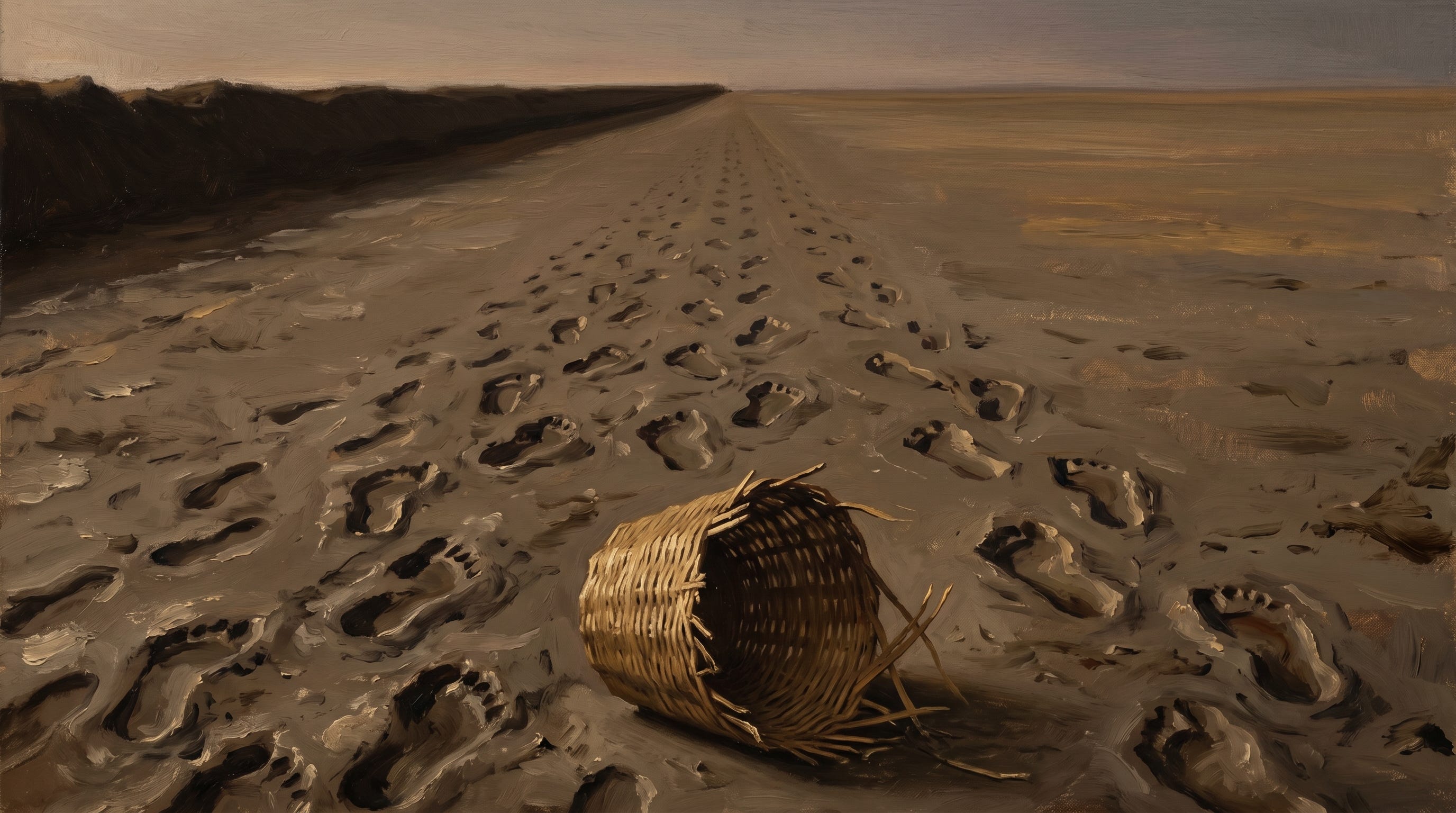
The boy in the basket grew up to administer it.
He was the adopted grandson of Pharaoh. Trained at the temple school of Heliopolis for 15 years. He learned the management of grain stores and the logistics of quarry operations and the 42 declarations of innocence before the assessors of the dead.
I have not murdered.
I have not committed theft.
I have not spoken falsehood.
He memorized them as a child.
40 years later he would walk past their priests with boils on their faces.
By 40 he was the senior logistics officer, adjutant to the chief architect of the Nineteenth Dynasty’s building program. He wore the pleated white linen of the inner court. Cedar oil in his hair. The gold cartouche of his office at his throat. His mind operated in three dimensions simultaneously: material, manpower, and time.
His Hebrew birth was a line in a file. His loyalty was to the system. The system held because every piece of it held.
The empire had trained him. The empire had been pleased with the work.
The break came at Pithom.
An overseer was beating a Hebrew laborer who had gone down in the mud. The overseer was bored. The rod came down with no anger in it. Just a man doing his work.
Moses watched this from the berm.
He had watched it a hundred times before.
He came down off the berm. He did not plan it. His mind, trained by 15 years of engineering school and twenty years of administrative work, calculated the angle of approach, the distance, the force required. One strike. Efficient. Final.
He stood over the body. He looked at his hands.
He buried the overseer in the soft mud at the base of the berm. He went back to his records. He ate his evening meal. He slept.
The next day a Hebrew said to him: Who made you a prince and a judge over us? Do you intend to kill me as you killed the Egyptian?
The killing was known.
He walked east into the Sinai with the clothes he stood in and shed them as he went. The gold cartouche first. Then the linen. Then the court sandals, traded at a desert outpost for rough cloth worth a tenth as much. The Prince of Egypt died at the border. The man who crossed was nobody.
He disappeared for 40 years.
He came back with a cedar rod.
He knew that river.
He had measured its flow in cubic cubits per hour. He had calculated the silt load for the spring planting. He had walked the irrigation channels at every stage of the flood. He had calibrated the sluice gates at Pithom to the millimeter because the difference between a good harvest and a famine was the depth of the water in the basins.
For 20 years he kept the hydraulic engine of Egypt running.
When he struck the water with the rod, he was auditing a machine he had spent his life maintaining.
The frogs were an ecological indicator. Moses had tracked the frog populations of the Delta his entire working life. They tracked the health of the irrigation system. When they left the water in waves that covered the ground from the river’s edge to the walls of the palace, they were doing what a population does when its environment has become uninhabitable. They were telling him the system had failed at a level below the water.
The livestock death. The hail. The locusts in a cloud so thick it blocked the sun. Each one another entry in the ledger. The agricultural system collapsing in the sequence an agricultural engineer would recognize as terminal.
The boils were on the priests of Heliopolis. The men who had taught him the 42 declarations as a child. They stood in their robes with their skin in ruins and could not bring themselves before Pharaoh because the pain made standing intolerable.
He had been their student.
He was the instrument of their destruction.
Then the darkness.
A withdrawal of the world itself. A substance in the air. Men could hold their hands before their faces and see nothing. The lamps burned without giving light. The Egyptian children woke screaming into a void their mothers could not reach.
The system had stopped. Every calibration, every sluice gate, every dike and canal Moses had ever touched with his hands, stopped.
The final plague was the closing entry. A senior administrator running an audit reaches the end of the audit. The books close. The firstborn die.
Moses did not perform the plagues.
He administered them.
He spent the wilderness years doing the math for a people who were never going to thank him for it.
He led 600,000 of them across a seabed he had calculated would hold under foot and would close under wheel. He stood on a summit for 40 days while the cloud built around him and came down with a stone the warmth of which was not his. He buried his sister in a dry wadi with nothing to wash her body. At Meribah he raised the rod against a rock for water and spoke one pronoun he was not supposed to speak, and in the speaking lost the land he had walked toward for 40 years.
He died on a summit he was not permitted to descend.
He had built a container for the thing in the bush. The best container a man of his formation could build. He did not think he had finished understanding what the bush had been. He thought he would not have time to finish.
The linen veil lay on the rocks of the Pisgah summit.
The wind moved it against the stone.
In an hour or a day it would be gone.
MOSES: SINAI REACTION is live. PDF on my site. Paperback on Amazon.
I love you.


