His Son Carried the Stone for a Week
Cain had taught the boy by living. He was about to find out whether the boy had been watching.
His son was twelve. The boy had Cain’s hands.
Cain had spent his whole life learning to keep his own from reaching.
He sat on the chair the council had built for him on the granary terrace. His back had stopped letting him kneel in the southern flat two seasons earlier. The chair was set against the wall where he could see the boy walk the perimeter without the boy seeing him watch.
Enoch had Cain’s gravity. His mother’s precision. His grandfather’s ease. Three bloodlines in one twelve-year-old body. He walked the grain bins running a finger along the stores the way Cain’s stepfather had read mortar half a century earlier. He was checking what held.
The boy reached the western bin. He stopped. He pulled a stone from his pocket.
River-rock. Palm-sized. The same weight Cain’s hand had known at twelve, at fourteen, at twenty, at every crossing on the road east when his hand had still been the hand that reached automatically.
Enoch held it the same way.
Then he did not throw it.
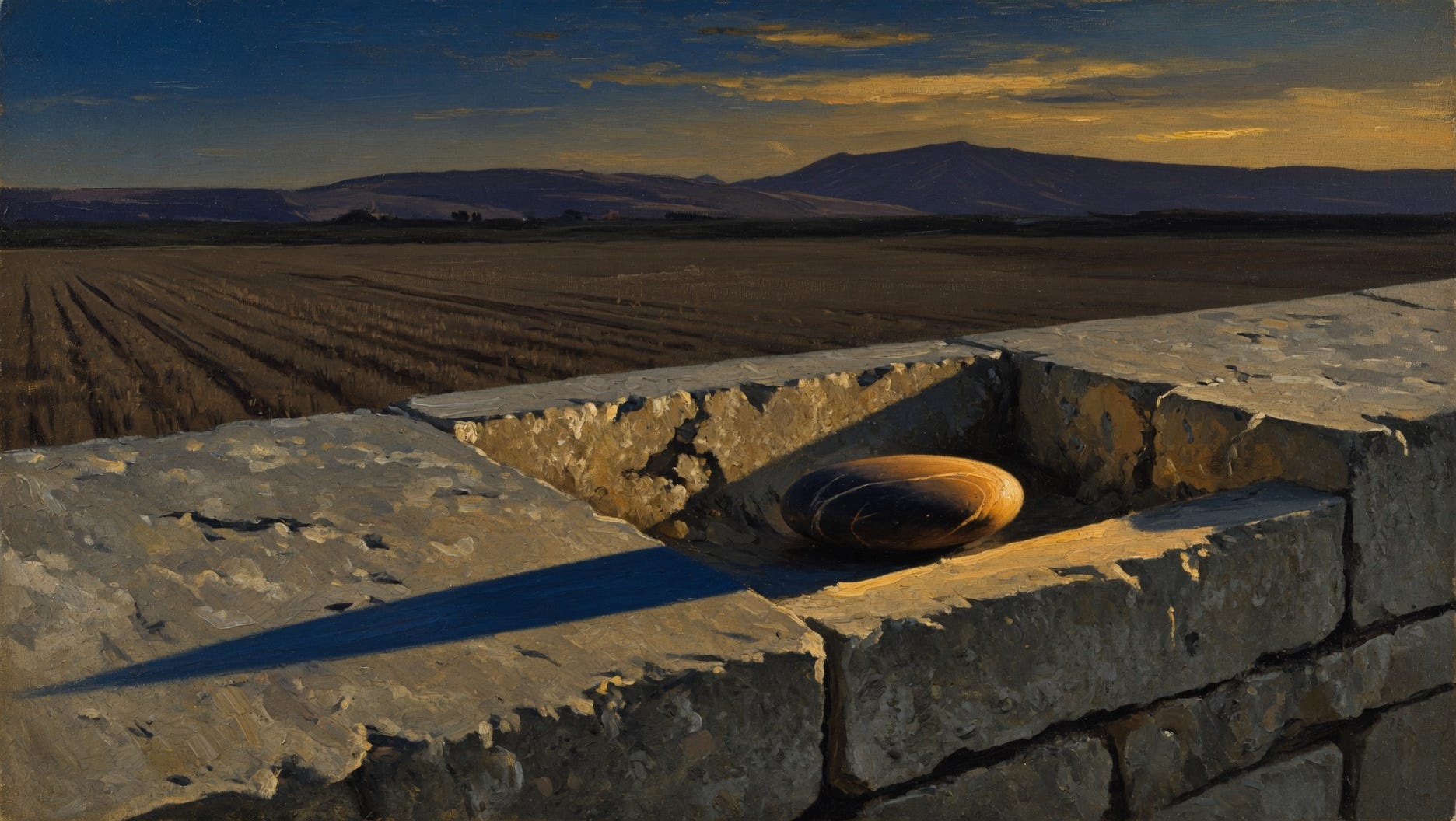
He set it on top of the bin. Looked at it. Walked on.
Cain did not speak. He did not stand. The stone stayed on the bin for three days. Enoch walked past it every morning and did not pick it up. Cain walked past it and did not move it.
On the fourth morning the stone was gone.
Not in the boy’s pocket. Not on the bin. Cain looked everywhere on the terrace and could not find it.
A week later, walking the eastern wall at dusk, he saw it.
The stone was placed on the parapet, in the alcove where the watchmen rested. Set down where the wind could not move it. Where no hand would lift it.
Cain stood at the parapet for a long time.
He had taught the boy by living. He had walked east without explaining east. He had cleared a field without describing one. He had eaten last at the council table for sixty-three years and never said why. He had not been sure any of it had landed.
The reaching had passed to the son.
The throwing had not.
CAIN: EAST OF THE WALL. Concluding the Edenic Trilogy.
The inherited story turned a man who chose into a man who suffered.
This book is the man who chose.
I love you.


