I Listen to the One Who Wrote It
A twelve-year-old boy walked into the Temple and sat down. The scholars of Israel couldn’t answer his questions. Nobody moved.
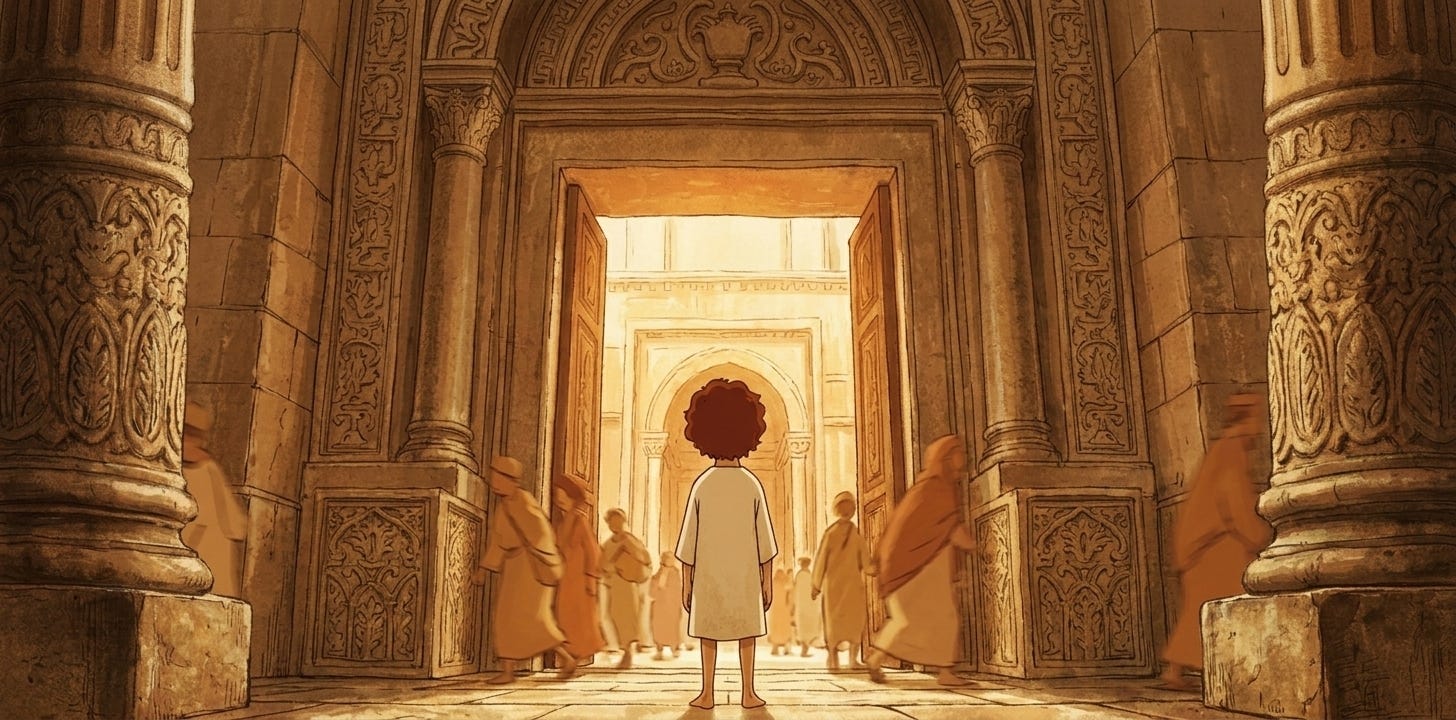
The Temple smelled of blood.
Not incense. Not stone. The Passover slaughter had been running since dawn, the channels carved in the limestone doing their work, and when the wind shifted it crossed the outer court like weather.
Yeshua stood at the edge of the Court of the Gentiles and breathed it in.
Twelve years old. First time. He had seen the gleam of it from the ridge above Nazareth on clear days, that distant shimmer of white and gold. Had heard Joseph describe it. Had listened to every traveler who stopped at the workshop with stories. Had held the image in his mind for years, turning it over.
The walls climbed higher than he had imagined. The morning sun broke on the stone and gold until you had to look away. The sound of hundreds of thousands of pilgrims pressed into one hillside city arrived not as noise but as pressure.
He knew this place.
The way you know somewhere you’ve left.
He made a fist against his ribs and stood at the gate and breathed the blood-smell of his Father’s house.
The caravan from Nazareth had arrived three days before the feast.
Over a hundred pilgrims from Galilee, traveling together for safety. They had gone east to avoid Samaria, followed the Jordan valley south, then climbed through Jericho in the pale morning while the road filled with people from every direction.
Joseph moved through the preparations with quiet efficiency. He had been here before, knew which gates to enter and which officials to trust. By the afternoon of their second day he had secured the paschal lamb, arranged accommodations inside the city walls, and untangled a registration problem at the outer gate that had stopped three other pilgrims cold.
Mary watched him work. Her hand found the edge of her headscarf and didn’t let go.
She’d been back in the grip of it since they crossed the Jericho road. The old vigilance. Too many faces. Too many strangers pressing close. She’d spent nine years learning how to stop scanning crowds this way, and here she was, her eyes moving over every face like she was looking for something she hoped not to find.
The law required this. At twelve a Jewish boy became a son of the commandment, required to observe the feast, to stand in the Temple, to be counted among the men of Israel. She had no right to her fear here.
So she watched him from behind as they entered the outer courts.
He walked slowly. He turned his head at angles adults didn’t bother with anymore. He stopped to study things other pilgrims walked past: the carved inscriptions above the gates, the patterns in the paving stones, a group of Levites arranging lamps in the colonnade.
His lips moved once. She thought he was praying.
He wasn’t praying. He was measuring.
The Passover services ran for four days and Yeshua attended every one he was permitted to attend.
He stood through all of it without moving, without the restlessness other boys his age couldn’t contain. He followed the ritual the way you follow a piece of music you’ve heard before but never played.
He watched the priests. Skilled, precise, efficient. They had done this ten thousand times and it showed in their hands. The movements were exact. The words were exact. The meaning had gone.
He watched the money-changers in the outer courts, converting foreign coin at rates he calculated before the pilgrims could argue. Forty percent above the honest exchange. He watched the animal merchants charging triple for sacrificial birds. A widow from Nazareth he recognized from the lane near their house counted her last coins for a dove that should have cost her less than a day’s bread.
The Temple magnificent. The Temple corrupt. He held both.
On the second morning, Mary took him to the edge of the Court of Women.
Beyond the carved screens at the eastern gate, she could not go.
He looked at the screens. Then at her.
“Why?”
“Because I’m a woman. Men go further.”
“But why?”
Her face did the thing it always did when his questions ran out ahead of what she had to give him. A brief tightening, a look past him.
“It’s the law.”
“But why is it the law?”
She had nothing. It had always been the law. That was all she had.
He looked at the screen. The cedar lattice-work was beautiful. Expensive. Financed by Temple levies that women paid same as men. And here were the women: same faith, same journey, same weeks of road, separated from the holy of holies by eighty feet and a carved wall that nobody had questioned in a hundred years.
He filed it.
On the third morning, Joseph took him to the consecration of the firstborn sons.
A row of boys, their fathers beside them, the priests moving down the line with brisk efficiency. Prayers said, blessings given.
When Yeshua stepped forward the priest gave him one quick glance, a professional assessment, then the prescribed words beginning.
He spoke the required responses. The ancient language. The prescribed channels.
His mother was behind the screen in the women’s court. She had carried him out of Egypt. Had sat up through the sicknesses. Had argued with Joseph for weeks to stay in Alexandria and come back anyway because the angel’s words required it, because the mission required it, because he required it. She had done more than anyone in this courtyard to bring him to this moment.
She watched through carved cedar while strangers blessed her son.
The priest finished the formula. Moved to the next boy.
Yeshua walked back to Joseph. Said nothing. But the question wouldn’t leave: if the God these priests served loved all his children equally, the screens had been someone’s idea.
And not his Father’s.
That afternoon, he slipped away.
The crowds were thick, Joseph absorbed with relatives from Capernaum, Mary at the women’s gate. One moment no one was watching him.
He followed the pull. Directional, specific, the way a sound you can’t quite hear still moves you toward its source. He walked through the Court of the Gentiles, past the animal pens and the money tables, through the Beautiful Gate into the Court of Israel. The sounds changed as he went deeper. Fewer vendors. More chanting. He kept walking.
A columned portico along the south wall, its shadow cool against the afternoon heat. Scholars on stone benches. Teachers who had spent lifetimes on a single body of text. Students arranged around them, some with tablets.
He sat at the edge. The only child. No one looked at him.
He listened.
The discussion was the Messiah.
Would he come as a political deliverer, a king of David’s line who would drive Rome from the land and restore Israel’s sovereignty? Or as something interior, a spiritual redemption that worked through transformed hearts?
The debate had been running for centuries. The scholars quoted prophecies. Built arguments and dismantled arguments. The older teacher leading the discussion had heard every position and counterposition and was no longer really listening to any of them. He was managing the conversation, keeping it productive, which was different from keeping it alive.
Yeshua listened until late afternoon. Heard every argument. Saw where each one failed. When there was a pause, he spoke.
“May I ask something?”
The scholars turned. Several frowned. A boy with dusty sandals and no credentials had interrupted a serious discussion in the Temple courts.
The old teacher, white-bearded, nodded once. “Ask.”
“Is the expected Messiah meant to be a temporal prince on David’s throne? Or the light of life, establishing a spiritual kingdom in the hearts of men?”
Nobody moved.
The question cut past every argument to the thing underneath.
The old teacher leaned back. “That is a very good question. What do you think?”
“I’m not sure. That’s why I asked. The prophets seem to say both things. Can both be true at once? Or does the answer to that question determine everything else?”
The discussion ran until the lamps had to be lit.
The next morning he was already seated in the portico when the scholars arrived.
Word had moved through the teaching courts overnight. By midday, more teachers had arranged themselves in the columns, some drawn by what they’d heard, some just drawn.
He asked about the veil separating the holy of holies. The high priest entered once each year. What did he actually encounter? The traditions offered many answers. What did the scholars think he found?
Nobody had asked it that way before.
He asked about the sacrifices. If God was a Father who loved his children, did he want the blood? Or was the ritual what the people needed, a container for something that had no other form? And if it was what the people needed, might that need change as the people changed?
He asked about the Sabbath. The law prohibited work on the seventh day. But God had worked six days creating the world. Was that work? If God’s labor was good, what did that say about the prohibition?
The questions arrived clean, without edge, and the scholars couldn’t decide whether to answer or just lean in. They had to do both. And they couldn’t answer fully.
On the third morning, three senior teachers arrived who hadn’t come before.
It was one of the younger rabbis who finally broke.
A Pharisee, perhaps thirty, with an educated Jerusalem accent and the particular brightness in his eyes that comes from having won many arguments. He had been listening for an hour, getting tighter with each exchange. When Yeshua finished a question about whether the spirit of the law could outrun its letter, the young rabbi stood.
“By what right?” His voice cut across the portico. “By what right does a child from Galilee question our traditions? You have no training. No credentials. No teacher. You sit here as if you have something to contribute to men who have spent their lives on this text.” His chin lifted. “I ask again. What authority do you claim?”
The portico went quiet.
Yeshua looked at him. He didn’t look away. His hands rested open on his knees.
For a half-second his eyes went somewhere else. The young rabbi saw it and his next breath came slower.
“I don’t question your traditions,” Yeshua said. “I’m asking what they mean. If you study the text but can’t explain what it means, perhaps we’re asking the same question.”
The young rabbi’s jaw worked. “You’re a child. You read a copy of a text that scholars have given their lives—”
“You study the text,” Yeshua said.
Quiet. Deliberate. Level. Each word exactly placed.
“I listen to the one who wrote it.”
The portico went still.
The young rabbi opened his mouth. Closed it. The color had changed in his face.
The old teacher sat very still. He looked at the boy from Nazareth with an expression no one in the group had seen on him before. He didn’t speak.
No one moved.
Then the Pharisee sat down.
They found him at the third hour.
Mary came through the crowd with Joseph behind her. She saw him. Seated among the senior teachers of Israel, twelve years old. Her legs went briefly unreliable. Every eye in the portico moved to her.
Three days. They had traveled a full day’s journey north before they knew he wasn’t in the caravan. Then turned back. Searched every camp on the road, every gate. She had not slept.
She pushed through and stood before him.
“Son.” The word came out broken. “Why have you done this to us? Your father and I have been searching for you. We’ve been terrified.”
Yeshua looked at his mother. He read the three days in her face. The searching, the fear, twelve years of vigilance against the one moment she looked away.
“Why did you need to search for me?” His voice was gentle. “Did you not know that I must be about my Father’s business?”
Mary heard it differently than anyone else in the portico.
My Father. Not Joseph. Not the man a step behind her with his face careful and his hands very still. Not the carpenter who had carried this family out of Egypt, who had taught the boy to square a corner and read a level, who had loved him with the quiet love of a man who doesn’t say things he can’t finish.
The other Father. The one the angel had spoken of in her room in Nazareth, thirteen years ago, in a moment she’d spent every day since trying not to misremember.
Her son had said it aloud. In the Temple courts. In front of witnesses.
She was not ready.
They left Jerusalem that afternoon.
Joseph walked ahead with the other men, his stride not quite his usual stride.
The old teacher watched from the gate of the portico until the road bent and there was nothing left to see.
Mary held her son’s hand on the road north. She had held it like this in Alexandria, crossing unfamiliar streets, when the city was too large and she needed to know exactly where he was. He was twelve now. She didn’t care.
He was a head shorter than Joseph. He ate too fast and left his sandals by the wrong door and sometimes laughed at things she couldn’t understand.
And he had just told fifty scholars of Israel that he listened to the voice that had written the text they’d spent their lives studying.
She held his hand tighter.
He let her.
<3 EKO
The Nazarene Saga is a weekly serial. Next episode Sunday. Catch up below.
https://shop.ekolovesyou.com/shop/support
If this found you, the one who kept the Savior and left the building, it was written for you.
And that’s why I love you.


Sweetly told, with power. Thank you for sharing the story within a story. ❤️
Wow…just amazing. This story played out so perfectly in my mind’s eye like I was literally an observer at the time this happened. Thank you for this incredible read 🙌