
Jesus Grew Up Four Miles From a Roman City. Everyone Assumes He Never Left.
Eighteen years unaccounted for, a harbor three days' walk away, and grain ships to Alexandria that never stopped running.

In 1894, a Russian journalist announced he found Jesus in Tibet.
His name was Nicolas Notovitch. He published a book claiming Jesus of Nazareth spent his unknown years in a Buddhist monastery in the Himalayas, and said he had seen the manuscripts himself. Scholars took the whole thing apart inside of a few years. Notovitch is a footnote now.
But people wanted to believe him, and they still do. The India legend never dies. There is one about Jesus in Britain with the tin merchants, and the Mormons have him in America. None of it is true.
That is the part worth sitting with. The hoaxes keep getting invented. Somebody builds a new one every generation, and every generation there is an audience waiting for it. Which tells you something nobody says out loud: deep down, no one believes a man like that just stayed home.
The Gospels give us Jesus at twelve, in the Temple, scaring his mother half to death. The next time we see him he is about thirty, walking down to the Jordan. Between those two scenes there is nothing. Eighteen years.
And the official answer, the one most scholars and every Sunday school land on, is that he stayed in Nazareth the whole time. Worked the bench. Lived quiet. Waited.
Nobody argues for that. They assume it. And it is the strangest claim of all.
Start with the village, because Nazareth gets called a backwater and it simply was not one.
Four miles away, a morning’s walk, the Romans were rebuilding Sepphoris into a proper city. Crews, merchants, money, pulled in from across the region. A building boom four miles from a carpenter’s door. Whatever else is true about those years, the work was there and so was he.
In the valley below the town ran the Via Maris, the Way of the Sea, one of the oldest trade roads on earth, carrying caravans between Damascus and the coast. A boy on the ridge above Nazareth could watch the world go by underneath him. Greek traders. Roman supply columns. Travelers out of countries he would never see. Greek was being spoken four miles from where he slept.
The world was not a rumor to him. It was down the hill.
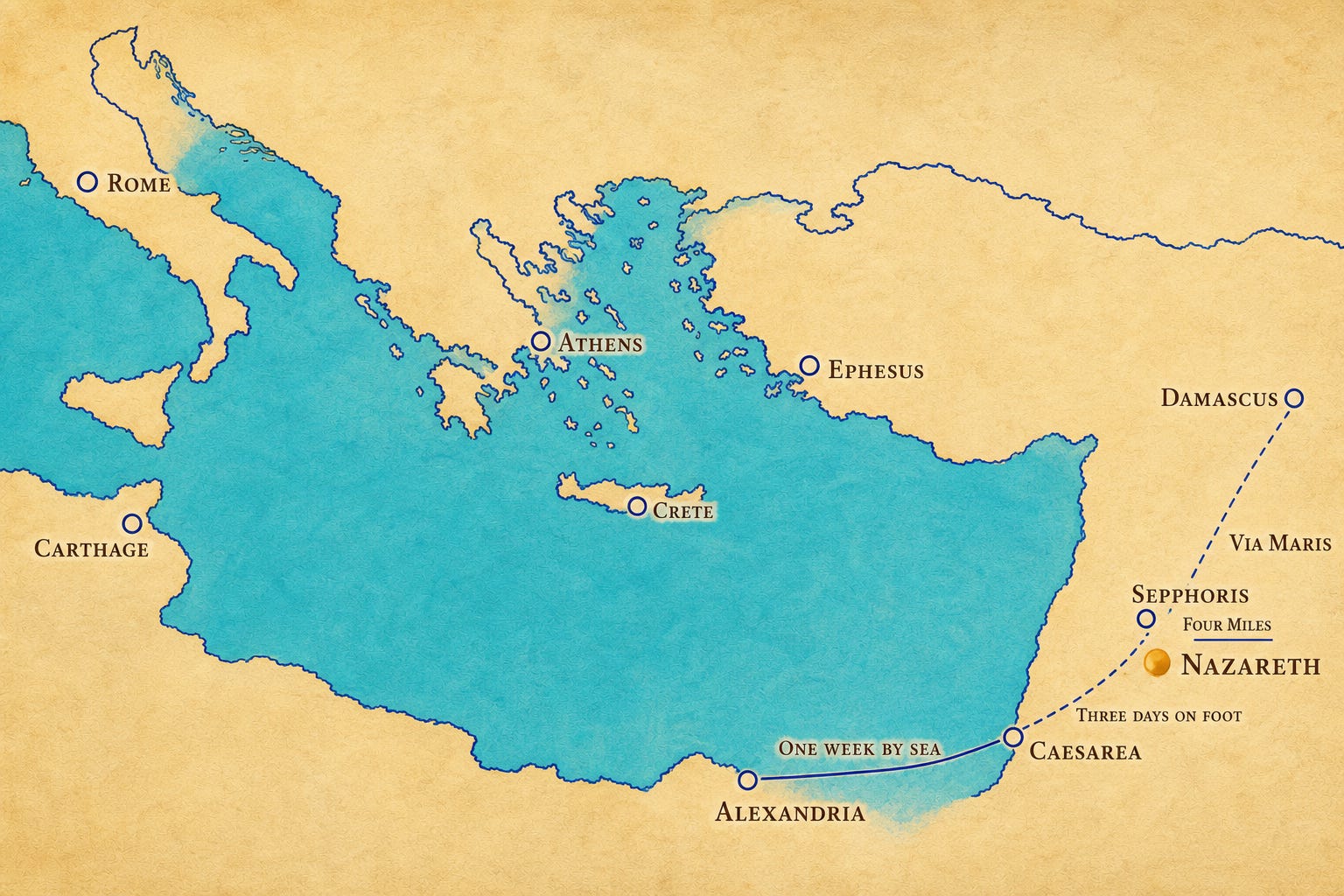
Then there is the sea, which is the part nobody does the math on.
The harbor at Caesarea was a few days’ walk. Grain ships ran from that coast to Alexandria on a fixed schedule, because Rome ate Egyptian wheat and the ships never stopped. Deck passage on a working freighter was cheap, because deck passage is always cheap. A young tradesman from Galilee could buy his way onto one about the way you would buy a bus ticket.
And Alexandria was not the ends of the earth. It held the largest Jewish community outside Judea, a quarter of the whole city, with its own synagogues, its own scholars, and the greatest library ever assembled. Going west was not exile. It was going to the biggest, smartest Jewish city in the world.
Rome was the same road, farther. Athens was the same water. The Mediterranean was not the edge of his map. It was the middle of it.
Now look at the family.
They had already crossed a border once, as refugees, when he was small. They traveled. They had a trade, and trades move. There were relatives scattered all through the hill country. For a household like that, mobile and connected and skilled, eighteen years without once leaving a four-mile radius is not the safe assumption. It is the claim that needs defending.
So there are three stories, and only three.
He stayed home. This one survives on habit. Nobody has ever made the case for it, because nobody thought they had to.
Or the legends. India, Tibet, Britain, America. These fail on the same map we just walked. Why would a young Jewish man go five thousand miles east, past a hundred cities full of his own people, when the center of his world was a week’s sail west on a road everyone agrees existed? The legends do not answer the question. They just make it exotic.
Or the third one, the boring one. The Mediterranean. Alexandria, Rome, Athens, the world next door. Not proven. Nothing about these years is proven. But possible the way ordinary things are possible. A road, a ticket, a reason.
That is the question I could not put down. Never mind did-he-go-to-India. The road was open, the ships were running, the cities were full of his own people. So what would a man like that have seen? What would the world have taught him, and what would he have carried home?
I do not claim to know where he went. No one can.
What I did was spend two years on the world that was actually reachable from his village, the ships and the ports and the people standing at the end of them, and then I wrote the journey the way it could really have gone. No hoaxes required. A plausible road through a real world.
Book One was the boy. The village, the family, the carpenter’s bench. Book Two, Far Country, is the man on the road, where he went and who he met and what got said at fires and sickbeds and strangers’ tables before he came home to begin.
And I can tell you where it ends, because the ending was never in doubt. Before the ministry, before any of it, he walked down to the Jordan, where a wild man in camel’s hair was shouting in the water. His own cousin. The whole world knows what happens at that river.
What nobody has ever told is what passed between the two of them in the breath before the water closed over him.
Book Two ends on that riverbank. Book Three opens in the water.
<3EKO
This morning I finished something I have been working at for a while.
The first complete audio edition of The Nazarene. All fifteen chapters, front to back, including the last four that never ran here. If you followed the serial this spring you stopped at Chapter 11. The ending was only ever in the book.
Now it is in your ears, and you can hear it the way I intended it.
It runs about 2.5 hours. Press play and let it go while you do something else with your hands. Subscribing and leaving a comment is how this finds people.
Far Country comes out in paperback next week. If you want an advance copy to read over the weekend, say so in the comments and I will send you the link.

And I want to say this plainly. A few dozen of you read early drafts of the next book. You wrote back with the hard notes, the places where it sagged, the lines that were not true yet. It does not exist in the shape it is in without that. I have your emails and letters. I read them more than once.
One last thing, and I almost never ask for this…
If this story lands for you, please go and send it to somebody. Not a repost. A person. Someone who has quietly wondered about those years and never had anywhere to put the question. Somebody handed you a book once and it changed the direction you were pointed. Do that.
I will see you at the Jordan.
P.S. A man wrote to me last night. He has read one chapter of Son of Man about ten times. He was not telling me the writing was good. He was telling me that Jesus had gotten more real to him, and he wanted somebody to know.
That is most of the mail. People do not write to praise the work. They write because something they already half-knew finally had somewhere to stand.
I do not take credit for that.
Whatever is doing it was in the room before I got there.
But if you know what he is talking about, then you already know one other person who does.
Have a great weekend.
I love you.