
Jesus Went Where No One Could Watch
Before he gathered disciples, he settled what kind of power he would use.
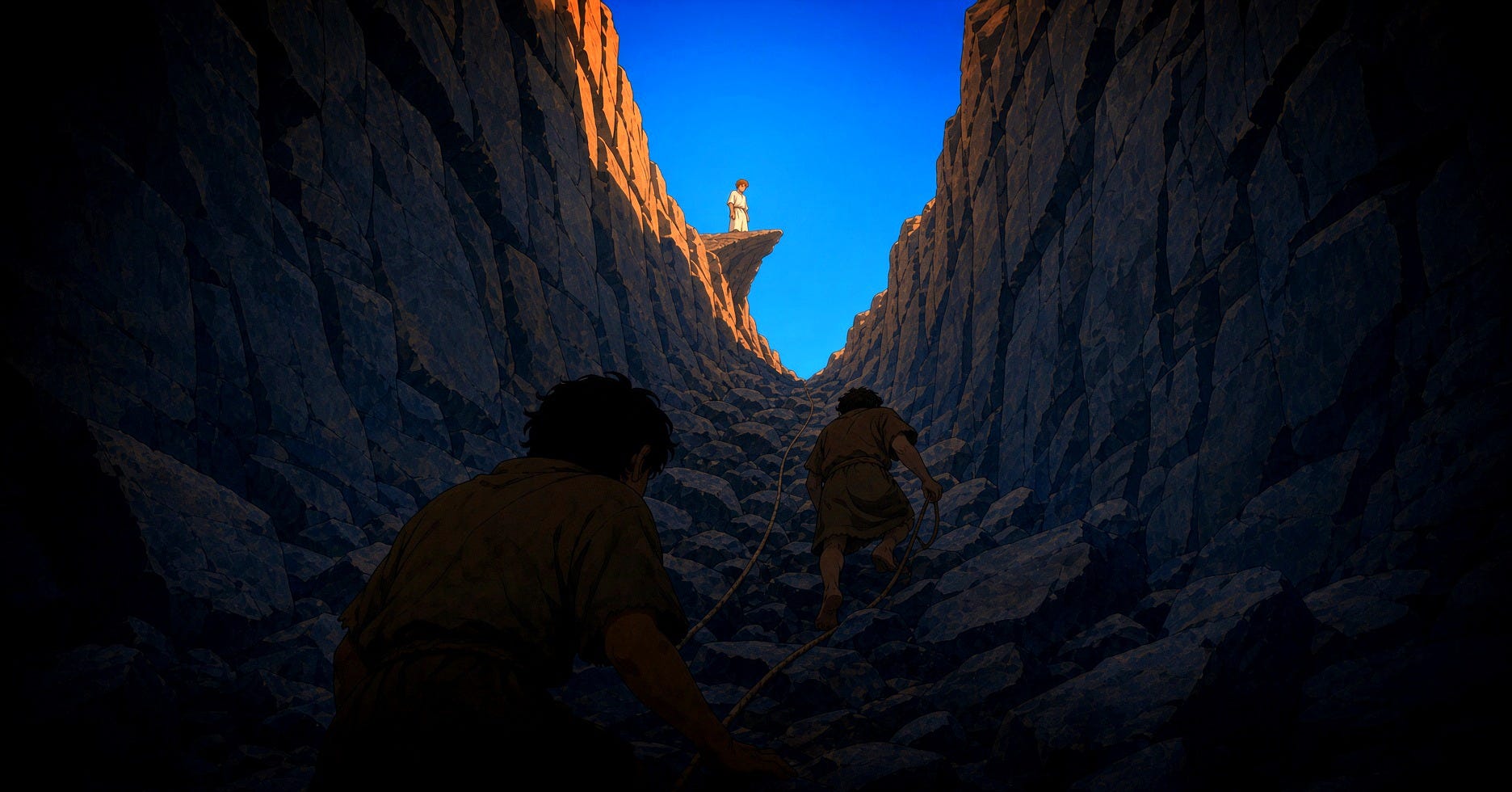
The Mountain
The first thing Jesus did in the hills was repair his sandal.
The thong had pulled halfway through the sole on the climb from the river. He sat where the last tamarisks gave way to stone, worked the leather free, and cut off the torn end with his knife. The shortened thong would not reach its old hole. He pierced another with the awl from his bag, closer to the edge, threaded the leather, and pulled until the sole held against his foot.
Above him the slope broke into shelves.
He put the knife and awl away and climbed.
The river disappeared first. Then the tents. By late light the voices below had thinned to a sound no larger than insects in the cane. His mother’s cloak had dried stiff across his shoulders. White salt marked the hem.
He found a shallow place beneath an overhang and set down his bag. Before entering, he took a stone from the ground and threw it against the roof. Dust fell. Two chips struck the floor. He threw again. Nothing moved.
He cleared the fallen pieces, carried the loose stones beyond the sleeping place, and laid the cloak along the back wall. Wind came around the eastern edge. He moved the cloak twice before the corner stopped lifting.
Dark took the slope. No fire showed above the river.
At John’s camp, men kept looking toward the hills.
The wild man came out of the water after the last immersion and wrung his garment by the bank. A potter from Jericho waited until John had twisted the hem dry.
“Will he return with a sign?”
John hung the garment over a cane.
“He went into the hills.”
“Moses came down carrying the law.”
“Then wait for Moses.”
The potter looked at the empty eastern road. Behind him, two women argued over whether the stillness at the baptism had been thunder too far away to hear. A soldier said he had seen the Galilean’s face change. A merchant said the river had stopped against his legs. The water went on brown between the banks.
James and John Zebedee arrived after dark.
They had walked from Galilee with a coil of rope, two skins, and enough bread for the road back. James asked where Yeshua had gone. The Baptist pointed toward the black line above the river.
“How long?”
“As long as he requires.”
John Zebedee shifted the rope to his own shoulder. “Which path?”
“He did not appoint a search.”
James looked at the hills.
At first light the brothers were gone.
High above them, Yeshua folded the cloak and drank the last of the water from his skin. He descended toward a cut in the rock where winter rain had left a shallow pool. Goat tracks crossed the mud. He followed them along the lower face until they entered a stand of carob.
Most of the pods had split or gone black on the ground. He broke the sound ones and held them to the light. Two carried holes. He discarded them. He filled the corner of his cloak with the rest, then cut cress from the water’s edge and washed the roots in the pool.
A flat gray stone lay beside the spring, round as a village loaf. He lifted it, cleared the cress growing beneath, and set it back into the mud.
He ate the pods one at a time. They took work. The dry flesh clung between his teeth. He drank, ate the greens, filled the skin, and carried the remaining food uphill.
Near the overhang he built a fire inside a ring no wider than both hands. The rock hid it from the valley. He fed it thorn twigs and dry dung until the cress wilted in a small cup. Smoke found the roof and moved out in a thin line that broke against the face above.
Far below, James cupped his hands around his mouth.
“Yeshua!”
The name climbed through two gullies and failed beneath the overhang.
James called again.
John studied the ground. Sand had collected in a crack between slabs. One print marked it from heel to toe, softened at the edges by wind.
“This way.”
They climbed until the crack narrowed into bare rock. At the next shelf it divided around a spine of stone. James took the higher way. John went low. The rope passed between them until it pulled tight.
“Anything?”
“Rock.”
They changed sides and climbed again.
Above the spine, Yeshua stood where neither brother could see him. James crossed the open ground below, leaning into the slope. John followed the shadow at the base of the face. Their rope scraped over a ledge, a short dry sound, then vanished with them into the next gully.
Yeshua returned to the overhang. He banked the fire with sand, rinsed the cup, and hung the wet sandal thong from a thorn. When the leather had softened, he removed it and drew the knot tighter.
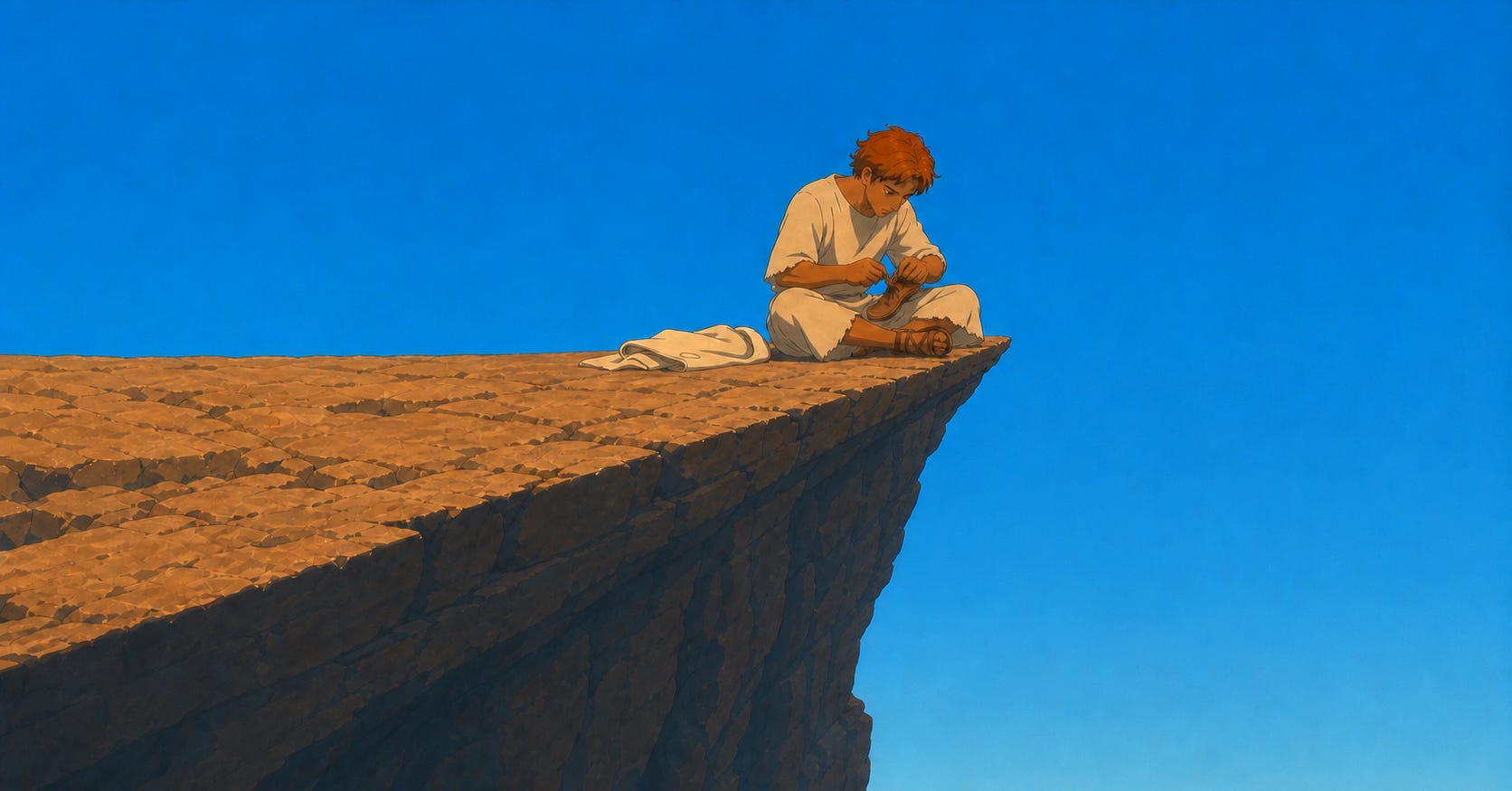
The next wind came from the north.
It struck hard enough to roll one of the stones he had cleared from his bed. He watched the stone cross the shelf and go over the edge. It struck once below. The second sound came much later.
Yeshua approached the drop on his hands and knees. A dark seam ran under the lip where frost had opened the slab. He pressed each side with his palm. The outer edge shifted.
He moved backward along his own tracks. He took the cloak and bag from the overhang and carried them to a lower hollow roofed by solid stone. Then he returned for the cup and the remaining carob.
The cracked ledge held through the night without him.
Below, the camp grew.
People who had watched the baptism went home and returned with relatives. Men arrived asking where the Galilean had gathered his followers. A lame boy’s father brought a litter because the merchant from Jericho had said the man in the water could not drown. One of John’s disciples tried to turn them back.
John took the next person into the river.
The father set the litter beside the cane and waited.
When John came ashore, the man caught his arm.
“They say the one you named has power.”
John removed the hand from his sleeve.
“Your son has been on that road since morning.”
The father looked down at the boy.
John took one end of the litter. His disciple took the other. They carried it out of the press and placed it in the shade. John brought water. He washed dust from the boy’s mouth and gave the cup to his father.
“Where is he?” the man asked.
John looked once toward the hills. “Not here.”
On the height, Yeshua could see the roads.
The river road cut north and south beside the water. A narrower track climbed west toward the villages. Beyond it, Herod’s riders moved in pairs, their spearheads showing and disappearing with the turns. At a crossing they stopped a farmer with a loaded mule. One rider pointed to his own packs. The farmer shifted them onto his animal. The three continued north.
Yeshua sat with one hand on the stone beneath him.
The shelf carried a frost seam from the hollow to its outer face. Gravel filled the opening. Beside it lay a wedge of harder rock, narrow enough to drive into the split. He picked up the wedge and fitted its point into the seam.
The riders below passed the next marker. The farmer and mule remained between them.
Yeshua removed the wedge. He set it beyond reach of the crack and brushed the gravel from his palm. His hand rested open on the stone.
[INSERT IMAGE → ART/CH02_INLINE_LEDGE.png : Yeshua kneels at the cracked ledge after removing the wedge]
By afternoon the road had emptied.
James and John Zebedee crossed the lower slope for the third time. James’s tunic was torn at one knee. John had wrapped his left foot. They had left small piles of three stones at the mouths of the gullies they had searched. From above, the markers made a broken line that doubled back on itself.
James stopped beneath a cliff and shouted.
No answer came.
John leaned against the face. “He may have gone east.”
“There is nothing east.”
“Then we search nothing.”
James pulled the rope loose from his shoulder. They went east.
Yeshua watched until the ridge took them. He poured the remaining water into his cup, drank half, and used the rest to clean grit from the repaired sandal. The new hole had stretched. He cut a square of leather from the inside of his bag and placed it over the weak edge. The awl passed through patch and sole together. He bound both with the shortened thong.
The sole held.
Days passed over the face of the hill. Rain marked the stone and dried. The moon thinned. Small fires appeared near the river and went out before morning. Yeshua gathered food near the spring, carried water, kept his fire low, and moved whenever loose ground made a shelter unsafe.
Once he found the brothers’ prints less than a hundred paces from his hollow. The next wind erased them.
He left no writing on the stone.
On the final morning he scattered the cold ashes with his fingers. He carried the dung and blackened thorns beyond the hollow and buried them in scree. He shook the cloak, rolled it around the cup, and tightened the bag.
Three ways led down.
The western track opened toward the villages. The broad southern face could be seen from the river camp. The eastern descent ran behind the ridge through broken ground and joined the lower path near the last spring.
Yeshua tested the eastern ground with his staff. The first shelf held. At the second, gravel slipped under the ferrule and ran ahead of him. He shortened his grip, placed the repaired sandal across the slope, and shifted his weight onto it.
A loose stone ran below his sandals as he took the first ordinary step downhill.
<3EKO
Howdy. I’ve been off grid in the woods and on the water for the past two weeks with my family. Also celebrated my birthday last week. Ready to lock in.
You just read chapter two from my third book on the Jesus we never knew.
The PDFs have always been free. A file is still a hurdle for some. So I built a page you can read on your phone. No email. No download. Just read.
Someone you know has not started this story. Hand them the beginning.

Thanks for sharing.
I love you.
Happy birthday, EKO.
love UncleMac