
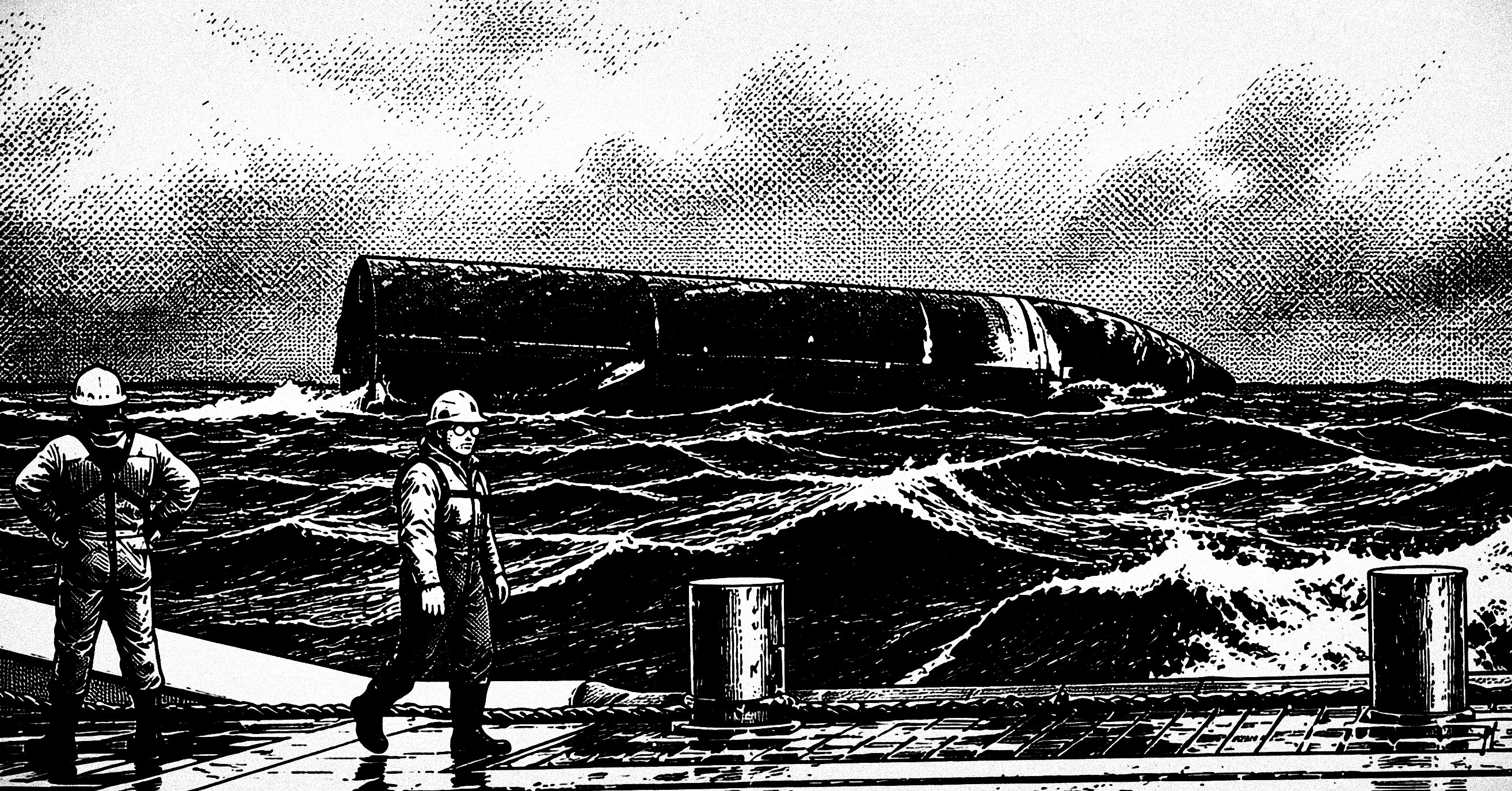
Tuesday morning, off Christmas Island, a recovery crew brought a spaceship into calmer waters.
Ship 40. 171 feet of scorched stainless steel, floating flat in the swell like a drowned grain silo. It lifted from Texas about a month ago, survived reentry, and splashed down intact. Previous Starship upper stages broke apart during descent or after hitting the ocean. This one toppled into the waves and stayed in one piece.
Then it stayed afloat.
For 24 days it remained at sea. Rough weather kept recovery uncertain. And earlier this month, Elon said it was “not looking good right now.” 11 days later the ship was just off Christmas Island in the Indian Ocean. SpaceX called it the first Starship to return from space in one piece. Engineers were on their way to inspect it before crews attempted the long tow back to Starbase, TX.
The pictures shared online blew me away. Guys on wet deck in hard hats, bollards at their feet. Behind them, the future lying on its side in the waves.


In a weird way it reminded me of an old comic strip that ran for 86 years.
Back in April 1937, Fortune asked adult readers to name their favorite comic strip. Little Orphan Annie finished first, ahead of Popeye and Dick Tracy. Four years earlier, when Sandy went missing, Henry Ford wired the paper:
“PLEASE DO ALL YOU CAN TO HELP ANNIE FIND SANDY. STOP. WE ARE ALL INTERESTED.”
Annie survives now as a musical, and the musical keeps just four souvenirs. A red dress, a dog, a bald billionaire, and a promise about tomorrow.
But the comic strip’s creator Harold Gray drew something much rougher.
At its height, his strip reached more than 30 million readers every single day. It carried kidnappings, murders, labor fights, court cases, war, poverty, business, and conservative politics into the morning paper.
Gray’s co-star was Oliver “Daddy” Warbucks, a munitions millionaire who handled problems with money, muscle, or both. In a 1935 storyline Warbucks backed Eli Eon (אֵל עֶלְיוֹן?), a homeless inventor with a super cheap, nearly indestructible material called Eonite.
Warbucks planned to mass-produce it for housing. It was a building material, but the dream was the same as free energy. Cheap abundance that made the old gatekeepers unnecessary. He stated it would create millions of new jobs.
But a corrupt union boss named Claude Claptrap and a long-haired journalist named Horatio Hack demanded that Eonite belong to the state and “the pee-pul.” Union men burned the factory before Warbucks could build it out. And Mr. Eon died with the formula.
Gray ran the story as Franklin Roosevelt signed the Wagner Act. A newspaper in West Virginia dropped Annie and accused Gray of using the strip for propaganda. The New Republic called Annie “fascism in the funnies.”
Complaints came from his own side too. Just before Pearl Harbor, Warbucks escaped a concentration camp and returned home ready to arm the United States. But isolationists wanted him out of politics and to just stick to comics.
He ignored every critic and kept going.
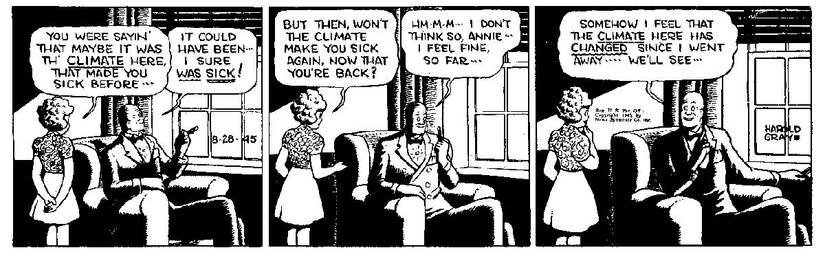
When Roosevelt won nomination for a fourth term in 1944, Gray answered with an arc called Death Be Thy Name. Warbucks died with jungle fever. On his deathbed he said his wealth came from “the imagination and common sense and energy that kind providence gave me.” Then Roosevelt died the following April. Warbucks miraculously walked back into the strip with a cigar and said, “Somehow, I feel the climate here has changed since I went away.”
Harold Lincoln Gray was born on a farm near Kankakee, Illinois, on January 20, 1894. He grew up admiring Lincoln and Teddy Roosevelt.
Hard work and self-rule mattered to him, and he injected both into his comic.
Gray paid his way through college by digging ditches and pouring concrete. One hotel job ran 10 hours a day for 20cents an hour. He studied engineering, boxed when he had free time, and drew pictures for the yearbook.
In 1917, John McCutcheon, the Chicago Tribune’s editorial cartoonist and a fellow Purdue graduate, helped him get a $15/week reporting job. Then the Army drafted him and sent him to Georgia to teach bayonet fighting.
After the war he helped letter The Gumps, the first strip that taught comics to tell one long story over time (rather than just gags) and learned the process.
Little Orphan Annie debuted in the summer of 1924. Annie began as an orphan boy but the newspaper publisher told Gray it would be more popular if he put the main character in a skirt. Gray remembered a tough girl he once ran into on a street in Chicago. He decided to base the girl off her. The first strip ended with Annie praying in the orphanage for someone to adopt her.
While he married twice, he never had any children of his own. So he spent 44 years drawing a daughter.
And at 70 years old he was still totally locked in, drawing and writing 70+ hours a week to produce six daily strips and a Sunday page.
Eventually he gave Annie a new job. She carried a daily opinion column inside an adventure serial. One of his storylines ran for nearly two years, through a murder, a trial, and a long recovery, four panels at a time.
In 1943 he wrote to Congresswoman Clare Boothe Luce about the power of a political comic strip. “I’d like to be that guy,” he said of whoever entered the forbidden field first. “A properly handled political strip would go like a prairie fire and be even hotter.” He sent his regards to “our RULER,” AKA FDR.
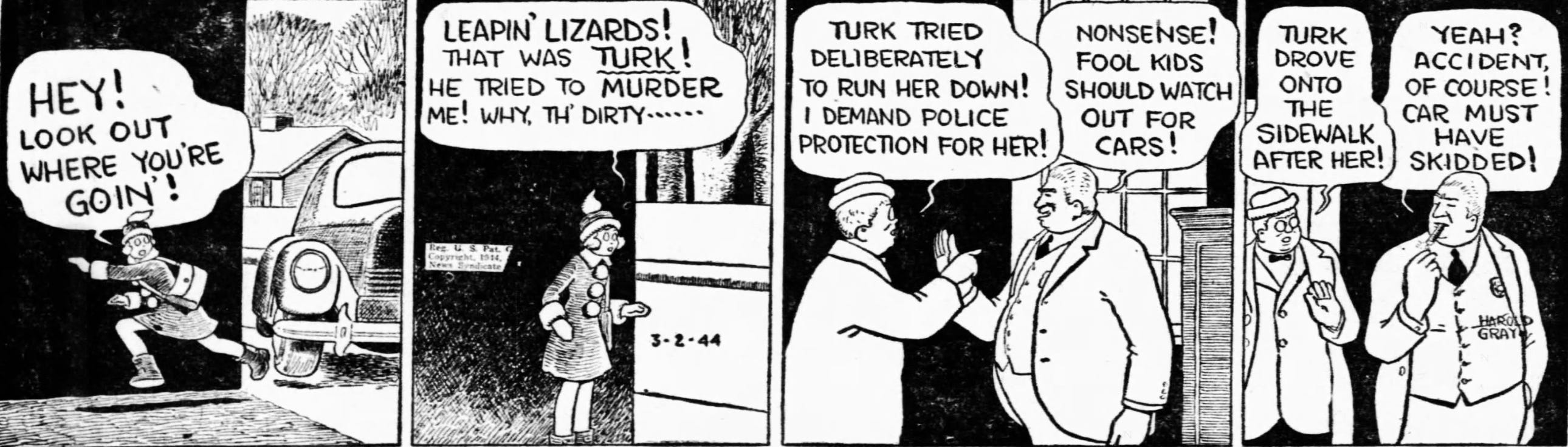
That same year, the Louisville Courier-Journal pulled Annie over a story about wartime gasoline rationing. It objected to opinion entering the comics “in the guise of entertainment.” Other papers followed suit and suspended Annie, too.
And those eyes. Gray did not invent the empty ovals, but he made them his signature. With the pupils gone, feeling moved into the jaw, shoulders, hands, and the black around the figures. His people look unfinished until they act.
The strip stayed inside the week in which it appeared. Laws, elections, ration cards, wars, and newspaper quarrels entered almost as they happened in real time. Gray put his argument in the part of the paper families opened every day over breakfast. Decades before social timelines and For You feeds, he had what every poster still chases—a page of his own with millions of readers.
Gray was a liberal Protestant universalist. In a 1927 strip, Annie says one religion is as good as another if a person lives up to it. His politics were free labor, hard work, and opportunity. Annie earned her keep wherever she landed. Warbucks was always building something and putting people to work.
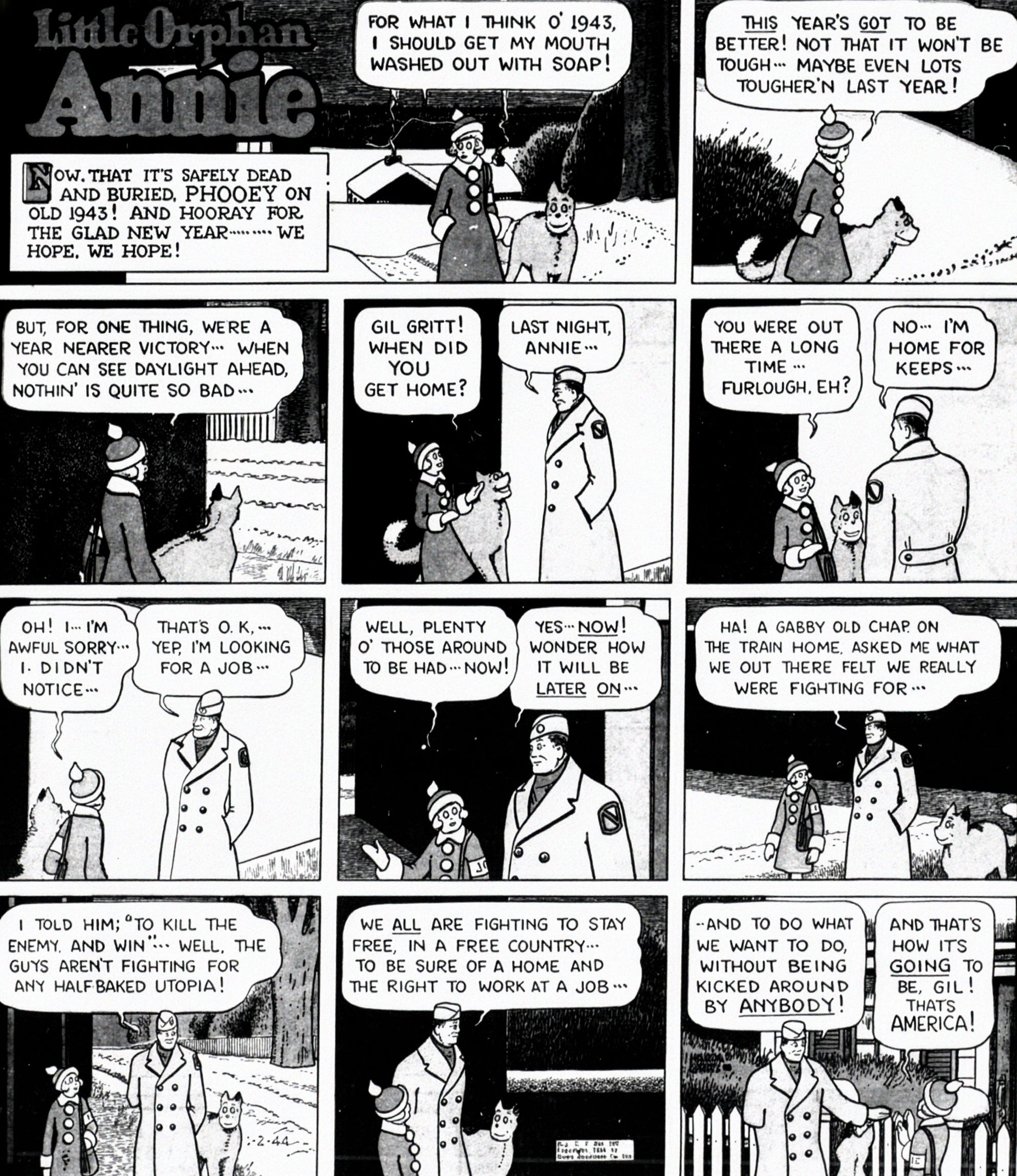
In a letter, Gray wrote, “I hate professional do-gooders with other people’s money.” A 1944 strip put the other half into Warbucks’s mouth...
“This country made him great, but his kind made this country great!”
Gray died on May 9, 1968. The strip continued without him and lost its soul.
In 1975, Garry Trudeau won a Pulitzer for Doonesbury, the first comic strip to receive one. Gray’s prediction finally arrived, under a very different politics.
Broadway followed in 1977. Then Hollywood. The musical and its catchy songs made Warbucks an ally of Roosevelt and let Annie’s optimism help inspire the New Deal. Gray would’ve turned in his grave.
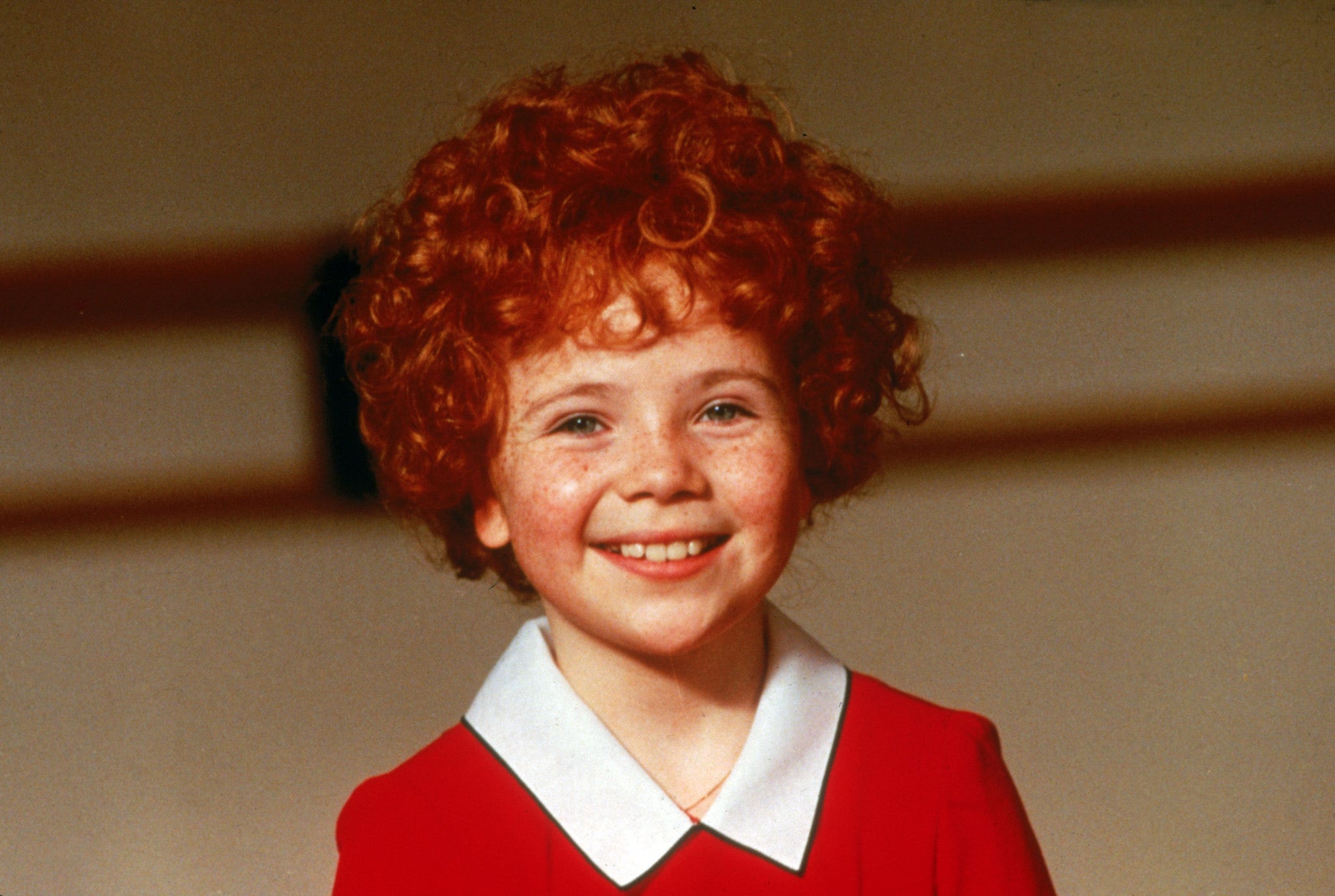
For people like me, this became Annie.
Reading Gray’s version as he originally intended now takes some serious salvage work. The collections are scattered, expensive, and mostly out of print. The version that survived is the one that inverted his message.
Gray killed his star Daddy Warbucks when the climate turned against those who build. He brought him back only after that climate changed. That was the limit of what a comic strip could do. Even Gray needed the weather to break.
But SpaceX’s Ship 40 did not wait. It came back through the same climate that has spent years trying to stop the work of builders.
A hundred years ago an editor could end Gray’s argument with a phone call. Who do the pee-pul call about a spaceship?
<3EKO
Here’s what I’m building. A saga about the living Jesus. The quiet years between 12 and the river, and the whole life around them. One relatable coming of age story, built so the last page hands you back to the first.
Start reading free. No emails needed, no forms. The URL is the library card.

I love you.
A popular David Burge (Iowahawk) tweet comes to mind
Interesting story. Learned something new. Thanks.