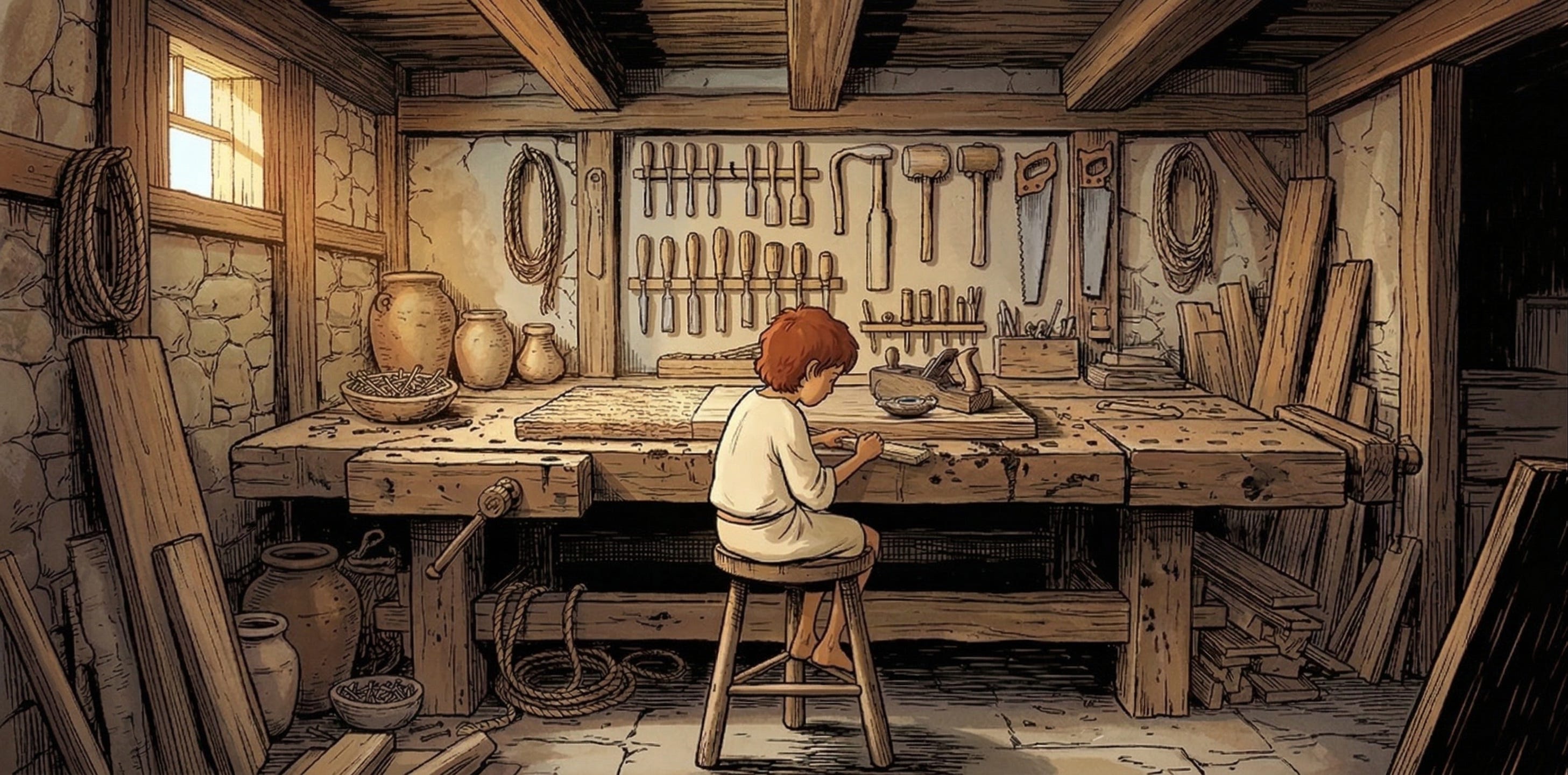
Small Deaths
He came home from the Temple carrying a fire he’d have to learn to swallow. He was twelve years old. He had eighteen years of practice ahead of him.
The road home was longer than the road south.
Same hills. Same donkeys plodding the same switchbacks above the Jordan. The caravan moved at its usual pace, families walking in clusters, children weaving between the groups the way they always did. Yeshua walked with his parents. He said little. He watched the road.
Behind him, the whispers had started before the caravan cleared the city gate.
The carpenter’s boy. The Temple. The scholars who couldn’t answer him.
Conversations stopped when he walked past. Neighbors who had known him since infancy made room as if he’d gotten wider. A woman from the lane near their house touched his sleeve and said a blessing he hadn’t asked for.
Mary walked beside him and said nothing. Her hand gripped the strap of her bag and did not relax for three days.
They reached Nazareth on the seventh day.
The news had arrived before them. His praise was already on everybody’s lips. The whole village had heard some version of it: the boy, the scholars, the questions that silenced learned men. At last a great teacher was coming out of Nazareth in Galilee.
Neighbors stopped him in the lane. Touched his arm. Studied his face.
He smiled. He answered their questions politely. He went inside.
Joseph closed the door and leaned against it.
“Well,” he said. “That’s going to last a while.”
That evening, after the younger ones were asleep, Joseph took him to the flat stone behind the workshop.
They sat with their backs against the wall. The sky was clear. The stars stretched north to south, thick as spilled flour.
“I need to understand what happened in Jerusalem,” Joseph said.
Yeshua pulled his knees up. “I don’t fully understand it myself.”
“Try.”
“When I sat in the teaching courts, it was like...” He stopped. A breath. “The questions I’ve always carried. They became urgent. I couldn’t hold them anymore.”
“The scholars were afraid of you.”
“They weren’t afraid of me. They were afraid of what the questions pointed to.”
Joseph turned a pebble in his hand. “Your mother thinks you spoke of your Father. The one who isn’t me.”
“I did.”
“Do you know what that means?”
“I’m beginning to.”
The pebble clicked against another pebble. The night insects filled the silence.
“I don’t know how to be your father,” Joseph said. “Not knowing what I know. Not knowing what I don’t know.”
“You’ve been my father every day of my life. The one who taught me to measure twice. To work with the grain. To listen to what the wood wants before I force it into what I want.” Yeshua’s voice was steady and quiet. “Whatever else I am, I’m your son. I want to be your son.”
Joseph’s hand found his shoulder and stayed there.
After a while he said: “You’ll need to be careful.”
“I know.”
“Can you?”
The question settled between them. In the Temple, for three days, Yeshua had been fully himself. The joy of that still lived in his chest. The intoxication of speaking without restraint, of asking what he actually wanted to know, of watching the scholars lean forward because the questions were real.
Could he go back to holding back?
“I can try.”
Joseph studied him. Measuring the gap between what the boy was saying and what the boy could deliver.
“All right,” he said. “All right.”
The workshop felt smaller than he remembered.
Three weeks away and the familiar tools looked different. The half-finished projects stacked against the wall. The smell of cedar and iron that had been the background noise of his entire childhood.
Joseph handed him a plane. The weight of it in his palm. The worn handle that fit his grip.
“Orders are backed up. The Romans want furniture for the new bathhouse. Simple work.”
“I can help.”
They worked side by side. Measure, mark, cut. The curl of shavings falling to the floor. He let himself sink into it. The honesty of wood. No expectations in a workshop. No scholars leaning forward. No neighbors scanning his face for signs.
He had missed this.
But the plane moved and his hands moved and his mind kept going to the Temple. The veil. The questions. The old teacher’s face when he said I listen to the one who wrote it. The way the portico had gone silent.
Joseph glanced at him. “You’re not here.”
Yeshua looked down. The board he’d been planing had a divot where his hand had pressed too hard.
“Sorry.”
“Don’t be sorry. Just be here.” Joseph took the board, ran his thumb across the gouge. “This is your life right now. This room. This work. The rest will come when it comes.”
He picked up a fresh board and started again. Slower this time. Matching his breath to the stroke. Trying to be in his hands instead of in his head.
The plane moved. The shavings curled. The light shifted across the floor.
His life. This room. This work.
The shavings curled and fell.
The weeks passed. The talk did not die down.
Mary stood in breathless anticipation, time after time, expecting to see her son engage in some superhuman performance. She watched when he walked to the well. She watched when he spoke at synagogue. She leaned forward, barely breathing, every time he opened his mouth in public.
Time after time, her hopes were dashed.
He saw all of it. Her face lighting when he entered a room. Her shoulders dropping, barely visible, when nothing extraordinary happened. The slow dimming behind her eyes, week after week, as the carpenter’s apprentice failed to become the messiah she had been promised.
She was striking the flint again and again. The fire wouldn’t catch.
He wanted to tell her. To explain. To say..
I see what you’re hoping for, and I’m sorry I can’t give it to you yet, and I don’t know why I can’t summon what happened in the Temple, and the weight of your hope is heavier than anything the scholars ever put on me.
He said nothing. And she kept hoping. And every week the distance between her dreams and his silence grew.
At the synagogue, the chazan watched him more carefully than before.
Yeshua asked his usual questions. Participated in discussions. Studied the texts. Gave answers that were good. Thoughtful.
Ordinary.
The man he had been in Jerusalem went back into hiding.
A merchant from Damascus visited the village one Sabbath and spoke at length about the prophets. He quoted Isaiah incorrectly, reversing two passages, collapsing a distinction that changed the meaning of both. Yeshua felt the correction rising in his chest. The words forming. The argument assembling itself the way it always did, clean and fast and complete, every connection visible.
He swallowed it. Nodded. Let the merchant continue.
The merchant finished. Several of the older men murmured approval. The chazan asked if anyone had questions. Yeshua looked at the floor.
After the service, walking home, his throat burned. A physical sensation, like swallowing smoke. He could still feel the shape of the words he hadn’t said. They sat behind his teeth, fully formed, pressing against the back of his mouth.
This was the cost. A hundred small deaths, every week. A sentence swallowed, a connection unmade, an insight choked back because the boy who corrected his elders in public would become the boy who had to explain what he was. And he could not explain what he was.
The next Sabbath it happened again. A debate about the Messiah, whether the deliverer would be a political king or a spiritual teacher. The same debate the Temple scholars had been running in circles around for a century. The same incomplete framing. The same missing piece.
He knew the answer. He had known it in the Temple at twelve. He knew it now at thirteen with a certainty that frightened him.
He pressed his palms flat against the stone bench and let the men of Nazareth fumble toward conclusions he could have given them in a single sentence.
The chazan glanced at him once. A quick look. Almost involuntary. The way you glance at a door you expect to open.
Yeshua kept his eyes on the floor.
The door stayed shut.
He craved a friend.
The boys from the village had started treating him differently after Jerusalem. The easy friendships of childhood had curdled into something more formal. They watched him now. Waited for him to do or say something remarkable. When he didn’t, they grew bored and drifted away. When he did, they grew nervous and drifted away.
His parents loved him. They were also afraid of him in ways neither of them would say aloud.
The caravan traders passed through every few weeks, interesting for an afternoon and then gone. No one to build a thought with. No one to return to.
What he wanted was someone whose mind moved at the same speed. Who could follow where his thoughts went without flinching. Who would talk about ideas the way other boys talked about fishing.
An equal. The word sat in his mind and wouldn’t leave.
Jacob, his oldest friend, was loyal. When Yeshua tried to explain the thoughts that pressed against the inside of his skull at night, Jacob’s eyes would go flat. He’d nod. He’d change the subject. He’d suggest they go climb the old oak behind the tanner’s yard.
Yeshua stopped trying.
He learned to keep his thoughts to himself. All of them. The ideas that woke him at odd hours. The connections he saw between texts that no one around him had noticed. The questions about God and duty and the purpose coiling tighter every month in the center of his chest.
To all appearances he became commonplace. Conventional. Just another boy in Nazareth learning his father’s trade.
The village stopped watching.
On Sabbath afternoons, when the work stopped, he walked.
Sometimes with Joseph, the way they always had. Up the ridge above town. Sitting on the flat rock where you could see the Jezreel Valley spread out below, the trade caravans moving like threads on a loom, the whole world going somewhere while Nazareth stayed.
Sometimes alone. Feet dangling over the cliff edge. Thinking.
His periods of meditation alarmed Mary. His frequent journeys to the hilltop. The long silences at meals. Sometimes she thought he was losing himself. Then she would steady her fears, remembering the angel, remembering the night, remembering that this child was a child of promise. Different from other boys in ways she could not measure.
She didn’t know how different.
Neither did he.
Joseph came to him one evening, late. The house was quiet. The younger children asleep. Mary in the back room nursing Jude.
“I’ve been setting money aside,” Joseph said. He sat down on the workshop bench and rubbed his hands on his knees. “For your education. There’s a school in Jerusalem. Gamaliel teaches there.”
Yeshua looked up from the chisel he was sharpening.
“When you’re fifteen,” Joseph continued. “A proper course of study. You’d live there. Years, maybe.”
“How long have you been saving?”
“Since before you were born.”
The chisel was sharp enough. He kept sharpening it.
“The scholars there would challenge you,” Joseph said. “Push you. You wouldn’t have to hold back.”
The hope in his father’s voice.
Yeshua set the chisel down. “I’d like that. I’d like that very much.”
Joseph smiled. A full smile, rare from him, the kind that rearranged his whole face. “Good. We’ll make it happen.”
He walked out of the workshop with his shoulders set differently than when he’d walked in. Lighter. Like a man who had finally put something down.
Yeshua watched him cross the yard in the last light.
This man had carried a family out of Egypt for a child who was not his blood. Had taught him to read the grain before cutting. Measured twice because he respected the wood. And now he was offering years of savings to give his son a future he barely understood.
Yeshua picked up the chisel. Put it down. Picked it up again.
He already knew the dream was not going to last. He couldn’t have told you how he knew. An ache behind his sternum. A certainty that had no argument behind it, just weight.
He didn’t pray about it. Didn’t ask for a different answer.
He just sat in the workshop with the chisel in his lap and let the feeling be what it was.
Fourteen now. The months moving. Autumn into winter into spring.
He worked. He studied. He held his tongue at synagogue. He played his harp on quiet evenings, the only hours when the thing inside him could move without cost. The music went where his words could not. Mary would pause in the doorway and listen, and her face would do the thing it did when she remembered what the angel had said.
He grew taller. His hands thickened from the work. His voice dropped and settled into a register that made the neighbors look up when he spoke, even when he was saying nothing worth looking up for.
The village had decided he was ordinary. A bright boy. Good with his hands. Capable. Reliable. The Temple story faded into the category of things people half-remembered and mostly embellished and eventually filed under didn’t amount to much.
He let them file it.
Every morning he walked to the workshop. Every evening he walked to the ridge. Between the two, a life that fit him like a sheath. Touching on every side. Holding the shape in place.
And every day, the blade got sharper.
<3 EKO
The Nazarene Saga is a weekly serial. New episodes drop every week.
If this found you, I want you to know it was written for you.
Catch up on the saga:
Want to go deeper?
Both books fully revised. New editions now live. Paperbacks on Amazon.
I love you.


I skip the religious posts.
I have been thinking about you losing so many subscribers when you wrote about sacred things.
I have been participating in online forums since 1996. The one consistent theme I have noticed over the years has been one of blinding fear from those who have not studied the sacred literature.
They have studied Foucault and Derrida. Chomsky, Nietzsche, and even Goethe and Shakespeare.
They may know great poetry, Brit Lit, a smattering of American History, Jungian philosophy and Carl Jung himself as the master of the universe.
But because they have not read or studied the testimonies of those who either knew Jesus Christ personally, met him and talked and walked with him, or those who prophesied of his gospel and role as humanities Savior, they are like toddlers attempting to learn Chinese in an English household.
I feel terrible for really smart, well read people who think they are wise, but are novices beguiled by the philosophies of men, mingled with scripture.
They only need to spend a few minutes chatting with those who know the scriptures before they immediately feel overwhelmed with how much they do not know and how deep the chasm is between the Marxist and Atheistic teachings they spent decades learning by rote and the simple and profound teachings of the Carpenter from Nazareth.
Thanks for sharing your deeply thoughtful visions of how it might have been for Jesus as a child. We know he wasn’t considered good looking and he probably struggled to know how to fit in with his community and younger siblings.
The love between him and his cousin John was undoubtedly a balm because John knew exactly who he was, but still? A loneliness and ache may have been ever present as he matured and attempted to fit in with those around him.
You captured it perfectly.