A ruling came down this morning, and a lot of people heard a death in it.
It was not a death. And I am not going to insult you by calling it a win. It was a blow. But the marble room everyone is staring at was never where this gets decided. The vote in that room is not the verdict.
The verdict comes later, on a clock no court has ever controlled.
A free people can outlast a corrupt executive. The office turns over. It can also outlast a corrupt legislature. The seats turn over. The one corruption it cannot outlast is a captured court, because the court was built not to turn over. That was the whole design. One room made unelected and unreachable, so there would always be a last place to hold the line after every other place had folded. So the alarm this morning is not the verdict. It is that the last room has started answering to the same thing the others already answer to.
The ones who think it is over and the ones who think a bigger plan is already in motion are both watching the wrong room. Underneath all of it is the one question the next thousand years turn on, and it is older than the court, older than the country, older than any of the names shouting about it.
Every nation that ever ran the world ran out of road at about the same mileage.
A British general named Glubb spent his career in the field and his old age in the records, and he found the same number under every empire he checked. The Assyrians. Rome. The Arabs. The Spanish. The British he had served himself. Ten generations. About two hundred and fifty years. Then the same ending every time, whatever the language or the gods or the weapons.
They rise on courage. They grow rich. They grow comfortable. The great-grandchildren of the men who bled for the thing come up soft and clever and certain it holds itself up, and it does not. Glubb had a name for the last stage, the pioneer worn down into a dependent of the state. That is where the road always ends. He counted 3,000 years of it and the number never moved.
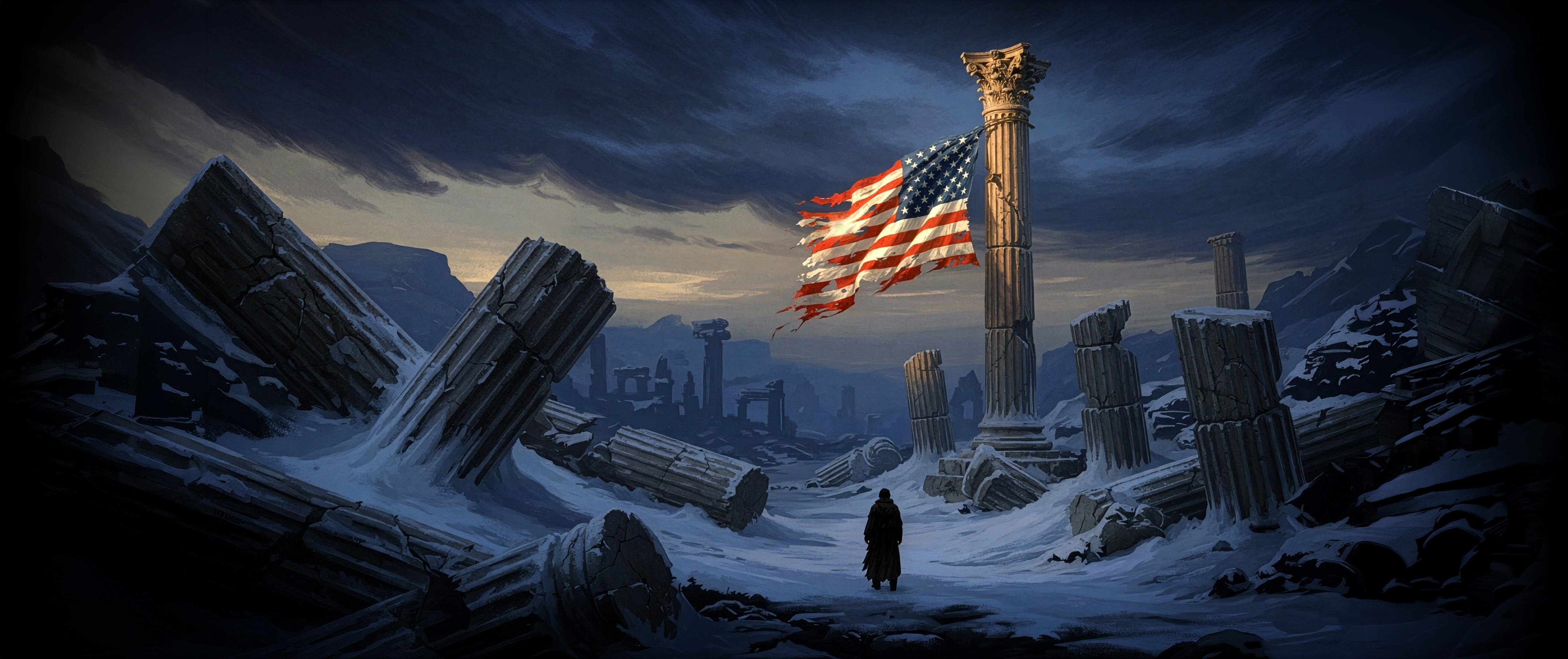
Our nation is two hundred and fifty years old. Old enough, by the only clock that has ever kept this kind of time, to die right on schedule.
The men who built it understood the clock. They had studied every one of those dead empires on purpose, and they built the one machine engineered to break the cycle that kills kingdoms. Power split so no hand could close around it. Authority running up from the people instead of down from a throne. A thing made to refuse the ending that comes for everything.
And the force that turns a free people back into a managed one came for it the same night. Before the signatures were dry, the paperwork to undo them had already started. There is an administration older than any government, and it has one move, run in every century, on every people who ever got loose. It does not conquer you. It waits, and it manages, and it makes the cage comfortable enough that you walk into it on your own. People have a hundred names for it. The system. The machine. The swamp. I call it the apparatus.
The name does not matter, because the move is always the same move.
It lost the first round to a printer, a woman in Baltimore who set the signers’ names in lead when setting them was treason and ran the sheets out the door faster than the fear could follow. That is the only way the cycle ever breaks. Not an army. A copy, and another copy, and the truth moving faster than the men sent to burn it.
There is one move the apparatus has never learned to counter, and it comes from the last place anyone looks. The tippy top. The machine can predict every man who climbs toward power. It has no model for the man who reaches the top and opens his hand. Who takes the throne he was handed and sets the authority back into a thousand hands instead, and walks away.
It is done, the old line runs, for you, until you learn to do it for yourself. The names change every century. The move never does. The strongest hand in the room opening when every law of power says it should close.
Which is the exact opposite of what the apparatus offers. The road forks here, and you are standing on it.
A free people is never conquered. It volunteers.
One road, you remember what the thing was built to be. You stop waiting for an institution to save it, because the institutions are where the apparatus keeps its address now. You carry it yourself, the way the printer did, one copy and one square of ground and one yard at a time, until the authority settles back where it belongs, in a thousand hands instead of one. That road is work. It is frightening. It comes with no guarantee, which is exactly what it came with on the first night too.
The other road, you take the story they are already telling you. The republic failed. The system is too far gone to save. There was never enough to go around and there never will be, and freedom was always a luxury you could not really afford. And there is an arrangement waiting, a generous one. Food. Shelter. The basics handled. Something coming in that you never had to earn. All it asks is the one thing you actually own. Glubb already named that stage. It was this one. The pioneer worn soft, trading the hard inheritance for room and board and calling the trade progress. It arrives dressed as compassion. A safety net. A fair share at last. Scaled, now, for a machinery that can hand it to everyone at once and watch to see who says no.
The apparatus is betting on the second road.
It has run this play on every free people for three thousand years and never once lost the long game. It is betting the memory has worn down to nothing, that two hundred and fifty years was enough.
The audit is whether the bet pays. I do not know how it comes out. No one does. That is what makes it an audit and not a parade.
And it does not get settled in a chamber or a court or a vote, because all three already answer to the thing you would be voting against. It gets settled smaller than that. Closer in. It gets settled the way the printer settled it, one person at a time, deciding the thing they were handed matters more than the fear. It gets settled where the country was settled in the first place, before there was an army or a flag or a single law on the books.
Inside a prayer.
<3EKO
One man once stood up in public and tried to name this machine out loud. They turned his name into a curse and kept it that way ever since. His name?
McCarthy.
You can download and read it free from my website. Or you can listen to it while on a walk or a drive or wherever else you need to be hands-free..
I’m now adapting all of my work into full audio readings on YouTube, uploading two or three a week. Subscribe and the rest will find you.
If you’d rather hold a copy, the paperback’s on Amazon.
The writing stays free and always will. If you want to help fuel the mission, you can always buy me a coffee. (Never required but truly helps).
P.S. I’m sending the final draft of my next manuscript, on Clarence Thomas, to a few dozen folks on the advance reader list.
If you’d like to get that piece when I send it out, just reply to this email.
I love you.


The Court is a mixed bag these days. Many of the lower courts are utterly corrupt with SCOTUS reliably undoing the damage at a great cost of time and lost opportunity. SCOTUS has been more right than wrong the last several years and that is cause for hope. The birthright ruling is horribly off and for no good reason.
John Adams correctly pointed out that a nation is not its institutions, a nation is its people. When the people are religious and moral they will not tolerate malfeasance from their elected representatives and will enforce discipline on their judges. When the people have become soft and corrupt they will hire thugs to steal from their neighbors and the end is not far off. We cannot survive theft and redistribution of property. We cannot survive the wanton disregard of borders and of culture, which is merely theft of a different kind. We have been given a reprieve these last few years. Has the citizenry earned its fruits or will we make a final slide into ruin?
"The fact that so many politicians are shameless liars is not only a reflection on them, it is also a reflection on us. When the people want the impossible, only liars can satisfy."
Thomas Sowell