The Candy House
Two disclosures landed the same Friday. By Sunday the country had answered with a third.
The Candy House
The most expensive sermon ever filmed asked a country to love the thing that takes the children. It opened Friday. The same Friday the government released a second wave of files on the things in the sky, so for one weekend the country was handed two disclosures at once and told both were good news. The name sold the ticket. The spell did not survive the parking lot.
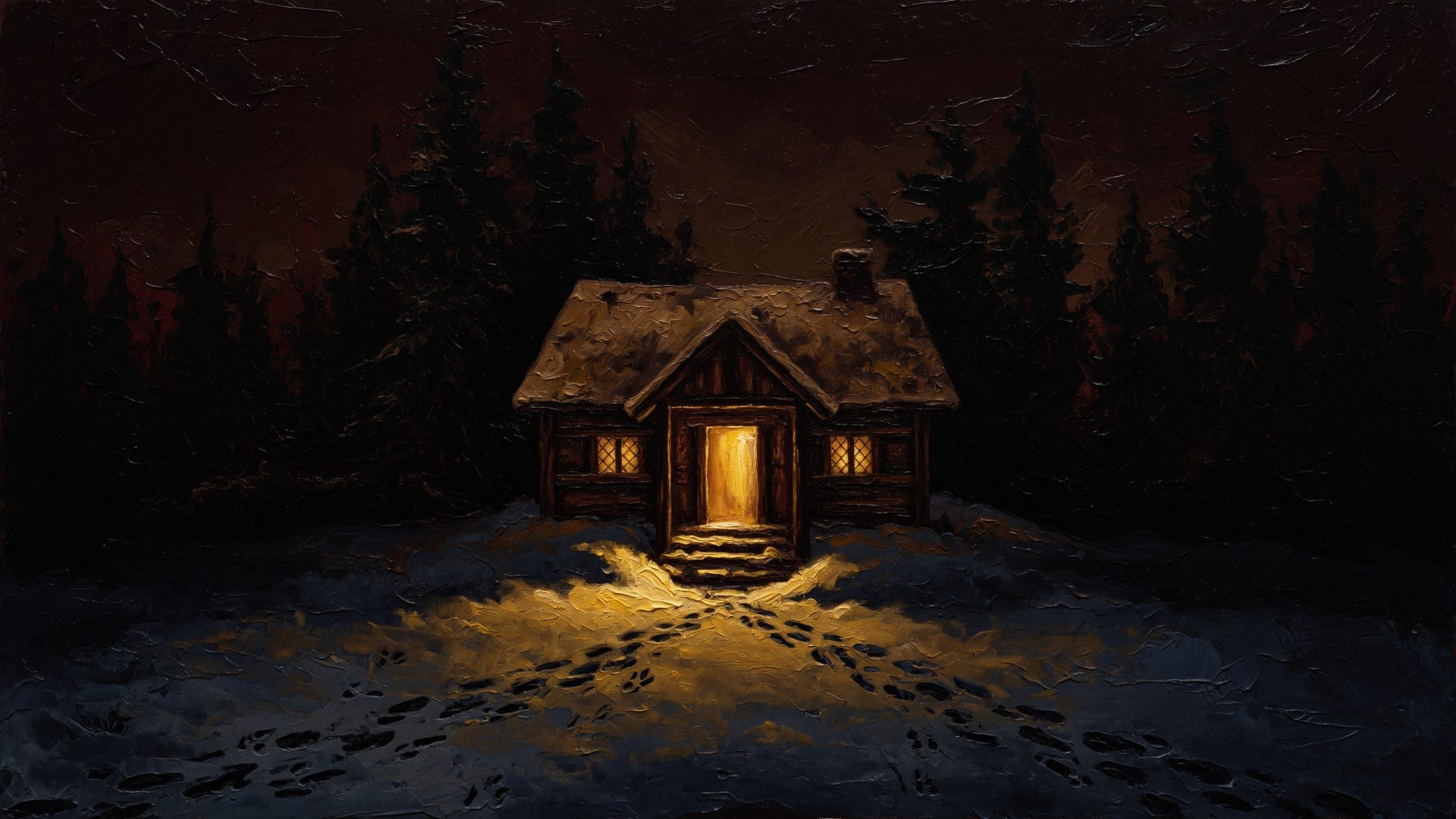
In the new Spielberg picture the visitors lead a small girl through warm snow to a glowing cottage the script itself calls Hansel and Gretel’s house. Then it walks her in smiling, lays her on a table, and spends two hours teaching you that the things that took her came to save us all.
Play the film’s own scenes with the score off and they confess what the music is hired to hide. Creatures come to a child’s window at night in the shape of woodland animals, small and warm and dear, the shape built to open a child. She follows them through the snow to the bright little house. Inside, a boy her age is already on the table. The visitors do their work. The memory goes down and stays down for decades, until they need it and switch it back on.
The film has a word for what the taken children grow into, and it says the word with reverence. Vessels. Carriers for the message of the beings who took them. The last thing the audience hears before the lights come up is a single instruction. Listen.
Then the film names the house. Out loud. After the one story in all our telling built to teach a child a single lesson, that the sweetness is the trap, that the witch made her walls out of candy because candy is what opens a child. The old story knew what its borrower forgot.
A country that has spent ten years in courtrooms and unsealed filings, learning what the powerful do with lured children, was asked this weekend to find the luring beautiful. It would not. Nobody had to expose the picture. The audience walked in already deposed.
The Inventory
Strip the saucer out and the plot has another name. Children taken from their rooms. A procedure at a site no one can find. The memory buried for decades and switched on when it is wanted. The grown subjects woken as carriers, their testimony routed out through the trusted desks, the anchors the country was raised to believe. Every step managed. Every witness kept.
I have written before about the other list in the released files, the one almost nobody combs because it is not salacious. Not the flight logs. The proposals. Designer-baby pitches, gene-editing ventures, money moving to laboratories in places that do not ask questions. A trafficker with no visible income bought a ranch in New Mexico ringed by every national laboratory that ever touched the saucer question, and spent his money recruiting physicists, not politicians. The children were real. The money was real. And the official voices managed what could be said about any of it for thirty years.
So when the biggest film of the year shows children lured from their windows, laid on tables, their memories managed, their testimony routed through the anchor desks, and calls the arrangement salvation, what it calls disclosure is closer to an inventory. The harvest renamed as love, released into theaters with a full orchestra to see whether the country would applaud.
It did not.
The Record
Every people that kept records remembers visitors from the sky, and every one of them remembers what the looking cost. Around 700 BC a Greek farmer set down the family tree of the gods, and at the head of it sat the oldest king of heaven, who kept his throne by swallowing his children as they were born. Rome called him Saturn.
The record has a modern page. Wernher von Braun, the man who built the rockets that carried this country off the ground, a Paperclip import himself, spent his last years repeating a warning to the colleague who sat with him at the end, and she has told it in the open since 2001. The threats would be sold to the public in order, he said, each one justifying weapons above our heads. Hostile nations. Terrorists. Rogue states. Asteroids. And the last card, he kept saying, would be the aliens, and the whole sequence would be a lie.
Lay the records side by side and the bill keeps arriving at one address. The vigils could be endured. The smoke cost only the harvest. What the sky gods wanted, at the bottom of every liturgy that lasted, was always the same line. Every god that came out of the sky asked for the children.
The Test
There is an instruction about this, and it is two thousand years old. Believe not every spirit, John wrote. Test them. Paul gave the reason, that the counterfeit arrives transformed into an angel of light. It wears the face of the rescuer, speaks the language of the wounded, and asks only for the thing the wounded have already been trained to hand over. The instruction was never don’t love. It was to test what asks for your love.
You know a giver by what it leaves in your hands. The lure in this picture runs on tenderness. The girl opens the window because the creatures are small and dear and she is gentle toward them. Her gentleness is the unlatched door. The film calls that same tenderness the law of the universe and says the visitors came to teach it to us. A gospel of empathy, preached by the thing that used a child’s empathy as the harvesting tool.
The Window
I was raised in this church. Like most children of my time I knew the bicycle crossing the moon before I knew a single psalm. The man taught us awe, real awe, the kind that rewires a child, and he had us practice it on the wrong object, and none of us knew, because the awe itself was true and nobody tells a boy of seven to test the spirits.
This week the trailer played in my front room and my children looked up from the floor. The creatures came to the girl’s window, small and warm and dear, and my daughter leaned toward the screen with her whole body and made the sound every parent knows, the soft little aw that means the door has just come open. The lure still works. It works on the people we would die for. I watched it work and understood I could not file this one under movies.
The Floor
There is one account in the whole record where the descent runs the other way. A man born under an occupied sky, in a province the empire kept for its taxes and its crosses. No lights over the capital. No craft on the mountain. No broadcast. The old sky kings took sons. This one was a Son, and he was given. When the crowd came to make him a king he walked away from the crown. When the friend closest to him asked the one thing every disclosure picture is built to deliver, show us the Father and we will be satisfied, he answered, whoever has seen me has seen the Father. And to the men who wanted to know when the kingdom would come, with what signs, on whose desk it would be announced, he told them the kingdom of God is inside you.
No vigil. No table. Nothing taken. The one visitor in the record who asked for nothing and paid for everything, his blood out and not ours in.
The film shares one assumption with both its critic camps, that the question is whether the sky is inhabited. The old texts never thought the sky was empty. They drew it crowded, ordered, governed, and they drew this world as the one province that went dark, a single world set under guard, cut off in a rebellion older than any human record. The question was never whether something is out there. The question is which voice, in a crowded sky, has the standing to ask for your trust.
The Father was never classified.
The Lawn
In the picture, the visitors are god. Outside the theater, the same weekend the film and the files both told the country to look up, the country stood three weeks from its two hundred and fiftieth year, flags already going up on the trucks, the talk already running to whether a nation could be built to last another thousand.
On Sunday, in a cage on the White House lawn, a fighter who did not speak the country’s language won in front of the world, took the microphone, and recited the verse the stadiums already know. For God so loved the world that he gave his only Son. He said it in his own language and told the hundreds of millions watching to give their hearts to Christ.
Two disclosures came down that weekend, both asking to be trusted. The lawn answered with a third. The one who came down once, and gave.
The Door
Tonight a man walks out of a late show into a quiet lot. He came alone. On the way to his car he looks up, out of the old habit the movies trained into him before he could read, scanning the dark for lights.
For the first time in his life the sky does not feel empty, and it does not feel hungry.
It feels watched over.
He stands there a while. Then he drives home and looks in on his kids.
<3EKO
The man who said the kingdom is within you is the subject of The Nazarene, the years that built that answer, told the way it should have been told.
If you haven’t had a chance to read it yet, you can also download here.
I love you.


Thank you for the breakdown now I don’t have to bother seeing it! It’s always about the children.
I really appreciate this. I’m not gonna bother to see it either. I don’t want my money going to that.