The runner came on a Tuesday.
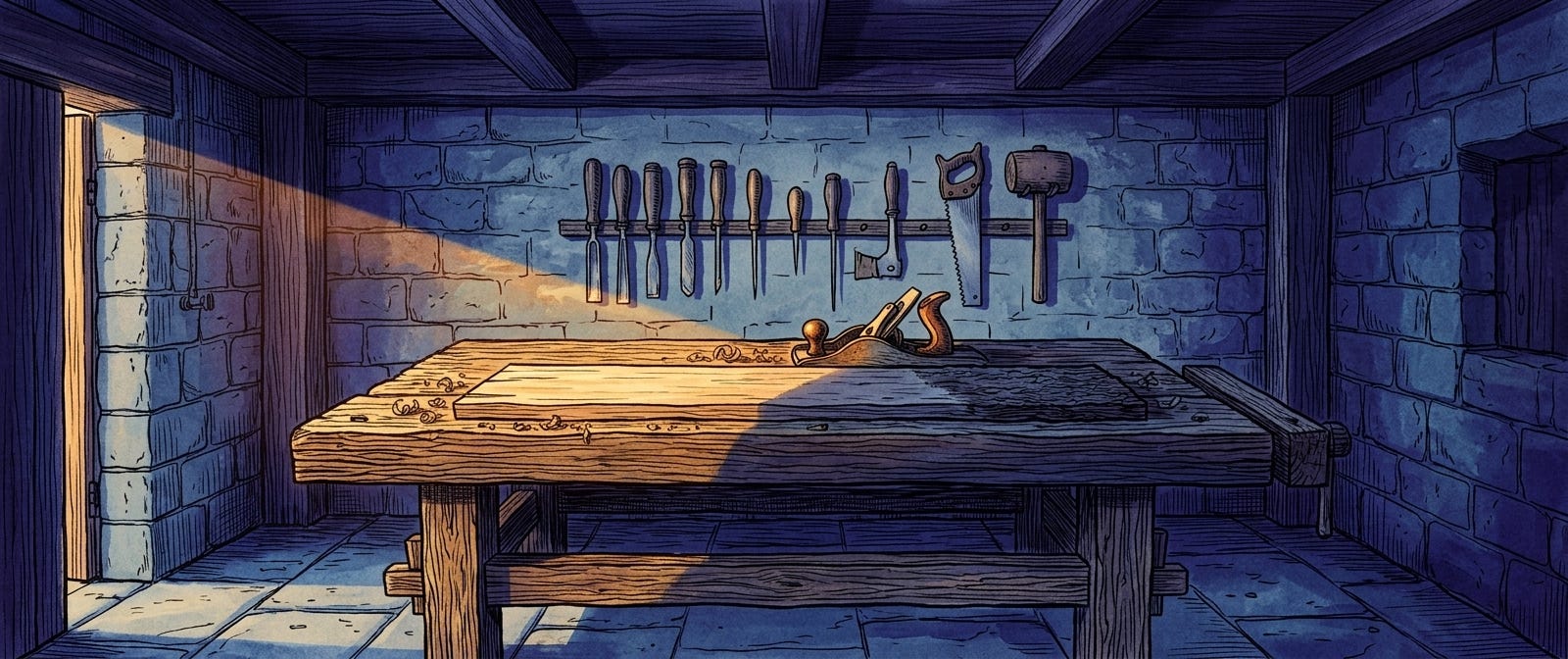
September. Late heat. The vineyards heavy with fruit and the air thick with the smell of crushed grapes from the press down the hill. Yeshua was in the shop, planing cedar boards for a cabinet the Romans had ordered for the new bathhouse. Fourteen now. Almost as tall as Joseph. His fingers knew the work without his mind following.
Outside, the younger children chased each other through the yard. James was supposed to be watching them but had gotten distracted building a cart from scrap wood. Simon was crying about something. Martha had stolen something from Joseph Jr. The usual noise.
The sound of a house that still worked.
Mary was inside with the younger ones. Jude sat on her lap while she mended a tunic, his head against her shoulder.
A normal morning.
The runner appeared in the shop doorway. A young man, breathing hard, sandals caked with road dust. He gripped the doorframe and his knuckles were white and he would not look up.
Yeshua’s hand stopped on the plane.
“Your father,” the runner said. “There’s been an accident.”
The words came in fragments.
Derrick failure. The governor’s new residence at Sepphoris. Joseph had been working the upper scaffolding. The support gave way.
“How bad?”
The runner studied the ground between his feet. “They’re asking for his family.”
Yeshua set the plane down. The cedar board sat half-finished on the bench. He looked at it for a moment. The grain half-exposed, the surface half-smooth.
He left it there.
“Come with me. We have to tell my mother.”
Mary was mending in the back room when they walked in. Jude was beside her on the floor, drawing in the dust with a stick.
She looked up. Saw the runner’s face, then Yeshua’s. Her hand went still on the cloth.
“What happened.”
He told her. The construction site. The fall. The injuries.
“I have to go to him.” Miriam had appeared in the doorway with the instinct of a girl who understood crisis. “I have to be there.”
“I’ll come with you.”
“No. Someone has to stay with the children. James can walk with me. You stay.”
“But I should.”
“Yeshua.” She gripped his arm. Her fingers pressed through the fabric to bone. “If something happens, you need to be here. They need you here.”
She kissed his forehead. Then she was gathering her shawl, calling for James, moving toward the door.
At the threshold she turned.
“Tell him I’m coming.”
She was gone.
He fed the children lunch.
That was the first thing. Simon was hungry. Martha was hungry. Joseph Jr. had skinned his knee and needed it washed and wrapped. Jude stood in the corner of the kitchen and would not eat and would not speak and would not stop watching the door.
He cut bread. Set out olives, dried fish, the last of the morning’s cheese. Made sure each child ate. Cleaned the plates. Swept the floor because the floor needed sweeping and he needed something to do.
“Where’s Ima?”
Simon. Eight years old. Standing in the doorway holding a wooden horse Joseph had carved him.
“She went to see Abba. He got hurt at work.”
“Is he going to be okay?”
Yeshua knelt. Looked his brother in the face.
“I don’t know yet.”
Simon’s lip trembled. His fist tightened around the horse.
“Can I sit with you?”
“Yes.”
Simon climbed onto the bench and pressed himself against Yeshua’s side. He was warm and small and he smelled like dust and olive oil and he did not ask any more questions.
The afternoon stretched. Every sound from the road made Yeshua’s chest seize. A cart rattling past. A donkey. Voices he didn’t recognize. Each time, his whole body went still, listening, waiting, reading the sound for something it would not carry.
He prayed. Not the formal words. Four words, repeated.
Please. Not yet. We need him.
Martha brought him a cup of water. She was nine. Her face was very serious and she said, “Drink this, you’ll feel better,” in exactly Mary’s voice.
He drank. He did not feel better. But he thanked her.
The light moved across the floor of the workshop. The cedar board sat where he’d left it. The plane beside it. Joseph’s tools hung on the wall in the order Joseph kept them, each one in its place, and for a wild moment Yeshua thought if he just kept everything exactly where Joseph left it then Joseph would have to come back, because you don’t leave work half-finished.
He sat on the bench. Simon had fallen asleep against his arm.
The shadows lengthened.
They brought the body at sunset.
A cart. Neighbors walking alongside. Mary and James trailing behind them. James was holding his mother’s arm.
Yeshua met them at the edge of the yard.
He did not need to ask. He could see it in the way the men carried the cart. The careful pace. The cloth draped over a shape that was not moving and would never move again.
Joseph had died before Mary arrived.
Mary reached Yeshua and her legs gave. The sound that came from her chest was not a word. He caught her weight against him. Fourteen years old and the last solid thing she could find.
The children came to the door. Joseph Jr. first, then Martha, then Simon still holding the wooden horse. They stood in a line in the fading light and watched their mother weep in their brother’s arms and none of them understood and all of them knew.
“It’s going to be all right,” Yeshua said.
He held her tighter.
They buried him the next morning.
The whole village came. The chazan spoke the prayers.
Yeshua stood at the grave with his mother and siblings. Eight of them at the graveside. The smallest ones kept looking around, confused by the crying.
James stood beside Yeshua. Twelve years old. His face wet, his lips pressed white. Trying.
When the prayers ended, Yeshua knelt. Placed his palm on the fresh earth. Still warm from the September sun.
He did not speak. He pressed it flat against the dirt the way you press your hand against a door that has just closed.
That night, after the mourners had gone, he sat with his mother in the quiet house. The lamps burned low. The children slept.
“What are we going to do?” Her voice was thin.
He had been turning the numbers all day. Fourteen denarii owed to the wood merchant. The unfinished cabinet for the Romans, half-paid. Three orders in the ledger, Joseph’s handwriting, that nobody would complete at Joseph’s rate. The savings for Jerusalem, for Gamaliel, for the future they had talked about three months ago on the workshop bench when Joseph had smiled the smile that rearranged his face.
The money would feed the children now.
“I’ll take over the shop.”
“You’re fourteen.”
“I know. But I can do the work. He taught me.”
She looked at him. The calluses on his fingers. The width of his shoulders in the lamplight.
“You were meant for more than this,” she said.
“Maybe. Someday.” He took her hand. “Right now there are seven children in this house who need to eat. That’s what matters.”
She cried again. He held her. He had watched Joseph hold her a thousand times.
He went to Sepphoris on the third day after the burial.
Joseph was owed wages. Three months of work on the governor’s residence. The figure was in the workshop ledger, Joseph’s script, exact as everything he did.
The contractor’s name was Ezra. A thick man with soft hands who ran crews he never worked alongside. He received Yeshua in an outer room with a dirt floor and a single chair. He did not offer the second chair.
“I’m here for my father’s wages. Three months. The amount is in his ledger.”
Ezra looked at him. Fourteen. Sawdust still in his hair. Wearing Joseph’s second tunic, too wide in the shoulders.
“Your father’s work was unfinished. The derrick failure set us back weeks. The governor is not pleased.”
“The derrick failure killed my father.”
“An unfortunate accident. For which we share your family’s grief.”
“His wages.”
Ezra leaned back. “I can offer half.”
“The ledger says full.”
“The ledger is not a contract. Your father worked by arrangement. Arrangements can be... renegotiated.”
Yeshua stood very still.
“Sixty percent. Not a denarius less. And I finish the cabinet work myself.”
Ezra studied him. His mouth opened, closed. He glanced at the doorway as if expecting someone older to walk through it.
“Done.”
They did not shake hands.
He took what he could carry.
The months after were a single long day that would not end.
He finished the contracts. Completed what he could. Clients who had wanted Joseph’s work got a boy’s work instead, and some of them said so, and he finished the work anyway. He reorganized the household. James took over the cow. Miriam watched the little ones. Everyone worked.
The hardest moments were the small ones. Reaching for a tool and finding the handle warm from sun, not from Joseph’s grip. Hearing Martha use a phrase Joseph taught her. Passing the flat stone behind the workshop where they used to sit on clear nights, the two of them, watching stars.
Mary moved through the house like someone visiting a place she used to live. She held Jude. She heated broth and let it boil over. She stood in doorways and looked at things she couldn’t name.
He did not push her.
One evening she found him in the workshop, late. The children asleep. A lamp burning low.
“Your father used to talk about you when you weren’t here.”
He looked up from the ledger.
“He’d say, ‘That boy sees things I can’t see.’ He didn’t understand what you were. But he loved you.” She paused. “He said once that he didn’t deserve you. That you were a gift he hadn’t earned.”
Yeshua’s hand stopped on the page.
“He was wrong about that. He earned it. Every single day.”
Mary nodded. Her eyes were bright.
“He would be proud of what you’ve done. The family. The business. All of it.”
“I’m doing what he did.”
“No.” She touched his face. “Your hands look like his now.”
She left him there.
He closed the ledger. Sat in the lamplight. The workshop smelled like cedar and iron.
On clear nights he climbed the ridge.
The same ridge. The same view of the valley and the caravans threading through it and the whole world going somewhere while Nazareth stayed.
He sat where Joseph used to sit. Let his feet hang over the edge.
The plans for Jerusalem were buried with the savings. The education, the scholars, the years of study, the life his father had been building for him since before he was born. All of it folded into bread and oil and roof repairs and a tax assessment that would come due in the spring.
Below him, the house was quiet. Seven children, fed and warm and sleeping because of him.
He was fifteen now.
The stars turned overhead. The same stars Joseph had shown him, naming the constellations, pointing north.
Yeshua sat on the ridge with his feet over the drop and the whole weight of a family on his back.
When the cold came he stood and walked back down the hill, because Ruth would need feeding and the workshop opened at dawn.
<3EKO
Thanks for reading. If you’re new here, welcome. If you’ve been here since the beginning, know that I see you.
If you read Eve last week and haven’t left a review yet, it really helps.
Next up: my eleventh book.
It’s called NEPHILIM: The Genesis Experiment.
I know I just handed you a lot. But I want to share this with you, too. Below are the first four chapters. 100% Free. Just read.
Let me know what you think.


You are a very good writer.
EKO, ever since I began following and supporting you, I have noticed that your articles have been diverging into two distinct types. The mythological storytelling and the analytical. The mythological storytelling completely loses me. From my perspective, please use your unique abilities to analyze the day's key topics and share insights on what matters. Thanks!