
The Cousin
He heard the voice a mile before he saw the water.
It came up out of the valley on the dry wind, one voice, going on and on, the words lost at that distance but the shape of them plain even so, the shape of a man saying a thing he would die saying and knew it. Yeshua came down off the high ground toward it. The track dropped through chalk and thornscrub, switching back on itself, and at each turn the voice was louder and the air was heavier and warmer, the dry desert wind giving over to the wet green smell of a river that had cut down through rock longer than there had been a road to walk to it.
The thing in his chest that had never had a name moved as he walked, the same as it had moved when he was a boy on the ridge. He did not slow for it and did not name it. He only came down toward the place where, for the first time in his life, something out in the dark moved when it moved.
He was not the only one on the track. Others went down ahead of him and behind, a family with a loaded donkey, two young men arguing a passage of scripture line for line, an old woman who stopped often and would not be helped. They had all heard the same thing in their own countries and walked out into this dry one to stand near it. None of them spoke to the dusty traveler keeping their pace. People on the road to a holy man save their words for the holy man.
He came over the last rise and the Jordan was under him.
It was a poor river to look at, brown and slow, narrower than the lake at home, sliding between walls of cane and tamarisk with the heat shaking the air above it. But the people. They were along both banks as far as the bends, more than Nazareth held, more than he had seen gathered for anything that was not a feast, sitting in the thin shade of the cane, standing in clusters, wading to the shallows and back. Cookfires smoked at the edges of it. Children ran the mudflats. A whole ragged town of the seeking had set itself down in the wilderness around one man standing in the water.
He stood midstream, to his knees.
He was burned dark as old harness and gone to bone, the ribs showing, the arms all cord and vein, camel-hair roped at the waist with a leather strap and nothing else on him. His hair and beard had never been cut and the river had not been kind to them. He did not look like a man so much as something the wilderness had grown and then sent down to the water’s edge to say aloud what it had spent forty years telling him in the dry places.
He took them one at a time. A man would wade out to him, and he would set a hand flat between the shoulder blades and a hand on the chest and lay the man back under the brown water and hold him there a beat longer than the man expected, and bring him up streaming. Some came up weeping. Some came up only wet and stood blinking, as though they had expected a thing to happen that had not. He did not mind which. The water was his work, and the saying. What grew in a man after was between the man and the One the wild man kept pointing him past himself toward.
“You brood of vipers.”
The voice had gone to gravel from years of it, and it carried to the back of the crowd anyway. “Who warned you to run from the wrath that is coming? Then run. But bear the fruit of it. Do not stand in my river and tell me Abraham is your father. God can raise sons of Abraham out of these.” He stooped and brought up a fistful of river stones and let them fall back, one and two and three, into the current. “The axe is already at the root of the tree. Not the branch. The root. Every tree that does not bear good fruit is cut down and thrown on the fire.”
A tax man near the front was weeping and not wiping his face. Two soldiers stood at the edge of the cane with their thumbs hooked in their belts and their heads down, like men at a graveside. One of them called out, rough, what they were supposed to do, then. The wild man told him.
The soldier nodded, slow, and that was a thing to see, a soldier taking his orders off a starving man standing in a river.
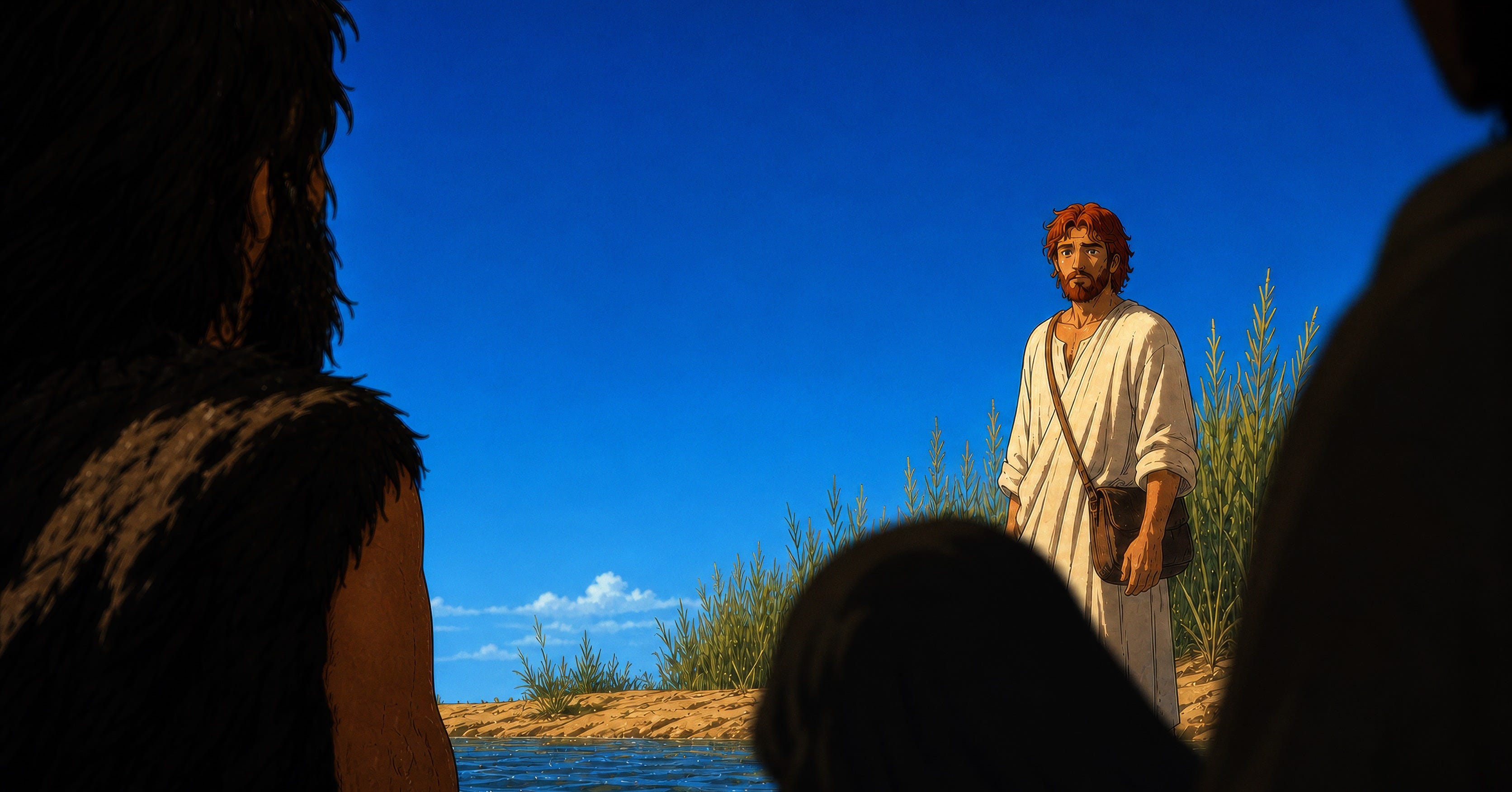
Yeshua came down the bank into the press of them and stopped at the back of it, one more sun-dark traveler with road dust to the knee, the bag on his shoulder he had carried up from Nazareth.
A woman beside him shifted to make him room without looking. A boy shoved past his legs chasing another boy. A man behind him asked him low was this the place, was this the one they had walked for, and he said yes, it was, and the man grunted and craned to see over the heads and forgot him. No one looked twice. No one ever had. He had gone through twenty-eight years as the one the talk went past, the one who took it all in and gave the least back, on the ridge and in the shop and at every rail and fire and sickbed of the road behind him, and he stood in the last hour of that now and let it be what it had always been, because it was almost over and it had been his.
He listened. It was the thing he did better than anyone on that bank, and not one of them knew it. He listened to his cousin’s ruined voice throwing out loud, in fistfuls, to a thousand strangers, the thing that had lived in silence in his own chest for as long as he could remember. The wild man had a word for it. Yeshua had never had the word. He had only ever had the thing. And around him in the heat the men and women stood with their faces open and their mouths a little apart, and some of them felt the pull under the words too, and had walked out into the desert because of it, and had no word for it either, and had come here to borrow this one’s.
The cousin worked his way along toward the near bank, taking them as he came, calling out between, his eyes going over the crowd head by head, a field he meant to harvest, missing none. The eyes came along the bank. They went over the soldiers and the weeping tax man and the families in the cane. They reached the dusty traveler standing quiet at the back of it all.
They stopped.
The voice stopped with them. Mid-word, on a breath already drawn to say the next thing, and the next thing did not come. The wild man stood midstream with the river running off his lifted hands and looked at his cousin across the heads of all those people, and the thing that had passed between the two of them once, a long time ago, when they were boys and neither of them could have told you what it was, came back across the years and the distance, grown now to the full size of the men they had become.
The crowd felt the silence before it understood it. A man who has not stopped talking since first light does not stop. The ones waiting in the water turned first. Then the ones on the bank. A thousand faces came round and followed the wild man’s stare back across themselves to the place it had caught and held, and they found nothing there to catch it. A traveler. Dust on him. A bag on his shoulder. They looked, and they looked at one another, and a low sound of not-understanding moved through them and died.
Yeshua took the bag from his shoulder. The boy’s book was in it, the one he had carried home and not opened and carried here, and he set the bag up on the bank above the waterline, where the river would not reach it, and left it closed.
He came down through the people. They moved aside to let him by without deciding to, opening for a thing they had not been told to honor and honoring it anyway, and closed again behind him. He came out of them onto the open mud at the lip of the water, and there was his cousin a few steps out in the current, waiting, the river breaking pale around his shins and running off his stopped hands.
Neither of them said anything. There was nothing that could be said in front of all these people. He had come down off the high country to take his turn in the water like the tax man and the soldiers before him, and it was his cousin’s hands that would put him under it, and the one true thing could not be said at all, only done, and it had not been done yet.
The river went on as it had since the hills first made it, sliding brown and patient past the two of them and the reeds and the thousand turned faces.
On the bank above the waterline the boy’s book sat closed in the bag where he had set it, the water a stride short of it and going no nearer.
The wild man did not move. The carpenter did not move.
And where the voice had been, the silence spread out over the water and the reeds and the turned faces, and held, and held.
✧
End of Volume Two.
This concludes The Nazarene: Far Country.

If you finished or are reading the book, leave an honest review on Amazon.
Volume Three, Narrow Gate, begins serializing here Friday with “The River.”
Have an amazing week. Know that He loves you.
And I do, too.
Your telling becomes a visualizer. I could clearly see the scene, the people, the the cousin -the wild man as I read. It awakened my own memory as a infant. The water sprinkled on my forehead. I did not know I had that memory. I will say no more.
incredible detail. all in one thought.