The Firstborn
Fifteen. His father dead. His mother in bed. A baby that wouldn’t stop crying.
The labor started before dawn.
Mary called for him. Not the midwife. Not Miriam. Him.
He found her in the back room, both hands white on the bedframe, her shift soaked through. Her face had gone a color he had never seen on a living person.
“It’s coming,” she said. “Too fast.”
He sent James running for the midwife. Sent the younger ones next door. Then it was just the two of them in the room that smelled of sweat and iron and lamp oil.
He boiled water because that was what you did. Found clean cloths. Held her hand and she crushed his fingers and he did not pull away. Between contractions she panted and stared at the ceiling and whispered Joseph’s name.
The midwife arrived in time for the birth itself. But the hours before belonged to Yeshua alone. A fifteen-year-old boy, kneeling on a dirt floor, holding his mother together with his hands.
They named her Ruth.
Small. Red-faced. Furious at the world she had entered. A scream too large for a body that small.
Mary held her for a few minutes. Then she handed her to Yeshua.
“I can’t. Not yet. I’m sorry. I can’t.”
Her fingers uncurled one by one, like she was prying them open herself.
He took the baby. She weighed nothing. She weighed everything.
Mary turned her face to the wall.
He learned to change her. To warm goat’s milk and hold the soaked cloth to her mouth when Mary could not nurse. To walk the length of the house at three in the morning, four in the morning, five, the baby against his shoulder, his feet tracing the same path on the packed earth floor until the crying stopped or the sun came up, whichever happened first.
James watched from the doorway one night. Thirteen years old. Arms crossed.
“Why do you get to be in charge?”
Yeshua kept walking. The baby had finally quieted and any change in rhythm would start her again.
“I’m only two years younger,” James said. “It’s not fair.”
“You’re right. It’s not.”
“Then why?”
“Because Ima asked me. And because I can.”
James stood there. Fists at his sides. Wanting to fight but having no target that would hold still long enough.
“Go to bed, James.”
“You’re not my father.”
Ruth stirred against Yeshua’s neck.
“No,” he said. “I’m not.”
James stood there. Wanting him to say more. Wanting him to say anything that would justify the thing in his chest.
Then he went to bed. Yeshua kept walking.
The prayers became a problem.
Every evening, the family gathered. Joseph had led worship every night of his life and Yeshua would do the same. But the old prayers sat dead in the children’s mouths. Memorized words. Eyes glazed. Minds elsewhere. Simon picking at a scab. Martha braiding her own hair. James staring at the wall with the specific hostility of a boy who has been told to perform grief on a schedule.
“Mean it,” Yeshua told them one evening. “Don’t say the words. Talk to God like you’re actually talking to someone who’s listening.”
“How?” James.
“Just say what you’re feeling. What you want. What you’re thankful for.”
Silence. Then Simon, nine years old, squeezing his eyes shut: “God, please fix my sandal. It has a hole. And make James stop taking my things.”
Martha: “God, bring Abba back.”
The room went still.
Yeshua looked at the ceiling. His throat closed.
“That’s good, Martha. That’s honest. God hears that.”
James said nothing. James would not pray. James sat with his arms crossed and his mouth shut for four nights running and on the fifth night Yeshua did not make him stay.
“What if I give you a way to start? Just the opening. You fill in the rest.”
He thought about it. What would Joseph have said? What did the children need? A frame. A structure. Something to hold the words the way a bowl holds water.
“Our Father,” he said. “Who is in heaven.”
“Which one?” James said from the doorway.
Because the boy meant Joseph. And Yeshua meant the other one. And both of them were right.
Yeshua looked at the ceiling. “The one who stayed.” He looked at James. “And the one who left.”
James studied him. Then sat down.
“Our Father who is in heaven,” Yeshua said again. “Hallowed be your name.”
“What does hallowed mean?” Simon.
“It means sacred. Set apart. It means when you say God’s name, you mean it.”
Simon nodded.
“Your kingdom come.” Yeshua paused. “Your will be done, on earth as it is in heaven.”
“Why do we have to say that?” James. Leaning against the wall now, not sitting, not standing. A boy who wanted to be in the room but would not admit it.
“Because we forget. We think what we want is what matters. And sometimes what matters is bigger than what we want.”
Martha was moving her lips, repeating the words silently. Committing them to memory the way children commit songs.
“Give us this day our daily bread.”
“Forgive us our debts, as we forgive our debtors.”
James’s head came up. Yeshua saw his brother hear it and hold it and say nothing.
“And lead us not into temptation, but deliver us from evil.”
Silence.
“That’s it?” Simon said.
Yeshua nodded.
“That’s not very long.”
“It doesn’t need to be.”
Simon closed his eyes and said the whole thing back, start to finish, with two words wrong and his fists clenched in concentration. Martha whispered it with him. Joseph Jr. mouthed it from the corner. James did not say it aloud. But his lips moved once, at the end, on the word evil, then stopped. He looked at Yeshua. A half-second. The look of a boy checking whether he’d been caught.
Yeshua looked away. Gave him that.
He kept the books. Every denarius tracked. The math never came out right. The orders had slowed after Joseph died. A merchant named Tobias returned a cabinet with the doors rehung and said nothing and Yeshua rehung them again, and the second time was perfect, and Tobias paid half. Clients who wanted the master craftsman’s work found a boy’s work instead, and he finished their work anyway and they paid what they paid.
The savings were gone. The property shares were sold.
One evening, after the children were asleep, he told his mother.
“We need to sell the house Joseph owned on the other side of town. His half of it. That clears the debts and keeps us through winter.”
She looked at him from the far place she’d been living since Joseph died.
“And then?”
“Then I work harder.”
“You’re fifteen.”
“I know.”
She closed her eyes. When she opened them she looked at him. His mother. Here.
“You shouldn’t have to do this.”
“No. But I do.”
The tax collector came in August. A small man with a ledger and a way of looking at things as if measuring what they’d bring. He had heard about Joseph’s death. He stood in the doorway longer than courtesy allowed. His eyes moved through the house before his feet did. The loom. The copper pot. The shelves. The oil lamp. He was pricing the room without putting numbers to anything.
“The assessment is overdue. With penalties.”
Yeshua showed him the accounts. Explained the situation. Asked for time.
“Time costs money.” The man walked in. He reached up and plucked the bottom string of the harp with one finger. The note hung in the room longer than the man’s attention. “That looks valuable.”
“It stays.”
“Everything finds a price eventually.”
“The harp stays.”
The man crossed to the corner. Knelt. Ran his thumb along the lid of the wooden case the way Joseph used to. Yeshua watched the hand. A stranger’s hand on the lid Joseph had oiled every month of Yeshua’s remembered life.
The complete Hebrew scriptures in Greek. The gift from the believers in Egypt, sixteen years ago. For when he’s ready, they had said.
“The scriptures, then. Greek translation. Worth quite a bit.”
Yeshua looked at the case. Joseph had carried it out of Egypt on his back. Had protected it through the years in Nazareth, keeping it oiled, keeping it dry. He had built the case himself. Cedar. Fitted joints. The lid closed without a sound.
“You have until the Sabbath,” the tax collector said. “After that, I take what I can carry.”
He did not close the door behind him.
That night he took the cedar case from its shelf. Ran his thumb along the lid the way Joseph used to. The joints were perfect. No gap. No give. Joseph had built the case himself, and the case was the last thing his hands had made that Yeshua could still touch.
He opened the clasp.
The scrolls smelled like Alexandria. Like oil and harbor salt and the room where strangers had wept over a sleeping child.
He closed it. Carried it through the streets to the synagogue. The case was heavier than he remembered, or he was weaker, or both.
“A maturity offering,” he said. “To the Lord.”
The chazan’s hands trembled when he opened the lid.
“This is... where did your family...”
“It’s what my father would have wanted.”
The chazan looked at him. Yeshua looked at the floor.
Joseph would have wanted him to keep it. To study it. To become the scholar they had dreamed he might be. Joseph had carried this case out of Egypt on his back.
But Joseph was dead. And the tax collector would come back on the Sabbath.
His fifteenth birthday fell on the Sabbath.
In the law, the threshold. A boy became a man. He could read Scripture in public. Could be counted. Could speak.
The chazan had asked him weeks ago: would he lead the service?
He had said yes.
The synagogue was full. The carpenter’s son who had silenced the Temple scholars three years ago. The boy who had held a family together. The young man who had just given away the most valuable thing he owned.
Yeshua stood before them. Thin from a year of hunger. Hands calloused from a year of work. Wearing a tunic Mary had let out twice.
He opened the scroll to Isaiah. Found the passage.
And read.
The spirit of the Lord God is upon me, for the Lord has anointed me; he has sent me to bring good news to the meek, to bind up the brokenhearted, to proclaim liberty to the captives and to set the spiritual prisoners free; to proclaim the year of God’s favor; to comfort all mourners, to give them beauty for ashes, the oil of joy in the place of mourning, a song of praise instead of the spirit of sorrow.
His voice was thinner than he wanted it to be. But it didn’t shake.
Seek good and not evil that you may live, and so the Lord, the God of hosts, shall be with you.
What does the Lord require of you but to deal justly, love mercy, and walk humbly with your God?
He lowered the scroll. Looked out at them.
“This is the word of the Lord.”
And sat down.
The chazan touched the case. “Your father built this.”
“Yes.”
“It will stay here. Until you’re ready.”
People approached him after. Touched his sleeve. Asked for blessings. An old woman wept. A young father asked him to name his son.
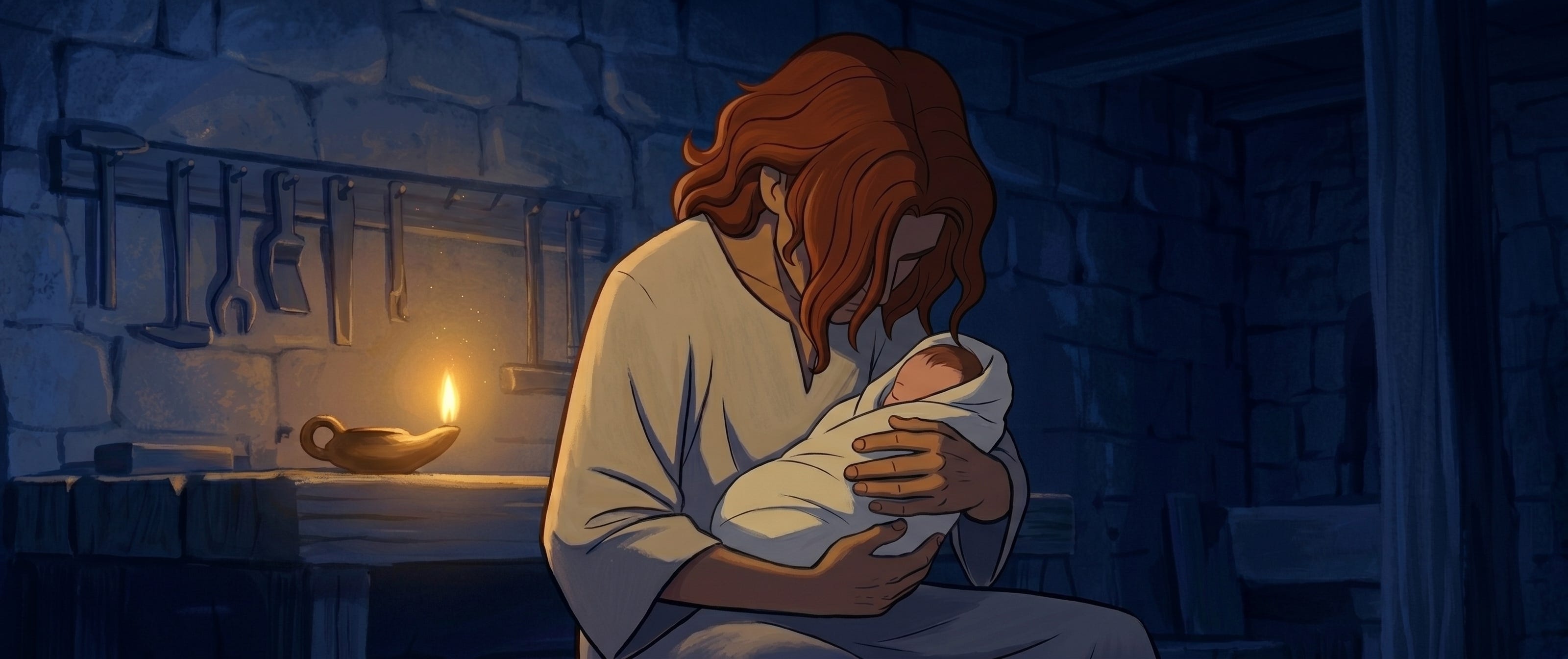
Then he walked home. Changed Ruth’s cloth. Warmed her milk. Sat in the workshop with the baby sleeping against his chest and the smell of cedar in the dark.
He sat with Ruth and listened to her breathe.
The lamp burned down. The workshop went dark.
The tools hung on the wall in the order Joseph had kept them.
<3EKO
One Whale · The Jesus Frequency · The Unsealed Archives
Previously:
Want to support my work? You can always buy me a coffee.
Next episode drops this Sunday.
I love you.


