The General Who Noticed
He had a hearing scheduled for January. He had a ledger inside his jacket. Three weeks before flying home, his driver of five years was reassigned.
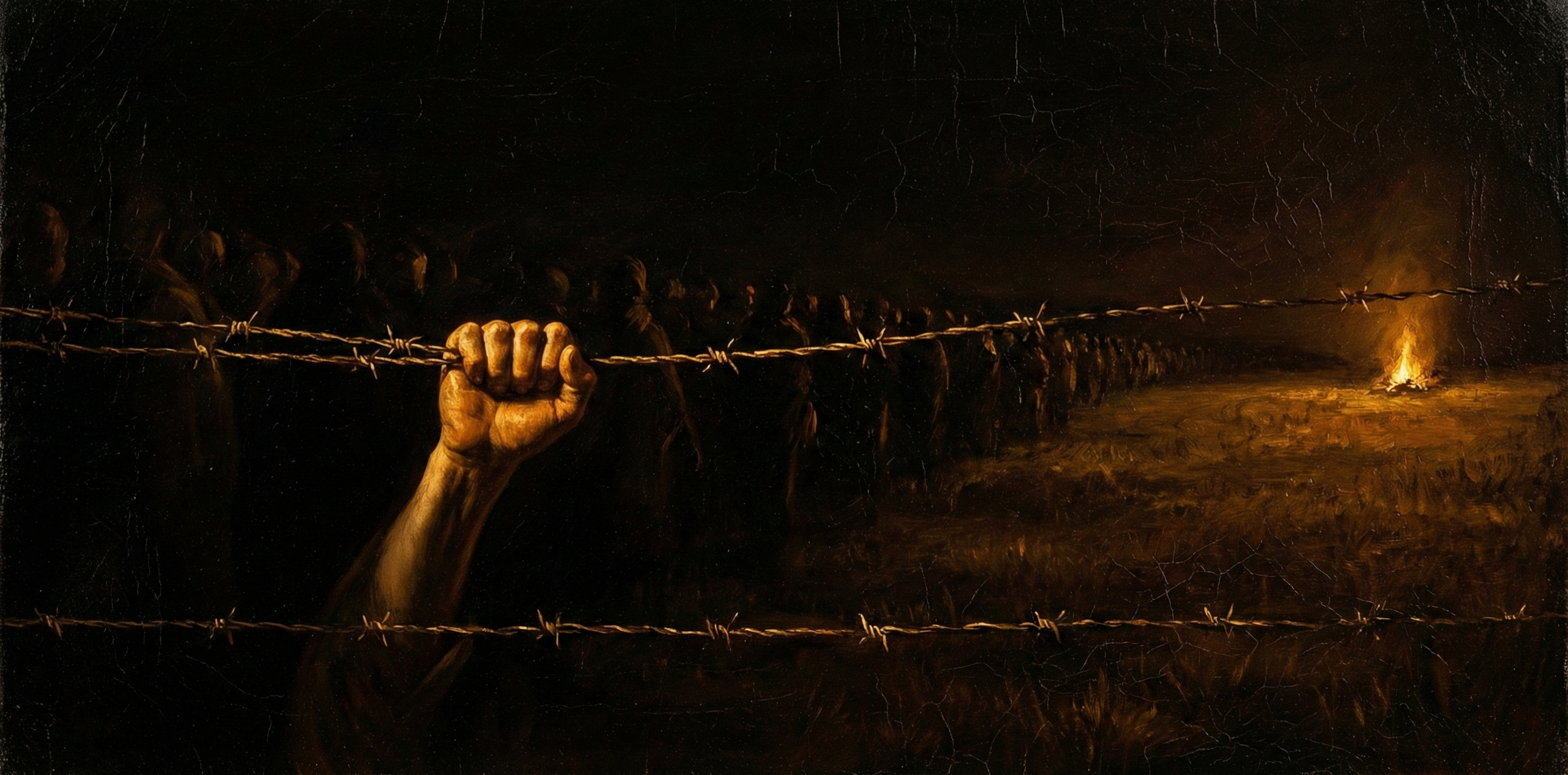
He named the camps. He named the orders. He named the men who gave them.
In the spring of 1945, more than a million German soldiers sat in open fields along the Rhine River.
No shelter. No latrines. No medical care. Rations that didn’t meet the minimum for survival.
The Rhine was right there. They could see it. They were denied water from it.
Eisenhower had reclassified captured German forces as “Disarmed Enemy Forces” (DEF) instead of Prisoners of War. The reclassification voided their Geneva Convention protections. The camps kept no official death toll.
Patton noticed.
He was the first senior American commander to say out loud what was being done and who had ordered it. He put it in writing. He named names. He connected the occupation directives, the Morgenthau Plan, the DEF classification, the dismantlement of German industry, to the apparatus he had watched being assembled in the shadows of the victory.
He knew who wrote those directives.
He knew what they were designed to produce.
He knew where they had come from.
His superiors called it insubordination.
In April 1945, Patton’s forces discovered the Merkers Salt Mine in central Germany. Hundreds of millions in Reichsbank gold. Currency reserves. Looted art stripped from occupied Europe.
The initial inventory was documented. The final accounting, when it came, did not match what went in.
Nobody investigated the gap.
Three weeks before flying home, his regular driver of five years was reassigned without explanation.
A nineteen-year-old Patton had never driven with took the wheel.
He had been in contact with members of Congress. He had a hearing date in January. He was carrying a leather ledger inside his jacket, documented allegations he intended to deliver in Washington.
There was a fourth item he never wrote down. He carried it in his head. About the camps. About the orders. About who gave them.
December 9, 1945. A slow-moving Army truck turned in front of his Cadillac on a clear morning outside Mannheim.
His passenger walked away without a scratch.
Patton’s neck was broken.
Twelve days later, he was dead. No autopsy requested. No investigation opened. The medical records from Heidelberg Army Hospital are still sealed.
In 1979, a former OSS operative named Douglas Bazata gave a statement on the public record.
He had been contracted to ensure Patton never made it to Washington. He described the method. He named the figure. He repeated the account until his death in 1999.
The government did not investigate. The story ran on the wires for one news cycle and disappeared.
What people are calling conspiracy today is the same thing Patton was calling fact in 1945.
The Rhine Meadows camps, the DEF reclassification, the Morgenthau Plan, the stop orders that kept his tanks out of Berlin, the gold discrepancy, the congressional hearing that died with him: all of it is on the record. The confession is on the record.
Everything except the fourth thing. That one he carried in his head.
I wrote the file on the general they couldn’t afford to let talk. The camps. The gold. The stop orders. The driver who was reassigned. The doctor who arrived uninvited. The testimony that was never given.
PATTON: IRON TESTAMENT, File 008 of The Unsealed Archives.
If you prefer the PDF, you can grab it here.
And if you’ve read it (or read the advance preview), one sentence in a review is worth more than anything else I can ask for.
You know the algorithm rewards the living.
I love you.


You may disagree, but sometimes I think that general Patton came back as Donald Trump. That’s why he’s going after his old enemy, the deep state. They even look similar, if you look at some of the pictures of the general.
OSS. Hmmm. Same as it ever was.