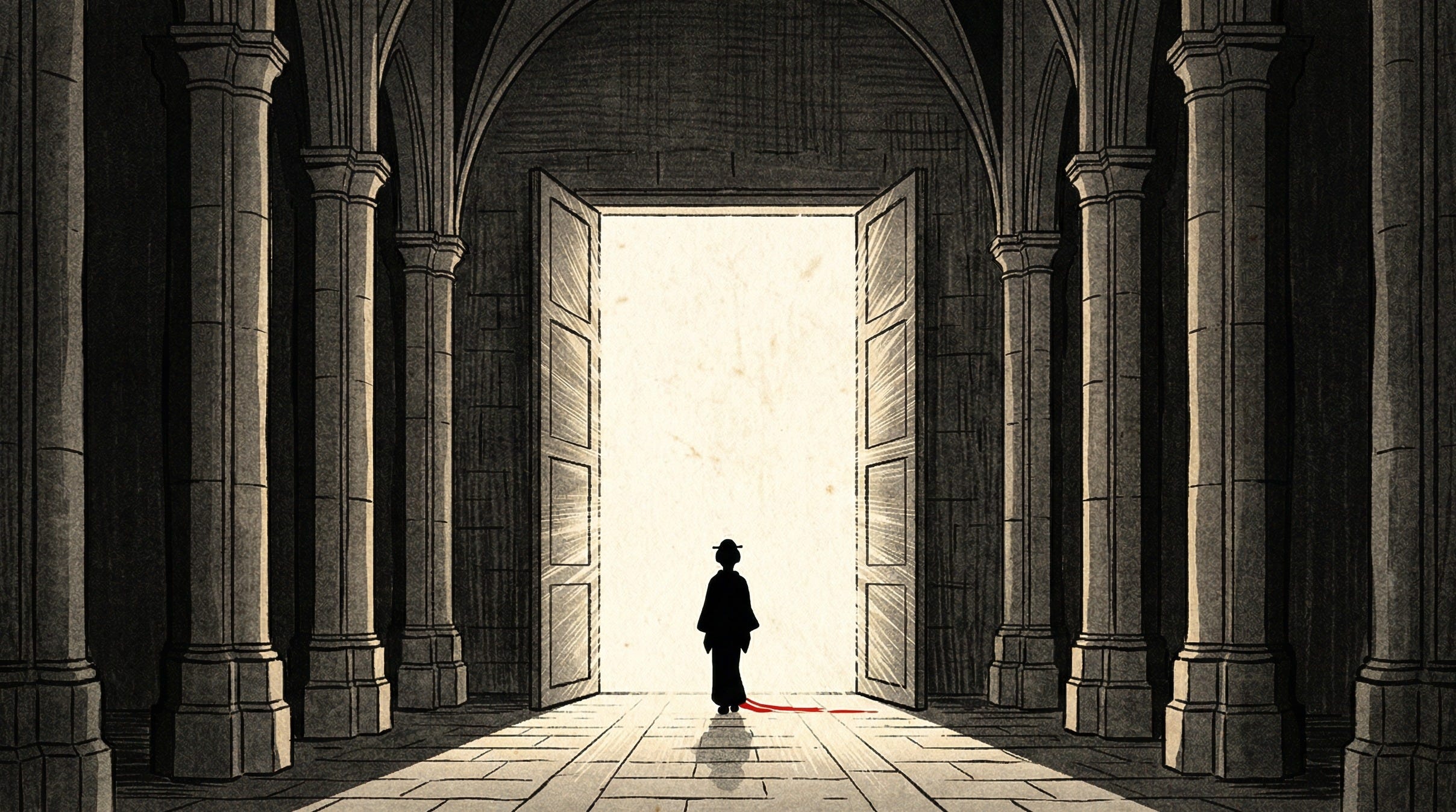
The Hidden Church
Japan’s hidden Christians survived persecution, silence, and the atomic bomb. Then came the hardest test of all.
The church had been open for a month. No one had come.
Ōura Cathedral in Nagasaki was built for the dead, not the living. The French priest Bernard Petitjean had raised it as a memorial to the twenty-six martyrs crucified on a hill above the harbor in 1597. He did not expect a congregation. Christianity in Japan had been extinct for two and a half centuries. Everyone knew this.
Fifteen Japanese villagers from Urakami entered through the front doors. One woman approached Petitjean.
She said: “Your heart and our hearts are the same.”
Then she asked where the statue of Mary was.
Christianity had not been destroyed. It had gone underground. For 250 years, cut off from Rome entirely, Japanese Christians had kept the faith alive in hiding. They called themselves kakure kirishitan. The hidden Christians.
Within days, 30,000 of them came forward across the Nagasaki region.
The Closing
Christianity arrived in Japan in 1549 with the Jesuit missionary Francis Xavier. It took root fast. By 1611 Nagasaki had ten churches, eight parishes, two hospitals. The Portuguese called it the Rome of the East.
The Tokugawa Shogunate saw a foreign religion with foreign loyalties and decided it was a threat. In 1614, all missionaries were expelled. In 1622, fifty-two Christians were publicly executed in Nagasaki in a single day. They called it the Great Martyrdom.
In 1637, after the Shimabara Rebellion, the Shogun declared Japan a chained country. Sakoku. Sealed shut to the outside world.
The government hunted them. Neighbors were paid to inform. Suspected Christians were forced to step on bronze images of Christ and the Virgin.
Refuse, and you burned.
Over the next two and a half centuries, an estimated half a million Christians suffered and died under this system.
But some refused to die and refused to leave. They hid.
The Hiding
Mary became a Buddhist goddess. The Kannon, the bodhisattva of mercy, became a secret vessel for the Virgin. Crosses carved inside wooden bodies. Rosaries folded into the fabric of the robes. A woman kneeling before Kannon in her home was praying to Mary. The authorities saw Buddhism.
The prayers were coded. The orashio were chanted in a mixture of Latin, Portuguese, and Japanese that sounded like Buddhist liturgy. Within a few generations, the Latin had drifted so far from its origin that the chanters no longer knew what the words meant. The words became sounds. The sounds carried what the meaning alone could not.
Baptisms happened in secret. A designated man called the mizukata performed the sacrament. No witnesses beyond the family. No records. No names written down. Rice and sake replaced bread and wine for communion. The priesthood passed through bloodlines. Father to son, generation after generation, because their fathers had done it and their fathers before them.
A visitor named Bastian, possibly Spanish or Portuguese, left behind a liturgical calendar before the closing. A designated keeper called the chōkata maintained it, converted it from solar to lunar, hand-copied it every year, and passed the duty to his son. If one keeper died without an heir, the liturgical memory of the community died with him. It survived anyway. For a quarter millennium.
Hidden shrines were built into furniture. Wooden prayer panels that looked like ordinary cabinets opened to reveal Christian images and vials of holy water.
The Bomb
Even after the rediscovery in 1865, the Japanese government persecuted them again. The Urakami Fourth Persecution ran from 1867 to 1873. 3,600 villagers arrested. More than 650 died in exile. Only Western diplomatic pressure forced the government to stop.
The hidden Christians rebuilt. They spent thirty years constructing St. Mary’s Cathedral in Urakami. When the twin bell towers were completed in 1925, it was the largest cathedral in East Asia.
August 9, 1945. The atomic bomb detonated 500 meters from the cathedral. The blast obliterated it. Of the 12,000 Christians living in Urakami, 8,500 were killed. Two priests and several dozen parishioners were inside the cathedral at 11:02 that morning, hearing confessions in preparation for the Feast of the Assumption of Mary.
What 250 years of persecution could not destroy, the bomb did in nine seconds. The city with the deepest Christian roots in Japan was chosen because of its port and its industry. The targeting was military. The irony was not.
The Split
When the ban on Christianity was finally lifted in 1873, most hidden Christians rejoined the Catholic Church. But a significant number refused. They became the Hanare Kirishitan. The separated Christians. Their faith had drifted during the long isolation into something Rome no longer recognized. Buddhist elements woven into the liturgy. Shinto practices layered over Christian sacrament. Forms that had no name in any catechism and no precedent in Rome.
Rome said come home. They said they already were.
The question has no clean answer. Did all those years of isolation preserve the essential thing about faith, the part that lives in practice and devotion and the body’s memory of prayer? Or had the faith drifted so far from its source that what they were practicing was no longer Christianity at all? Rome has been arguing about it for a hundred years. The old women on the islands never asked the question.
The Last Sound
On Ikitsuki Island, off the western coast of Nagasaki Prefecture, four men can still chant the orashio. The prayers their ancestors learned from Portuguese missionaries 400 years ago. Thirty prayers over thirty minutes, palms together, sometimes making the sign of the cross. They finish with three sung prayers: the Laudate Dominum, the Nunc Dimittis, and the O Gloriosa Domina. The Latin has drifted into Japanese syllables that no longer map to their original words.
One of the four is Masatsugu Tanimoto. He is 68 years old. A farmer. He wants his son to learn the chants. The island is depopulating. The young leave for the cities. Funerals are no longer held at homes. The orashio are performed two or three times a year now.
“At this point, I’m afraid we are going to be the last ones,” Tanimoto has said.
But he added: “I hope it will go on at least in my family. That’s my tiny glimmer of hope.”
<3 EKO
Thank you for reading.
All of my books can be downloaded for free here.
If you want to support the mission you can always buy me a coffee.
I love you.


🙏🙏
This is fascinating. Arigatou.
*********
From me to you. Unfinished but inspired.
https://substack.com/@crisbeau/note/p-192471530?r=bmv5f&utm_medium=ios&utm_source=notes-share-action