The Man Who Named the Thieves
America is pulling the phones out of its schools. The diagram of the theft was published in German in 1973, and we never read it.
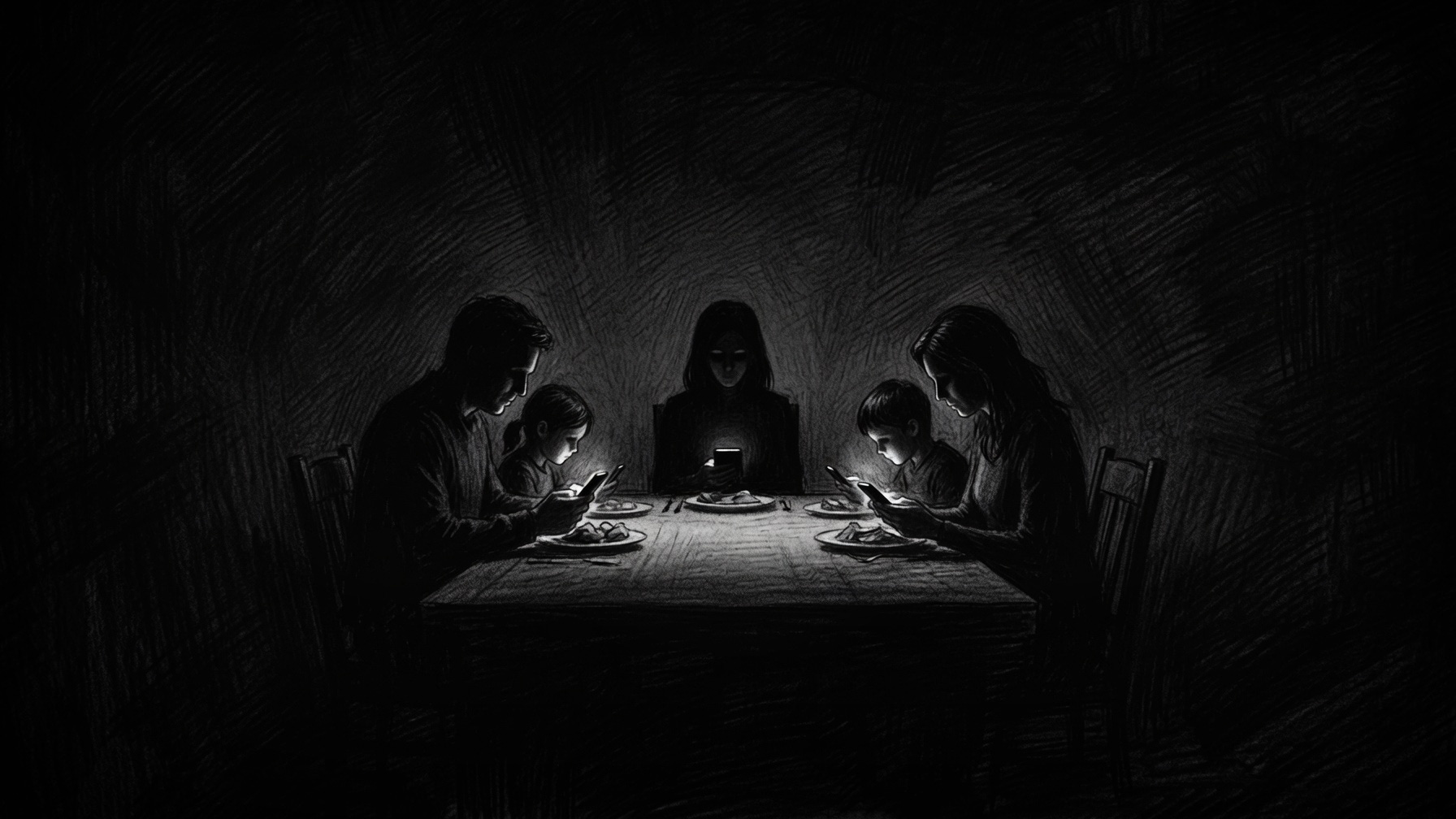
They are taking the phones away.
This month the Pennsylvania House voted to require every district in the state to restrict them. Illinois sent its own bill to the governor’s desk the same weekend. Indiana and Kansas went dark this year, bell to bell. Just a few years ago a parent who said this out loud at a school board meeting was booed. Now it is statute.
The bans are right and overdue. The parents who dragged the schools to them have been right for years. None of it touches the thing underneath.
The phone was never the thing. The phone is a collection point. What’s being collected is time, and the collection has been running a lot longer than the technology, and the most precise diagram of it ever drawn was published in German in 1973 by a man whose name you’ve never heard.
You know one thing he made. You don’t know you know it.
The Bank
The book is called Momo. A girl with no parents and no shoes lives in a ruined amphitheater at the edge of a city. She owns nothing. Her single gift is that she listens, with everything she has, no reply loading, all the way to the end. People walk out to the ruins angry, or finished, or lost, and they sit with her, and because one human being is fully present to them for one full hour they hear themselves think for the first time in years.
They remember what they meant. They walk home.
Then the men in gray arrive.
Gray suits, gray hats, gray faces, gray cigars.
They come from the Timesavings Bank, and they go door to door with a pitch. You are wasting your life. Every hour you spend on your mother, a friend, a meal, a customer, a song, is an hour thrown away. Deposit it with us instead. Cut the visit short. Skip the conversation. Save now, live later.
People sign. And no one remembers signing. The contract erases itself, and the surgeon general’s office is fumbling toward the same thing fifty-three years late. The saver only notices that his days got faster and colder, that his work lost its joy and his street lost its neighbors, and he cannot say when, and he assumes this is what adulthood is.
The deposited hours go nowhere. The men in gray smoke them. Dried human hours, rolled into gray cigars. The thieves have no time of their own. They run entirely on what we hand over.
Deep in the book, Ende shows where time actually comes from. Momo is taken to the house at the edge of everything, to a keeper called Master Hora, and he shows her the source: every human hour grows out of a single human heart, and it opens like a flower, an hour-lily, and no two that have ever bloomed are alike. Time is life, he wrote, and life lives in the heart. The gray men can grow nothing. Every cigar is a cut flower, dried.
He published that in 1973. No computer, no smartphone, no social feed, no algorithm, no notification engineered by a behavioral team to fire at the hour your willpower runs lowest. He watched postwar Germany trade its evenings for productivity and he understood the trade was neither new nor German. The theft is voluntary, the pitch is always efficiency, and what’s taken is the present moment, the only place a human being is ever alive.
The Structure
The appetite is older than the instrument. There has always been a structure that feeds on human attention, and it changes costume every century. The mill took the hours of the body. The ledger took the hours of the mind. The feed takes the rest. The costume is whatever the era will tolerate. The hunger underneath never varies, and it has one target: get the human out of the present tense. Keep her in the saved-up future or the replayed past, anywhere but here, because here is where everything that matters transacts. Love, attention, prayer, the still hour where a person hears what she is for.
A structure like that burns the hours as fuel, but the product it is after is your absence.
Ende drew it gray for a reason. Gray is what’s left when presence drains out of a life. Every reader who has watched a dinner table of bowed heads lit blue from below has seen the color he meant.
The Record
Where does a children’s author learn to see that?
The century taught him with documents.
In 1936 the Reich banned his father. Edgar Ende was a Munich surrealist, a painter of dream-pictures. His work was classified as degenerate, he was barred from exhibiting, and finally barred from even buying paint. The machine looked at the man’s imagination and ruled it a threat to public order.
His son grew up in that apartment. Then the bombs came to Munich, burning most of the paintings the world would never get to see.
What the father took to the grave, the son spent a career answering. In 1960 he published his first novel, about an orphan on an island too small to hold him, and it made him famous in his own language. In 1973, Momo.
In 1979 he published The Neverending Story and it sat at the top of the German charts for three years. A boy steals a book and reads his way inside it, into a world called Fantastica that is being eaten, province by province, by the Nothing, a void that spreads wherever human beings stop imagining. Every piece of the world it swallows turns up in ours as a lie.
Hollywood bought it. In 1984 Ende saw what they had built and went to war. He called the film kitsch and commerce. He sued to halt it or change the title, lost, and made them remove his name from the credits. The film made its money. Generations of American children grew up holding the shell of the warning with the warning scooped out.
A story about the Nothing eating imagination, processed into product.
I was one of those children. We had it at home and I wore out the DVD. The attic scene was my whole ambition for years. I learned his name decades later. The delay was the surgery working.
This spring my daughter’s ballet class danced their recital piece to the theme song, the one everybody knows. Her costume borrows from a film I haven’t let her watch. Too dark for her, and I would know. She has no idea where the melody comes from. Neither did I.
He died in 1995. America knows him as one movie he disowned. In Germany, Italy, Japan, and Korea he’s one of the great seers of the century. The Japanese took him so completely that he married his Japanese translator, Mariko Sato, in 1989. Two years ago his estate announced the book will be rebuilt as a new multi-film franchise. The machine is now reassembling the host body. Watch what survives the surgery.
The Letter
Munich, 1945. Michael Ende is fifteen when his call-up papers arrive. Three boys from his class have already been sent and killed on their first day. The order tells him to report and hold the city to the end.
He tears the letter up. He finds the men trying to surrender Munich before the SS can burn it for honor, and for the last weeks of the war he carries their messages through the collapsing streets. A fifteen-year-old walking past the army he deserted, to keep what was left from going up in flames.
The state that banned his father’s pictures is now demanding his body.
Everything he wrote for the next fifty years is that tear, repeated.
The Circle
Every other figure on my shelf, Lewis, MacDonald, Cash, Dylan, walked some road to Jesus and said so. Ende did not. He was not a Christian. He never claimed to be. He was schooled in Steiner’s mysticism, breathed the German occult air from boyhood, looked east for the rest. He saw the prison with terrible clarity. The question is what cure his cosmos could offer.
Look at the amulet.
AURYN, the talisman at the center of The Neverending Story, the emblem stamped on every edition. Two serpents, one light and one dark, each biting the other’s tail. A loop with no beginning and no end. The book says so itself.
The sign means the neverending, the way a closed circuit means infinity.
On the reverse, an inscription: DO WHAT YOU WISH. The boy who wears it gets every wish granted, and each wish costs him a memory of who he was, and he comes within one wish of erasing himself entirely.
Ende knew what sovereign desire does to a soul with no anchor. He drew the warning and stamped it on a wheel.
The wheel is everywhere in him. The book that ends where it begins. The adult masterpiece he built from his dead father’s surviving paintings and titled Mirror in the Mirror, recursion all the way down. A cosmos that turns and returns and never ends because it never goes anywhere. When his heroes win, the world is restored. Restored, and pointed nowhere. The story just starts over. That is what neverending meant to him. A map of the prison, drawn for children, and a cure shaped like the corridor walked in a circle.
But there is an older claim.
Jesus grew up in an occupied province, a man who also stood in front of an apparatus that wanted him absent, told his friends that his Father’s house had many rooms and that he was going to prepare one. A house with rooms beyond rooms, and a road to it, and the road runs through the door Ende guarded his whole life. The present moment. The listening. The child’s way of being all the way here.
His story doesn’t circle. It climbs. Rooms beyond rooms, and at the top of them a Father who listens the way the girl in the amphitheater listened.
All the way to the end.
The Door
Somewhere tonight a school gym has a locked cabinet full of sealed pouches. Inside them screens are lighting up with notifications nobody can hear.
And somewhere a mother is reading on the machine’s device that eats up her hours. Across the room her son is telling her about a dragon he imagined. The machine’s device pulls at her wrist the way it was built to.
She sets it face down. She turns to her boy.
She does not look away until the dragon is finished.
Somewhere a gray man goes hungry.
<3EKO
P.S. For a while now I have been telling my children a story at bedtime. It started the way most of them do, invented on the spot to get small people to lie still. They kept asking for more of it. So I wrote it down in the mornings.
The Nazarene is my life’s work. This is what I am making next.
There is a girl in it who still hears the voice the cold is trying to silence. A darkness that comes for every light before the name on the door can be read. And a door already carved with the name of the one who listens all the way to the end.
I will start sharing it here this summer. When I do, I will ask the only question that matters.
Would you read it to a child you love?
The Nazarene, Book One is out. The early years gathered and tightened into one volume, with four all-new chapters included. You can read here for free.
The journey I didn’t know I wanted or needed. It has been a gift received with deep gratitude. Thank you EKO
—Barbara D.
If it lands, a review is the only thing that moves it.
Thank you for being here
I love you.
Lineage follows the artists who refused to look away. Previous entries:


![Warner Bros: The Neverending Story [DVD] Warner Bros: The Neverending Story [DVD]](https://substackcdn.com/image/fetch/$s_!Kea4!,w_1456,c_limit,f_auto,q_auto:good,fl_progressive:steep/https%3A%2F%2Fsubstack-post-media.s3.amazonaws.com%2Fpublic%2Fimages%2F25be39ec-7b04-427d-9de0-d34fb7d360c0_2000x2256.jpeg)


I love reading deep thinkers! Thank you EKO!