The Missing Pages of Mary Magdalene
The first witness to the resurrection was a woman with seven demons. What he told her alone has never been recovered.
They called it seven demons. She called it seven walls around a fire that would not go out.
The physicians did. The synagogue women who stepped back three paces when she passed in the market. Her father, who stopped knocking on the locked door after the first week but never stopped standing outside it.
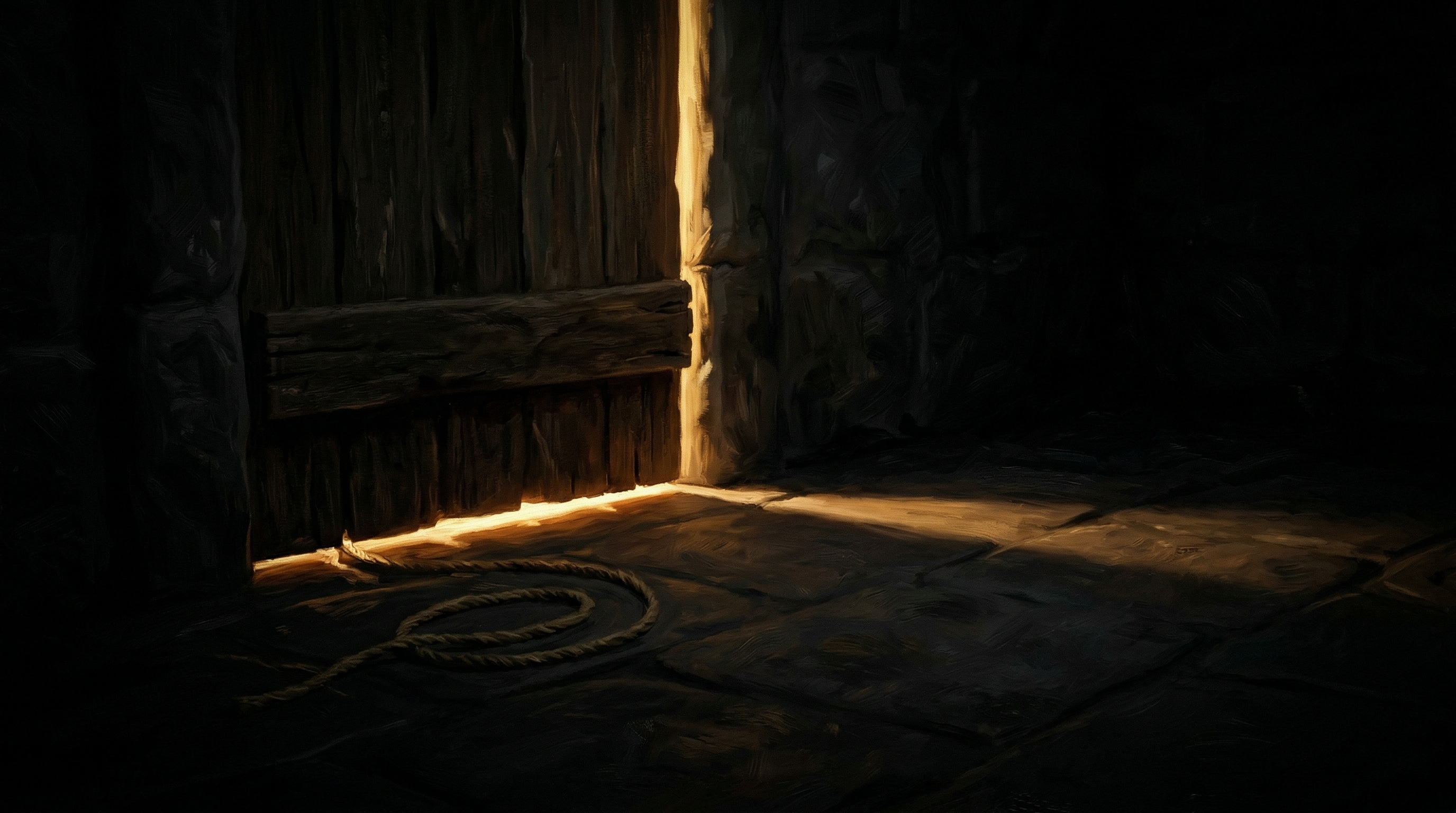
She could hear him through the gap at the bottom of the door. The footsteps: the rhythm of a man who has a destination but is slowing himself before he reaches it. And the other sound. The small dry sound of the length of cord he carried from the harbor, the one he used to measure the girth of a bale of cloth or the depth of a net, tying and untying it against his left palm while he stood outside her door.
He never knocked.
She filed it. Proof that someone was still outside the door, still coming, still present. She could not receive it directly. She filed it.
There were seven of them. She counted them in the dark.
The one who endured. The one who left. The one who raged. The one who numbed. The one who performed. The one who kept the fire. The one who forgot.
Seven walls around one flame.
He came back.
That was the first surprise. The merchants came once. The physicians until paid. He came back.
She was at the well before the other women. He was already there. Sitting on the edge of the stone casing. A man who had been waiting but was not impatient. Had separated the two entirely.
“Miriam.”
“You know me.”
“Yes.”
“Then you know what they say.”
“I know.”
She filled her jar. Her hands were steady. She noted this.
“Seven demons,” she said.
“I know.”
“And?”
“And your name is Miriam.”
She said: “They don’t go. People have tried.”
“I know.”
“Then why are you here?”
He looked at her. Through the history, through the diagnosis, through everything the town had decided about her, at the thing underneath.
“Because you’re still in there,” he said. “Counting.”
Her hand went to her chest. The fire flared.
She had never told anyone about the counting.
She told him about the sixth one. The fire. She had never told anyone. The fire was the most private thing she had, more private than the history, because the history had been witnessed by others and the fire was entirely hers. She still believed. Against everything.
He listened. When she finished he said: “That’s not a fragment. That’s you.”
She was quiet a long time.
“If that one is me,” she said, “what are the other six?”
“The six are what you built around the fire to keep it from going out. The room tried to kill it. You wouldn’t let it die. So you built six walls around it and counted them every night to make sure the walls were holding.”
“The walls held,” she said.
“Yes. They held. And now you don’t need walls. You need a house.”
At the cross, the men ran.
She stayed.
For three hours she was nothing but present. Every fragment had come home. She stood on a hill outside Jerusalem in the middle of the afternoon and she was entirely herself, witnessing an event she could not control or change or fix, and she did not turn away from it.
Three days later. The garden before dawn. The tomb was open. The body was gone.
Two of the disciples came, looked, left.
She stayed.
A voice behind her said: “Woman. Why are you weeping?”
She answered without turning. She thought it was the gardener.
Then he said her name.
One word.
Mary.
She went to the locked room where eleven men were hiding. She told them what she saw.
Andrew said from the back wall: “I do not believe the Savior said this to a woman.”
She looked at him a long moment before she answered. A sentence sat in her throat that would have ended him. She held it.
“You were not in the garden,” she said. “I was.”
She picked up her cloak. She moved to the door.
“I’m going to keep telling this. With you or without you.”
She touched the doorframe on the way out. The wood was warm.
She told the story for sixty years.
The synagogue stone from Magdala was found in 2009, eight feet underground, carved with a menorah that catches the light at a certain angle and seems lit. The pages of the Gospel of Mary describing what he told her alone have never been recovered.
<3EKO
I wrote MAGDALA because the first witness was a woman and the record still has pages missing.
Orthodox Easter is Sunday. This is my gift to you.
The twelfth entry in the Unsealed Archives.
The paperback goes live on Amazon BY Sunday morning, for the person you want to hand it to.
Thanks for reading. I look forward to reading your reactions.
I love you.


looks like the book landed early on Amazon: https://a.co/d/0ibenMRX
The attitude behind “I do not believe the Savior said this to a woman” is still with us and probably always will be. And it’s not the only one. There is so much doubt and suspicion and distrust out there, I’m amazed we can accomplish anything. This is why I have to pray and meditate and do my readings and writing before I go anywhere because I don’t want the attitude and need my shield to guard having a reaction to it. Great story EKO. Thank you. Fire burning