The Signal They Couldn’t Kill
Philip K. Dick wrote one perfect chapter about a plumber, a prisoner, and a transistor radio. It’s been waiting forty years for you to read it.
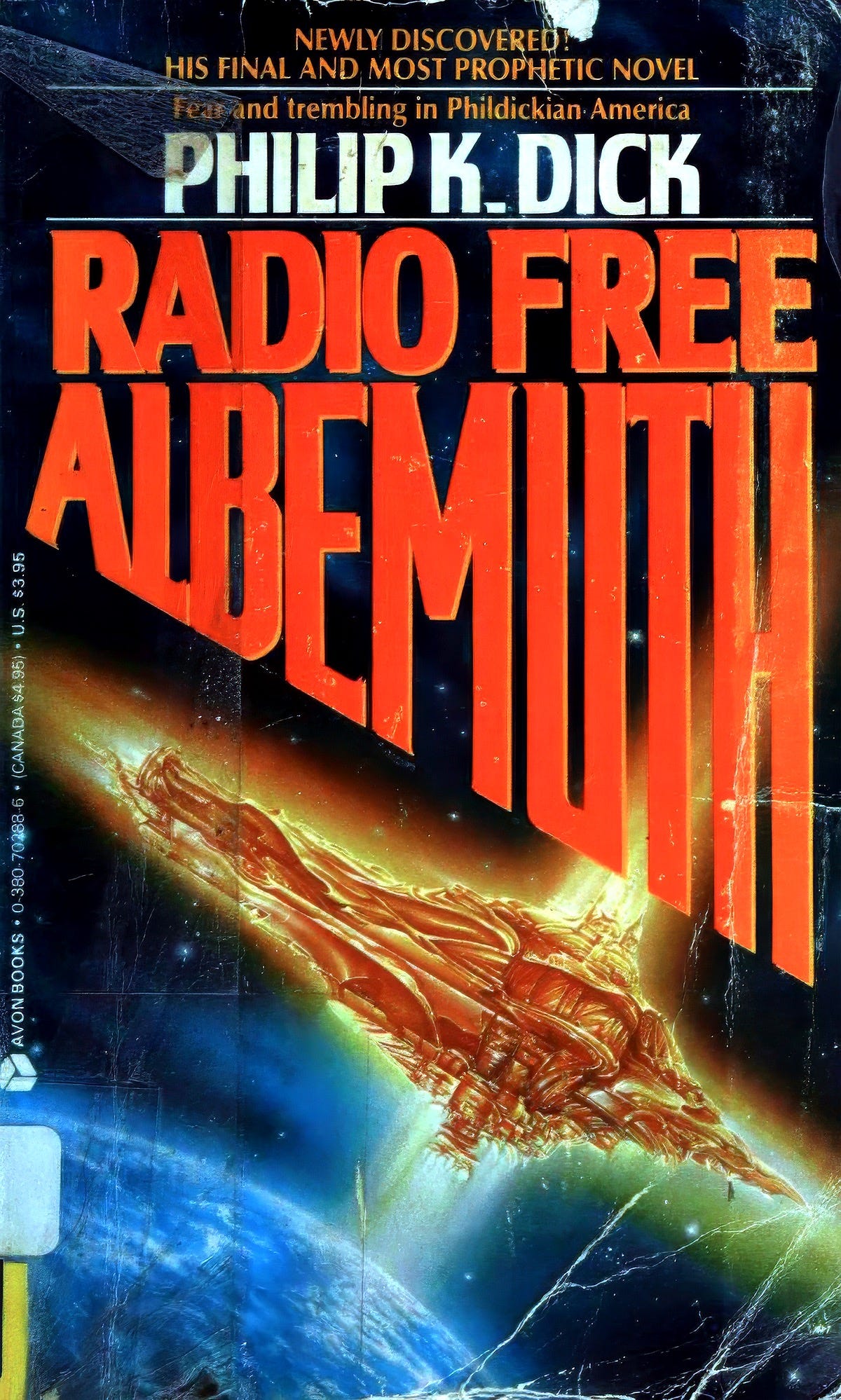
The government sentenced him to fifty years. The signal was already playing on every radio in the country.
That is the last chapter of Radio Free Albemuth, the final novel Philip K. Dick ever wrote. Published three years after his death. The book nobody asked for that says everything the famous ones couldn’t.
Dick wrote it in the late seventies, in a small apartment in Santa Ana, California, broke and half-mad and convinced that a pink beam of light from an orbiting satellite had restructured his mind in March of 1974. He spent the rest of his life trying to figure out what had happened to him. He wrote VALIS. He wrote the Exegesis, eight thousand pages of it, a fever dream of theology and paranoia and pattern recognition that he kept in a filing cabinet and never finished. And before all of that, he wrote Radio Free Albemuth, the raw version, the one without the literary distance, the one where he just told the story straight.
It is the best thing he ever did. And almost nobody has read it.
The plot is simple. In an alternate America ruled by a president named Ferris Fremont (think Obama but permanent), a man named Nicholas Brady begins receiving information from a source he cannot identify. A satellite. An alien intelligence. God. The information is true. It tells him things he could not know. It guides him toward an underground organization called Aramchek, whose members believe that loyalty belongs to the heavenly father and not to any human ruler.
The government finds Nicholas. Spoiler—the government kills him. The government kills the girl he recruited, a singer named Sadassa. The government arrests his best friend Phil, a science fiction writer, and sentences him to fifty years for treason.
But that is not the end of the story.
The last chapter takes place in a prison work yard in east Los Angeles. Phil is breaking concrete in the sun for three cents a day. He has lost everything. His two closest friends are dead. He will not outlive his sentence.
And then a plumber named Leon sits down next to him against a cyclone fence, and they share a bologna sandwich, and the plumber turns out to be an ex-preacher, and the ex-preacher starts decoding the parables of Jesus in a way that makes Phil realize that everything Nicholas told him about the silver egg and the plasmatic entity and the corporate life form was already in the New Testament, hidden in plain sight for two thousand years, waiting for someone to hear it again.
The pearl of great price. The treasure buried in the field. The mustard seed. The wheat grain that falls on the ground and dies. Something small, placed in the ground, which is a secret symbol for the human head.
And Leon says: that’s all real. And it’s not enough. The kingdom has to be here. In this world. Where the suffering is.
And then a kid’s transistor radio starts playing.
And on it is the music. The signal. Already pressed and shipped and climbing the charts. Recorded by a completely different group, guided by the same source, at the same time Nicholas was being killed. The government destroyed the first record label. They were too late for the second. The records were already in the stores.
The last two words of the novel are: The kids.
I adapted the last chapter into a standalone piece. You do not need to have read the book. Everything you need is in the yard.
I have never found a piece of fiction that does what this chapter does. A man who lost everything discovers that the thing he lost had already won, through a channel he wasn’t watching, in a form he didn’t recognize, delivered to a generation that doesn’t know what it’s receiving yet.
Dick died in 1982. He was 53. Radio Free Albemuth was published in 1985. The beam, the satellite, the network, the silver egg placed along the optic conduit to the pineal body. You can read all of that as science fiction. You can read it as the theological autobiography of a man who had a genuine encounter with something he spent eight thousand pages trying to name.
Or you can read it the way the last chapter asks you to.
As a story about two broken men in a yard who discover that the signal cannot be killed, that the kingdom is a frequency, and that the kids are already tuned in.
Here is the yard.
The Yard
Adapted from the final chapter of Radio Free Albemuth by Philip K. Dick
They sentenced me to fifty years without parole. That meant I would be released after I had been dead some good time.
I chose the work gang over solitary. Our job was razing condemned buildings in the slums of east Los Angeles, three cents a day, and at least we stayed in the sun. The alternative was a concrete box where the light never changed and nobody spoke and the government did not have to feed you as often.
My name is Phil. I used to be a writer. My two closest friends are dead. One was named Nicholas. The other was a girl called Sadassa. They belonged to something the state considered dangerous, and the state was right to consider it dangerous, and the state killed them both, and the state is still afraid.
I am not dead. I am not immortal. When I die there will be nothing eternal left of me, no voice whispering from the stars, no signal beaming down through the long frequencies of night. I am just a man breaking concrete in the sun and trying not to remember what they did to a girl I barely knew.
Some days I managed.
“Phil.”
A voice cut through the noise of sledgehammers and the idling diesel of the guard truck.
“Knock off and eat. We got half an hour.”
Leon. My buddy on the line. Former plumber. Arrested for running mimeographed handbills out of his basement on a machine he bought secondhand. The flyers said things about justice and truth and freedom. He had hidden them in his backyard under a rhododendron, inside a coffee can, like a man burying treasure in a field.
We sat together against the cyclone fence. The sandwiches the red-white-and-blue ladies provided were not bad. Bologna and bread. Leon ate with the slow contentment of a man who had stopped expecting anything better and found peace in it.
“You used to be a writer,” he said.
“Yep.”
“Did you belong to Aramchek?”
“No.”
“But you know about it.”
“Two friends of mine belonged.”
“They’re dead?”
“Yes.”
Leon chewed. Swallowed. Looked at me sideways.
“What’s Aramchek teach?”
“I don’t know if it teaches. I know a little about what it believes.”
“Tell me.”
I set down my sandwich. “They believe we shouldn’t give our loyalty to human rulers. That there is a supreme father in the sky, above the stars, who guides us. Our loyalty belongs to him and him alone.”
Leon made a face. “That’s a religious idea. That’s the basis of religion. They been talking about that for five thousand years.”
He was right. I had to admit it.
“Well,” I said. “That’s Aramchek. An organization guided by the supreme heavenly father.”
“You think it’s true? You believe that?”
“Yes.”
“What church do you belong to?”
“None.”
Leon studied me. “You’re a strange guy. Do the Aramchek people hear this supreme father?”
“They did. They will again, someday.”
“Did you ever hear him?”
“No. I wish I had.”
“The Man says they’re subversive. Trying to overthrow Fremont.”
I nodded. “That is true.”
“I wish them luck,” Leon said. Then quieter, leaning in: “I might even be willing to run off some flyers for them.” His voice dropped to a murmur. “I still got some hidden away. Under the rhododendron. In the coffee can. Justice, truth, freedom.” He eyed me. “You interested?”
“Very much.”
“Of course, we got to get out of here first. That’s the hard part. But I’m working on that. I’ll figure it out.” He paused. “You think Aramchek would take me?”
“Yes. I think they have already.”
“How? I never heard any voice.”
“Your own voice,” I said. “Which they have heard through the ages. And are waiting to hear again.”
Leon sat with that a moment. Then he said, very quietly, “Nobody ever said that to me before. Thank you.”
We ate in silence.
“Did believing that, about a heavenly father, get them anywhere?” Leon asked.
“Not in this world, maybe.”
Leon’s face went hard. He set down his sandwich.
“Then I’m going to tell you something you maybe don’t want to hear. If your Aramchek friends were here I’d tell them too. It’s not worth it, Phil. It has to be in this world.” He nodded once, firm. “There has to be something here first. The other world is not enough.”
I had nothing to say. I felt broken and feeble, my arguments used up during all that had happened to me.
“Because,” Leon continued, “this is where the suffering is. This is where the injustice and imprisonment is. Like us, the two of us. We need it here. Now.”
“It may be fine for them,” Leon said, “but what about us?”
I started to answer and stopped. He was right and I knew it.
“I’m sorry,” he said. “I can see you loved your two friends and you miss them, and maybe they’re flying around somewhere in the sky, zipping here and there, happy as spirits. But you and I and three billion other people are not, and until it changes here it won’t be enough, Phil. Not enough. Despite the supreme heavenly father. He has to do something for us here, and that’s the truth. If you believe in the truth... well, Phil, that’s the truth. The harsh, unpleasant truth.”
I sat staring at my hands.
“What’s this,” Leon said after a while, “about the Aramchek people having something resembling a beautiful silver egg placed with care very secretly in each of them? I can even tell you how it enters. Along the optic conduit to the pineal body. By means of radiation, beamed down during the time of the vernal equinox.” He chuckled. “The person feels as if he’s pregnant, even if it’s a man.”
I looked at him. “The egg hatches when they die. It opens and becomes a living plasmatic entity in the atmosphere that never...”
“I know all that,” Leon broke in. “And I know it’s not really an egg. That’s a metaphor. I know more about Aramchek than I admitted. See, Phil, I used to be a preacher.”
“Oh.”
“That beautiful silver egg that’s put into each of them and grows and hatches and guarantees immortality? That’s in the Bible, Phil. Jesus speaks about it several times in different ways. The Master was talking so as to bewilder the multitude. It was only supposed to make sense to his disciples. They guarded the secret carefully because of the Romans.”
“There’s nothing about silver eggs in the New Testament.”
“The pearl,” Leon said. “Of great price. And the treasure which is buried in the field. The man sells everything he has to buy the field. Pearl, treasure, egg, the yeast that leavens the mass all through. Code words for what happened to your two friends.” He was leaning forward now, eyes bright, ancient and clear. “And the mustard seed that’s so tiny but it grows to become a great tree that birds land on. Birds, Phil. In the sky. And in Matthew, the parable about the sower going out to sow... some seeds fell on the edge of the path, some fell on patches of rock, some on thorns, but listen: some fell on rich soil and produced their crop.”
He paused.
“In every case the Master says that’s how the kingdom is. The kingdom which is not of this world.”
I looked at him for a long time.
“Tell me more, preacher Leon.”
“I’m not a preacher any longer. Since it isn’t worth anything. I’ll tell you one further instance, though, where Jesus talks about it. Your friends that died, they are now a single creature together instead of separate. Did they tell you that before they died?”
“Yes. Nicholas had told me about their future merging into a composite life form, all of them in Aramchek. The corporate existence that would come.”
Leon raised a finger. “John, chapter twelve, verse twenty-four. ‘Unless a wheat grain falls on the ground and dies, it remains only a single grain. But if it dies, it yields up a rich harvest.’ And: ‘Anyone who loves his life loses it; anyone who hates his life in this world will keep it for the eternal life.’ See? In each case something small. A treasure. A mustard seed. The sower sowing seeds in rich soil. A grain of wheat. Something is placed in the ground. Which is a secret symbol for the human head. The brain. The mind. And it grows there until it hatches, or sprouts, or is dug up, or it leavens the whole mass, and then it brings eternal life. The kingdom which no one can see.”
“All the parables have to be decoded, then?”
“Yes. The Master says he’s speaking cryptically so the outsiders won’t understand. Matthew thirteen, twelve.”
“And you know what he said is true.”
“Yes.”
“And yet you still...”
“Still I say,” Leon said, “that hating this world and forgetting this world is not enough. The work must be done here. Let me ask you this.” He gazed at me with those ancient eyes. “Where did the Master teach? Where did he do his work?”
“Here in this world.”
“You see, then,” Leon said, and returned to his bologna sandwich.
Beyond the rusty cyclone fence, a group of schoolchildren were staring at us with a mixture of fascination and fear.
Leon noticed them first.
“Hey, kids!” he yelled. “Don’t you ever wind up like us. Do everything you’re told, you hear?”
The kids continued to stare.
One of them, an older boy, had a portable transistor radio. I could hear rock music blaring from its tiny speaker. The announcer, a local Los Angeles DJ, was babbling about the next cut, the latest release, already a bullet on the charts, from a rock group called Alexander Hamilton, the San Francisco performers who were number one these days.
The music started.
Leon turned to stare at me with disgust.
I said, “That’s it.”
“That’s what?”
“They got another record company to press it.” I was calculating, my heart moving faster than my thoughts. “And it’s already out, it’s already a hit. So...” It must have been at virtually the same time. As one group was preparing its tape, another group, guided by the same signal from the same source, prepared another.
Nicholas’s efforts had served as a diversion. All of it. While they were killing him, and Sadassa, and imprisoning me, the hottest rock group in the country was recording the same material at a different studio. The government had moved against the record label too late. The records were pressed. The records were shipped. And some of them, for a time at least, played.
The government had moved too late.
“Did you hear that?” I said.
“That garbage,” Leon said. “I never listen to AM radio. At home, before they arrested me, I had a big quad set, worth maybe three thousand dollars. That stuff is for kids. They like it.”
The kids continued to stare at us. At the two political prisoners, old men to them, worn and dirty and defeated, eating their lunches in silence.
The transistor radio continued to play. Even more loudly.
And, in the wind, I could hear others starting up everywhere.
By the kids, I thought.
The kids.
<3 EKO
I wrote about Dick and the pink beam last year.
I love you.


I live for my adult kids but give them the space to choose for themselves what to believe is the truth. They know I hold God as my highest authority.
I love your finds. We are all truly one, just trying to find those who see it already.