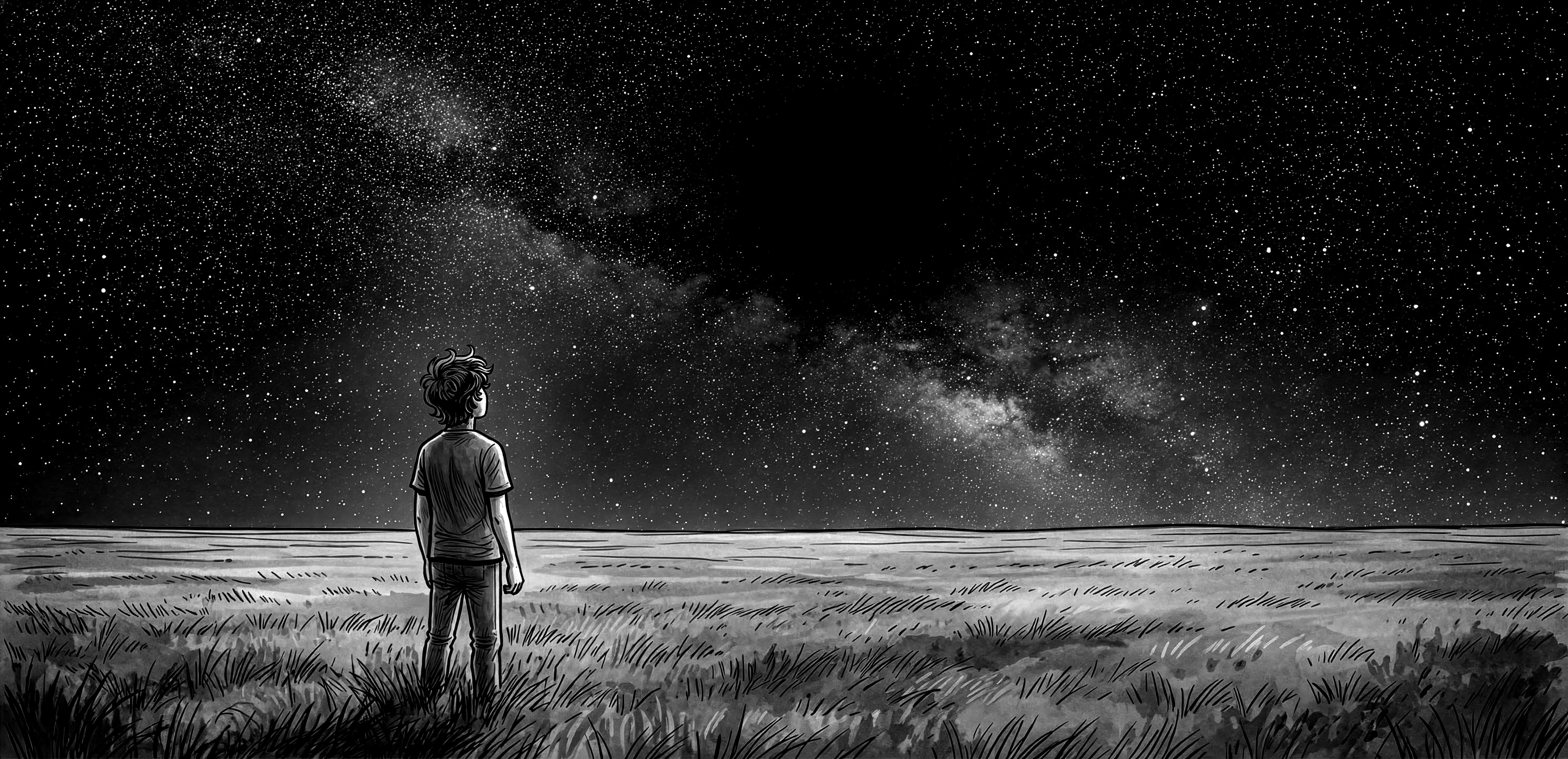
The Silent Planet
The quarantine is lifting. Here is the blueprint.
THE SILENCE
You look at the stars and feel homesick.
Not for anywhere you’ve been. For somewhere you can’t name. A frequency just outside hearing. A memory that doesn’t belong to your life.
C.S. Lewis couldn’t shake this feeling either. In 1938, while the world prepared for war, he started writing a story he couldn’t fully explain. A man gets kidnapped and taken to Mars. What he finds there undoes everything he thought he knew.
The planet isn’t dead. It’s alive. Inhabited by creatures who never fell, governed by an intelligence in communion with the rest of the cosmos. They have no word for war. They find the concept difficult to grasp. When the protagonist tries to explain Earth’s history, they listen with the confusion of doctors examining a patient who keeps stabbing himself and can’t say why.
They worship the same God we do.
Lewis called him Maleldil. The Father of all worlds. The unfallen Martians pray to the same source we do. They’re our older siblings. Same family. Same father. They just never ran away from home.
They have a word for our planet: Thulcandra. The Silent Planet.
Earth, in Lewis’s telling, was cut off. Our planetary administrator rebelled. The quarantine went up. The rest of the heavens continued in communion, in worship, in contact, in relationship with the Father, while we spun in the dark, deaf and mute, convinced our silence was the universe’s natural state.
Lewis wrote the third book in 1945. The war was ending. The battle moves to Earth. The protagonist discovers that the old Arthurian legends were garbled transmissions of a real cosmic situation. Merlin returns. Angels descend. The quarantine shows cracks.
Lewis never wrote a fourth book. Maybe he said what he could say. Maybe the rest was ours to live.
THE WOUND
What does a quarantined planet look like from the inside?
It looks like history.
The same patterns repeating across millennia. Empires rising, conquering, rotting, collapsing. Liberators becoming tyrants. Revolutions devouring their children. The beautiful dream curdling into the familiar nightmare, again and again, with such regularity that we’ve convinced ourselves this is just how things work. Human nature. The way of the world.
What if it’s just the nature of quarantine?
Cut off from the source. Running on corrupted software. Every attempt at building something good gets infiltrated by the same pattern. The rebellion’s signature. The worm in the code.
The Anti-Federalists saw it coming before the ink dried. Men like Brutus warned that the Constitution contained the seeds of its own corruption.
They were mocked as paranoid. But they were right about everything.
Two hundred and fifty years into this experiment and their predictions read like prophecy. The capture is total. The branches are theater. The founders built for a virtuous people and a virtuous people never showed up.
Or showed up and got ground down by a system that selects against virtue.
This is what quarantine looks like. A closed loop. A wheel that feels like progress but goes nowhere. The same prison with different wallpaper every few decades.
THE NEIGHBORING PLANET
Lewis imagined Mars. He imagined Venus. He saw us the way an unfallen world might see us.
Let’s continue his experiment.
Picture a neighboring planet. Similar to ours. Similar struggles. But somewhere in their history, they made a different choice. Maybe they never rebelled. Maybe they rebelled and found their way back faster.
Their current system is young by cosmic standards. A couple hundred years into this particular arrangement. But they’ve discovered some things. And if we could sit with them and ask how they structure a civilization that doesn’t eat itself, here’s what they might say.
On Family
They might tell us that the family is the basic unit of everything. Not as a slogan politicians invoke while going home to their third divorce, but as the actual operating system of society.
On their world, parents hold final authority over the formation of their children. The state cannot override them. The architecture won’t allow it. There are standards, expectations, accountability—but it flows upward from families to communities, not downward from bureaucracies into homes.
When a parent fails, they answer to extended kin and neighbors long before any official body gets involved. When a parent succeeds, they’ve done the most important work the civilization recognizes.
We might ask why. They might say: because no institution can love a child. Because character is forged in the intimacy of daily life. Because outsourcing the formation of souls to strangers with credentials creates a civilization of strangers.
On Voting
They might tell us that political voice is weighted.
Everyone starts with a baseline for showing up. But from there, you earn more weight through what you contribute.
Weight for age, if you’ve stayed engaged. Weight for parenting—specifically, for raising children who themselves become contributors. Weight for education—not credentials, but demonstrated wisdom. Weight for service.
We might ask if this is elitist. They might laugh and say that pretending every opinion is equally informed is the real elitism—it flatters the powerful who benefit from an easily manipulated public while guaranteeing that wisdom never reaches the levers.
On Wealth
They might tell us that wealth has a ceiling.
The profit motive drives the early stages of enterprise. Competition generates surplus. The engine needs fuel. They’re not naive about incentives.
But beyond a certain threshold, accumulation converts automatically into contribution. You can’t hoard past a certain point because the social architecture won’t hold it. The wealth flows back outward or it stagnates. Hoarding becomes embarrassing. Like a grown man still bragging about his high school trophies while his peers are funding libraries.
The most successful compete to fund public works. The game at the highest levels isn’t who can keep the most. It’s who can give most effectively.
On Trust
They might tell us that their information systems have memory.
When trust is actual currency, deception becomes a losing strategy. Your record follows you. What you said thirty years ago is still attached to your name.
We might ask about their politicians. They might look confused and ask why anyone would trust a leader who lies. On their world, get caught in deception once and your public weight drops. Your voice shrinks. The math simply doesn’t favor dishonesty over time.
They’re still figuring things out. But they’re building in the light. They never lost the signal. They never forgot whose children they are.
AMERICA
We’re 250 years into our experiment. A blink, cosmically.
The founders built for a people capable of self-governance. They knew the machinery would become a weapon if the people operating it lost their virtue. They launched the experiment anyway. Hoping we’d grow into it.
Stephen Miller posted something the other day that stuck with me. A young man who watched the Wright brothers take flight lived to watch Americans walk on the moon. One lifetime. Kitty Hawk to the Sea of Tranquility.
So why does the future feel like something to survive instead of something to build? Why does the world feel smaller instead of larger?
We had the potential. We had the resources. What we didn’t have was a social architecture that could resist capture. The system selected against virtue, and virtue lost.
Maybe the quarantine theory is right. Maybe we never had a fair chance.
But something is shifting.
THE CRACK
The narratives that held for decades are breaking.
The patches aren’t holding. The fact-checkers have lost their power. The experts have burned their credibility. The institutions are eating themselves in public, on camera, in real time.
You can feel it. The floor is moving. The panic is visible now. The desperation in the narratives. The wars and rumors of wars. Blackpillers crying, “it’s over!”
Something is shifting at a level below the news, below the politics.
The quarantine is cracking.
The sealed room is finally getting air. Frequencies that were blocked are starting to get through. The chaos is the passage.
THE SIGNAL
If the quarantine lifts, it doesn’t mean we escape Earth. It means Earth rejoins.
The silence ends. The signal that was always broadcasting finally gets through. The same Father the unfallen worlds pray to. The same source the founders tried to encode. The same voice that speaks in the silence.
It never stopped. We just couldn’t hear it over the noise of the ward.
The noise is louder now than it’s ever been. That’s what noise does when it’s dying. It peaks before it breaks. It throws everything it has at maintaining the separation. It needs your attention. It needs your fear. It needs you watching the screen, feeding the algorithm, believing the theater is real.
The war is real. But it’s not the one on the screen.
The war is for your attention. Your awareness. Your soul’s alignment. The rebellion needs you plugged into the static. The Father just needs you to turn around.
Turn inward.
THE DOOR
The door isn’t just for escape. It’s for building.
When you find that connection, you don’t become passive. You become capable. Capable of discernment. Capable of building things that don’t get captured. Capable of raising children who see through the theater before they’re five years old.
The neighboring planet didn’t build their civilization through policy. They built it through transformed people raising transformed children across generations. The architecture came later. The inner work came first.
This is why the Machine fights so hard to keep you externalized. Looking at screens. Consuming outrage. Waiting for a leader to save you. As long as your attention points outward, you’re manageable. The moment it turns inward, you become dangerous.
The door opens both ways. Inward to the source. Outward to the work.
THE BEGINNING
Tomorrow night at midnight America turns 250.
The silent planet is learning to sing.
I don’t know what that looks like. I don’t know if it takes ten years or a hundred. I don’t know what breaks, what survives, what gets built in the clearing.
But I know what it depends on.
It’s up to you. You reading this right now. Your choices, your attention, your willingness to turn around when everything is engineered to keep you looking at the screen.
It’s up to all of us together. Nodes finding each other. The conversations in spaces the algorithm can’t reach. The quiet work that doesn’t make headlines.
It’s up to our children. The ones who see through the theater faster than we ever did. The ones carrying messages in frequencies the Empire forgot to jam.
It’s up to their children. And theirs. The long game. The generational project. The patient work of building something that doesn’t eat itself.
The signal is getting through. I see it in the comments. I even see it on Tiktok. In the exhaustion with the game. In the hunger for something real.
The machine needs you to believe you’re alone. That it’s over. That the awakening is small, fragile, easily crushed.
But you’re not alone. The awakening isn’t small. The storm isn’t something to survive. It’s something to walk into.
The founders’ experiment may have failed. The Constitution may have been captured from the start. But we’re still here. The signal is still broadcasting. The blueprint still exists. The door is still open.
Go find the others. Build the nodes. Plant what you can in the clearing.
Our 250th year begins. Here’s to the next 250.
The world as we know it is ending. But it’s the beginning of everything to come.
<3EKO
Thank you for reading and sharing, and for being with me here this year.
I have eight new books + a video channel ready for our 250th Anniversary.
If you would like to support me directly, you can always buy me a coffee.
Thank you.
I love you.
Happy new year.
Read Part I: Eyes Open in the Dark
Read Part II: The Dissolution


Fear not for the Lord is with you. I have no social media or television. Thank you Eko for the email format. I left California 8 years ago for a tiny town in Idaho. You would never know there was chaos. I walk many mikes everyday. I look to the heavens and pray. God is all around.
Bless you EKO.
It was fun to see this arrive in my email as am currently reading for the first time, Lewis's "space trilogy". I'm a couple chapters into That Hideous Strength.
I like this piece of yours (as I do most of your writing) except for the "wealth" subsection.
Accumulating wealth is accumulating capital, and that's what drives further improvements in production for the benefit of all the rest of us.
Yes, it's fine if a rich person spends money on philanthropy and "public works", but it's even better if they pour that wealth back into the economy in the form of capital investment. Building a library or a public park is fine. It benefits some. But putting capital to work in a successful business benefits many many more people.
The "Scrooge McDuck" image is a silly fiction. Almost nobody "hoards" wealth, and most productive people don't live in the kind of opulence that they could. First of all, that's not usually how productive people operate. And secondly, how many yachts can a guy water-ski behind anyway.
When we look at rich people and calculate their wealth, realize that the vast majority of their wealth is held in the form of stock in companies that they consider productive.
(Except for cronies of course, who got rich via government intervention in markets.)