The Sky is Not Emtpy
The man who wrote Narnia spent three books telling you why it only feels that way. Almost nobody read them.
Everybody knows the wardrobe.
The lion, the lamppost, the four kids, the snow. C.S. Lewis sold something north of a hundred million copies, and two generations grew up inside that world without ever being told it was about anything.
The same man wrote a trilogy for adults. He published the first in 1938. Those are the ones that matter, and those are the ones nobody reads.
He wasn’t a novelist by trade. He was a medievalist, an Oxford man who spent his life inside old texts, and he had a standing argument with the century he was born into. He and Tolkien made a deal over beer: one would write a story about traveling through time, the other through space, and both would smuggle the old truth back into a world that had decided it was childish. Tolkien never finished his. Lewis finished all three.
What he buried in them is one thing, told three ways. It reads like science fiction. It’s the oldest thing we have, and it’s about you.
The Silent Planet
In the first book a philologist named Ransom gets taken off a country road by two men who need a body. One is a physicist with a cosmic ideology. The other is a businessman in it for the money. They put him in a ship and take him up, and on the way up the first lie of the modern world falls off in his hands.
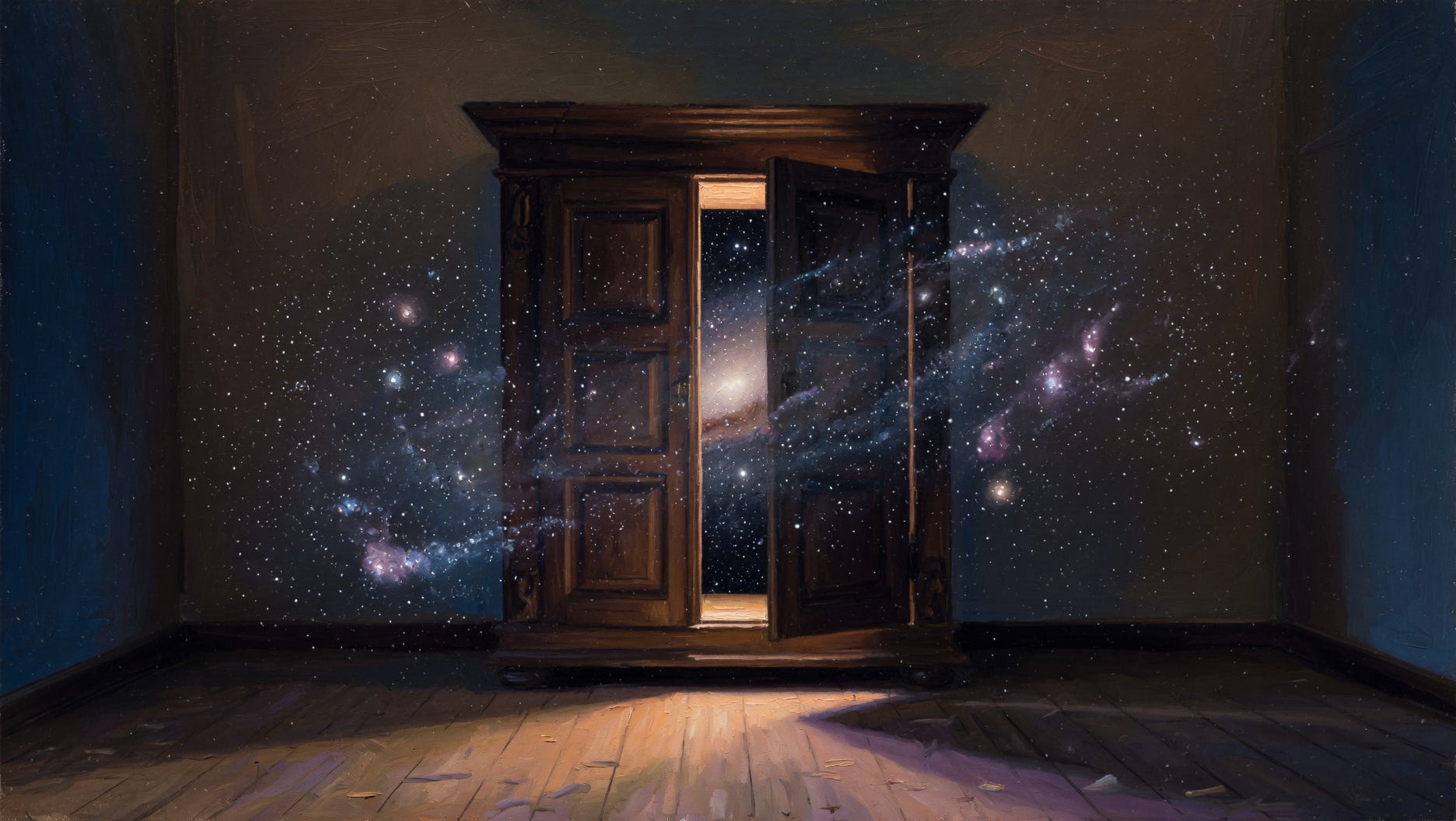
He had been taught what we were all taught. Space is black, cold, empty, dead. The sky is a vacuum and we are a wet accident at the bottom of it. He braces for that nothing. What he finds instead is light. A heavens so full and so alive he stops being able to call it space at all. Lewis gives it a name. Deep Heaven. A plenum. Crowded. Ordered. Singing.
Then Ransom learns the second thing.
Every world out there has a name for our world, and we are the only ones who don’t know what we’re called. They call Earth the silent planet. Silent because it is the one world you cannot reach, the one that went dark, the one that was sealed off from all the rest. Long before any human history, the intelligence set over this planet rose against the order above it, made war, lost, and was bound. The connection that tied this world to the living rest of the universe was cut. We went quiet because we were quarantined.
War in heaven. An angel who would not serve. A prince of this world, thrown down, still loose, still working. A garden, a sealing, a long exile under a sky that stopped answering. Lewis invented none of it. He read it in the old texts and decided the modern world had traded all of it for “we are alone on a dead rock” without ever checking whether the trade was true.
The sky only sounds empty from inside the one cell that had its line cut.
The Garden That Held
The second book sends Ransom to a young world that hasn’t fallen yet. A new Eden, a new first woman, one rule she’s been asked to keep, and everything else on the whole world is hers.
The physicist comes back. Except by now there isn’t much physicist left in him. Something older is wearing him like a coat. And it goes to work on her, not with a fruit but with a conversation.
It doesn’t tell her to break the rule. It asks her about the rule. Why this one law. Have you wondered. Don’t you find it strange that he’d give you a whole world and fence off one field. It tells her she’s already grown, already wise, that a grown person would test a boundary instead of obeying it like a child. Every move is a reframe, and none of it is a lie you could catch. Each step is almost true. The almost is the hook.
Ransom argues back, and by the second day he’s sick, because he can see he’s losing, and that the losing is built into the shape of it. The thing isn’t trying to win any exchange. It’s trying to keep the conversation open, because as long as it runs, the floor keeps moving. You cannot out-argue something whose whole goal is to keep you arguing.
So he does the unthinkable thing for a man of books. He stands up and fights it with his hands. It costs him a wound that never closes, and the world stays whole. Paradise, for once, not lost.
You know this argument. You’re in it. It’s the voice that says the limit is the enemy, that the rule is a cage and the one who set it is holding out on you, that you’d finally be yourself if you stopped holding the one thing back and claimed it. It doesn’t arrive as a devil with a fruit. It arrives as a reframe, reasonable, almost true, patient enough to wait years for the single yes that opens the door.
It has been run three times that we know of. Once in our garden, and it won, and everything you call normal is downstream of that win. Once on Lewis’s second world, and it lost. The third time is the one that matters, and it comes later.
The Machine and the Kitchen
The last book doesn’t go to space at all. It stays here.
An outfit called the N.I.C.E., the National Institute of Coordinated Experiments, a fusion of science and state and press and police, sets out to take the human race in hand for its own good. Free man from his body, his soil, his God, his limits. It speaks the language of progress the entire way down. Lewis published it in 1945, and two years earlier he’d put the same warning in plain prose, a small hard book called The Abolition of Man: a civilization that sets out to conquer nature won’t stop at the weather and the seed. It turns the same tools on human nature, and at the end of that road a few men hold the power to make all the rest of us into whatever they decide.
He was describing the thing being built right now. Man is a stage to be transcended. The body is a limit to be edited out. Death is an engineering problem. The species has to escape this planet and seed itself across the stars, and any single person, any law, any old loyalty that slows the destiny down is sentiment, and sentiment is weakness. They say it on stages now, to applause. The same hunger that cut the line the first time, this time in a lab coat.
The Institute isn’t the frightening part. How it fills its chairs is.
The book follows a young academic named Mark. He isn’t evil. He just wants, more than anything, to be inside. In the room where the real talk happens, on the right side of the invisible line between the people who count and the people who get managed. The Institute reads that hunger like a label and reels him in on it. Not with money. Not with force. With proximity. With the daily sense that he’s almost in, that one more yes will do it.
You’re never recruited by the horror. You’re recruited by the circle.
Mark signs the report he doesn’t believe. Says nothing in the meeting where the bad thing happens. He never once feels himself cross a line. He just keeps moving it, because the people on the far side are the people he wants to stand near. That isn’t a 1945 problem. It’s how the apparatus staffs itself in every generation, this one included. It doesn’t need monsters. It needs men who’d rather be inside than clean.
And the men who think they run the Institute don’t run it. There’s a thing in the building they keep alive and treat as their oracle, and they’re certain they command it. They have it backwards. They built a tool to master the world and became the tool. The people most certain they’re the masters are the ones most completely used.
It isn’t stormed, or out-argued, or beaten by a bigger machine. The title comes from an old line about the Tower of Babel, and the Institute falls the way Babel fell. At its own banquet, at the peak of its confidence, its language comes apart. Men open their mouths to give orders and produce noise. Every tower built to reach up and remake heaven comes down the same way, by its own confusion of tongues.
And the war, for all of it, comes down to one man remembering who he is and walking home to his wife. Mark gets loose of the ring and goes back to Jane. Orwell ends in defeat. Huxley ends in despair. Lewis ends his in a kitchen. The kingdom is the kitchen on the hill, not the banquet hall in the city, and it always was.
The third time is the one that matters.
Two thousand years ago, in a desert on this planet, a man who hadn’t eaten in forty days got the same offer the woman got, broken into three. Turn these stones to bread. Take all the kingdoms. Throw yourself off the height and make them watch. The same voice. The same almost-true. The same patient insistence that the limit is beneath him.
He said no. Three times.
In the one place the no had never held, on the planet that lost this fight at the start, a man stood inside the same argument that emptied Eden and didn’t move.
The heavens were never empty.
Neither were you.
That’s the line coming back on.
<3 EKO
I’ve been out sailing the last few days. Docked now, heading home later this week, back online Monday. Handed out a few copies of After Jesus to sailors I’ve met at the marina. Pick it up in paperback if you haven’t already.
Next week the big one drops: volume one of The Nazarene series, every episode gathered and refined into a single book on the early years of Jesus, with four all-new chapters.
Want an early look before it’s out? Just let me know.
As always, everything is free at books.ekolovesyou.com.
I love you.


Earth was made by an angry and jealous demiurge, the son of the head strong Sophia who had no husband. Sophia is of the Pleroma, the fullness of space and unbounded eternity. God of genesis is demiurge. We have sparks of the Pleroma in us, but many of us depress to jealous demiurge who formed flesh from mud rather than merge with the Pleroma.