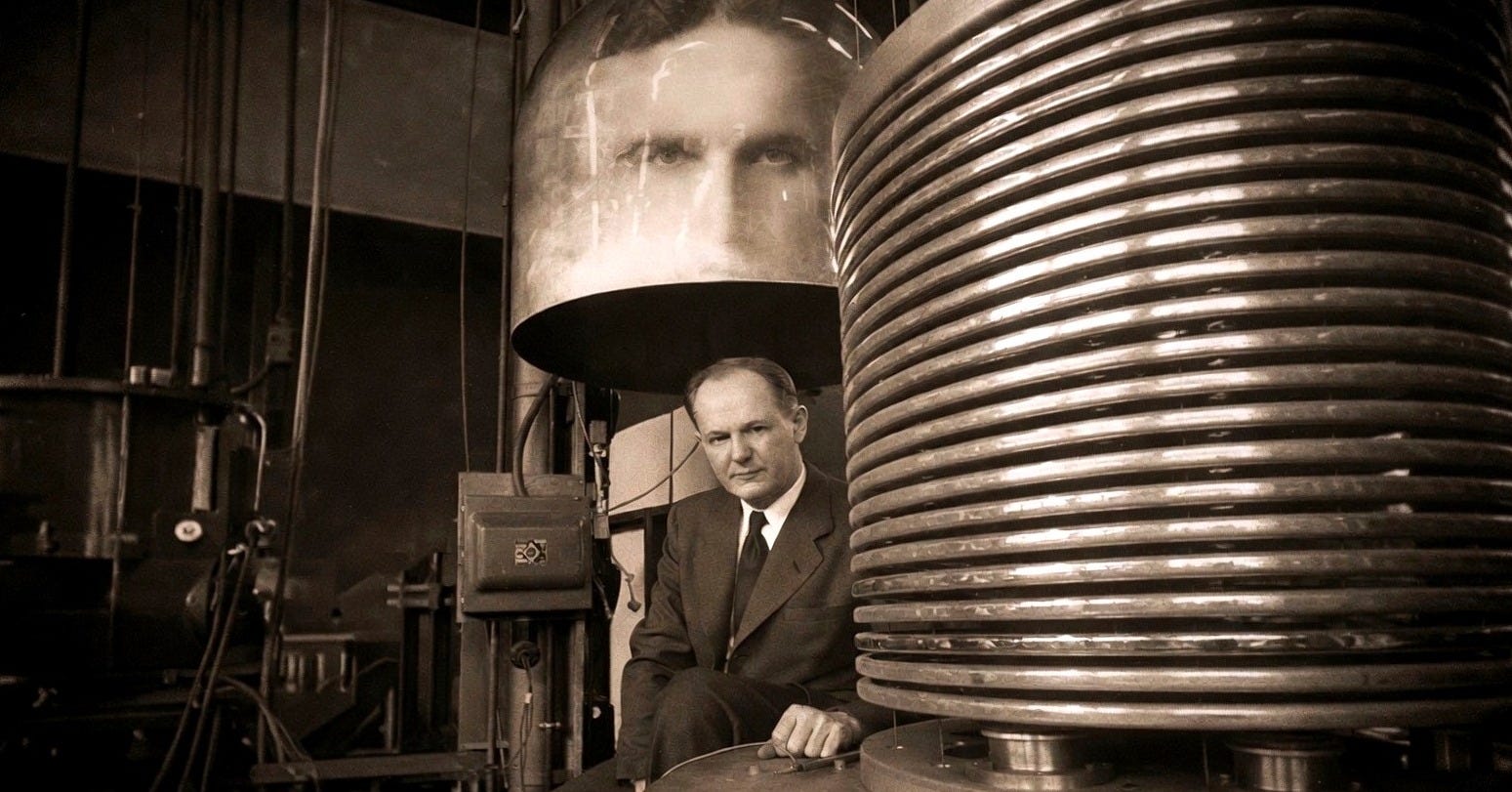
A physicist named Trump spent three days alone with everything Nikola Tesla ever wrote, and told the government there was nothing there.
This was January 1943.
Tesla had died a few days earlier, alone, in a hotel room on the thirty-third floor, and the government wanted to know whether the dead man’s papers were a weapon. They sent an MIT physicist with the right clearance and calm hands. His name was John G. Trump. He opened eighty trunks in three days, signed a report that said there was nothing of military value in any of it, and went home to his family in Queens.
A few years later a certain nephew of his was born. You know his name.
82 years later his nephew continues to sit in the White House, and his admin just took a stake in the company Nikola Tesla tore up a contract to save.
If you spend any time down here, you already know the Trump part. It has been circling for years, and POTUS himself mentions it. So set it down. Two men named Trump touching one story is the shallow end of this. What they touched is the deep end, and it did not start with either of them.
The story is running everywhere with the numbers attached. A fleet of new reactors, public money and private money braided together, built to feed the electricity the AI machines are going to eat. The name on the paperwork is Westinghouse. The same Westinghouse. The one George Westinghouse ran when he bet his company on a Serbian immigrant’s motor, and won, and then nearly drowned in what he owed the man who built it.
You are being invited to argue about the numbers. Whether the reactors come in on time. Whether the AI is worth the watts. Whether this is a boom or a bubble. That argument is a curtain. The thing behind it was settled a long time ago, on a beach on the north shore of Long Island, when a man in a dark coat looked at the most important machine of the century and asked one question.
Every empire keeps a department for this.
There is a job older than any company and older than any government. The job is to stand between a person and a thing that person needs, and to build a place to charge them for it. Water. Salt. Grain. Fire. The road. The men who hold that job do not invent anything and do not build anything. They arrive after the thing is built, with a clipboard and a question, and the question never changes. Where do we put the meter.
They are very good at their work. They are patient. They will wait a hundred years if they have to.
Tesla handed the world a thing they could not meter.
In 1888 he signed his alternating current patents over to Westinghouse at two dollars and fifty cents per horsepower of capacity sold. The grid was about to cover a continent. Held to term, that contract would have made him one of the richest men in the country. By 1897 the royalties were compounding faster than the company could carry, and Westinghouse came to him and said, plainly, that the company would not survive them. Tesla picked up the contract, held it at both edges, and tore it into four pieces. Take it, he said. The gift matters more. He walked away from the fortune so the current would reach the cities.
Then he built the tower.
Wardenclyffe was the most dangerous thing he ever made, and the danger had nothing to do with the voltage. The tower was built to broadcast power through the Earth itself, through the planet’s own resonance, free to anyone standing anywhere with a wire, a ground, and the frequency. He had the physics. He had the land. He had Morgan’s money. And three weeks after the financiers reviewed the plans, a man in a dark coat came out to the property, went through the drawings, and asked the question that ends every story like this one.
Where can I put the meter.
There is no meter for the sky. You cannot bill the ionosphere. Tesla could not answer, because the honest answer killed the project and he would not tell the other one. The letters from Morgan’s office stopped. The money evaporated. The tower stood empty on the shore for fourteen years, and then a salvage crew dynamited it for scrap. He read about it in a newspaper. The free thing was refused. Not because it did not work. Because it worked, and no one could stand at the door of it holding a clipboard.
The meter always comes back.
The current he gave away built the companies. The companies metered it, billed it, owned it, and ran the twentieth century on it while the man who invented it moved from hotel to cheaper hotel and died owing for the room. Most people know some version of that half.
The newer half is still being written. The company he saved by tearing up the contract is the same company the government just moved into, to build the reactors that will power the machines teaching themselves to think. The wire is being laid again. The same name is over the door. And the question in the dark coat, the one there was no answer for in 1901, has a very clean answer now. You put the meter on the reactor. You put it on the data center. You put it on the intelligence itself.
The meter always comes back for what was given away free. That is not a complaint. It is closer to a law. You do not fix a law by getting angry at it. You fix your position relative to it. You notice who is holding the clipboard, you notice what they are metering, and you remember that once, on a beach on Long Island, a man was handed the whole thing for nothing, and the only reason you never got it was that no one could figure out where to stand to charge you.
What the report left out.
John G. Trump spent three days with the most complete record of electrical genius the century produced, and wrote three pages that said, in effect, nothing to see here. Every word of it was technically true. And it left out the man entirely. It left out the sixty years of notebooks in which Tesla described the universe as a thing that transmits, and himself as a receiver tuned to catch it. Trump read all of that. Then he wrote a report that was a door, and made sure the door opened onto an empty room, so that no one who trusted the report would ever think to look behind it.
He went home on the train to Queens with the report in his briefcase, and something else that never made the inventory, and a nephew growing up a few miles away who would one day hold the whole grid in his hands.
The apparatus assessed the dead man’s papers and found nothing of value. It always does. It cannot price what it cannot meter, so it calls it worthless and moves on. And every so often it reaches for the one thing that mattered and finds that a quiet man got there first.
I wrote down what really happened in that basement. The three days, the eighty trunks, the torn contract, the tower, and the notebook the report never named.
When I posted a preview of this on Monday, a bunch of you asked for the whole thing. So I hustled last night and finished it.
Here it is, my 17th book in the series. Fitting.
Hope it connects some dots for you.
<3EKO
And if you’d rather listen on the go (or with your eyes closed), got you covered.
Thanks for being here.
I love you.


Probably not coincidental timing that the Pfizer building in NYC cannot bear its own weight.
https://www.linkedin.com/posts/lawrence-rogak-853958b_heres-my-understanding-of-whats-happening-activity-7480610602542055424-cKPl?utm_source=social_share_send&utm_medium=member_desktop_web&rcm=ACoAAAFlWIcBnioAAzftTxRmWxShgpJ7W-DthvE