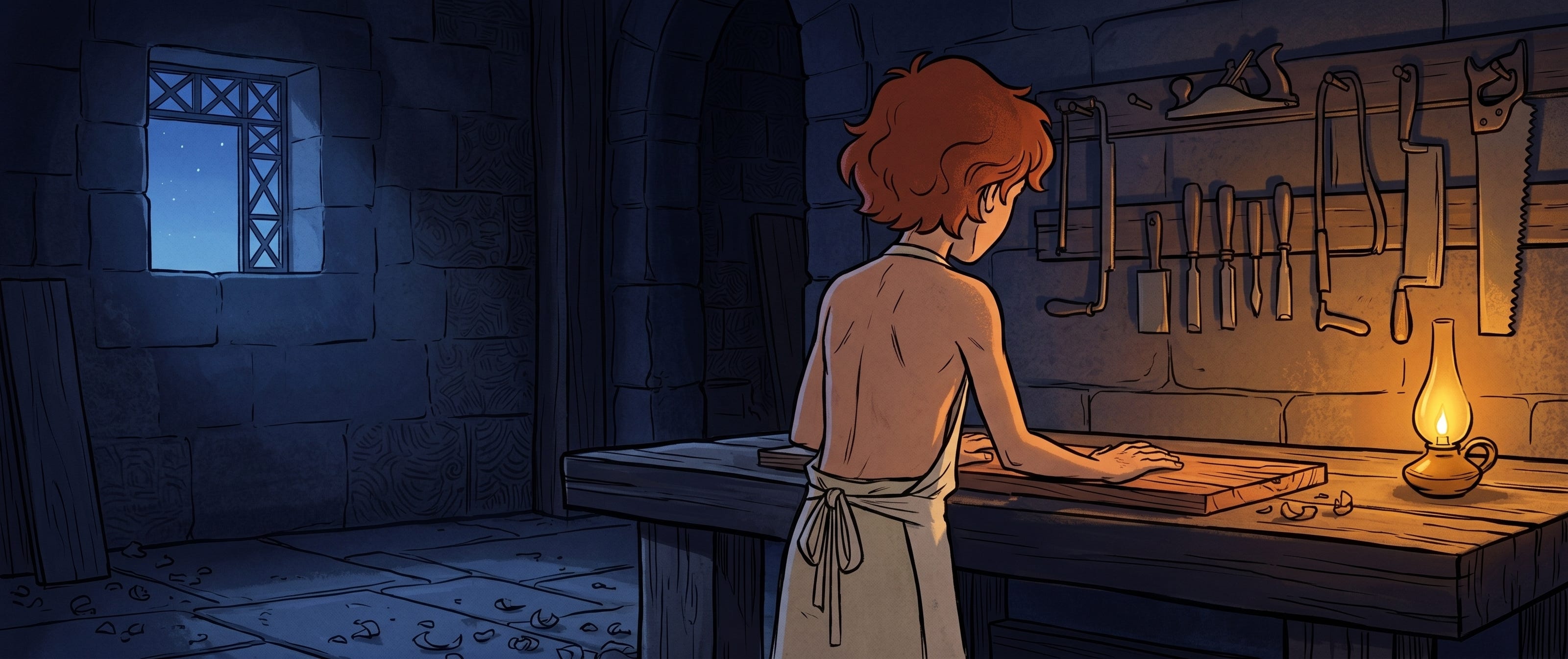
“Are you the carpenter’s son?”
“I am the carpenter.”
The workshop still smelled like Joseph.
Cedar shavings. Leather. The oil Joseph used on the plane blades. Eight months since the accident, and sometimes Yeshua still expected to see his father at the workbench when he came in before dawn.
He didn’t. There was only the lamp, the tools, the half-finished projects that had become all-Yeshua projects now.
This morning there were three commissions waiting. A door frame for the mason. A plow handle repair for old Ezra whose hands shook too much to do it himself. Two stools for the inn, simple jobs that paid simple money.
Lamp lit. Apron on, still too big, but less so than it had been. The plane in his hand.
The wood waited.
The woman came at first light.
She stood in the doorway with the sun behind her and he could not see her face. Only the shape of a woman holding herself the way people hold themselves when something inside them has come loose and they are afraid of what will fall out if they move wrong.
“Are you the carpenter’s son.”
His thumb found the grain of the plane handle. Joseph had shaped it for his own hand. The wood was worn smooth where Joseph’s fingers had gone.
“I am the carpenter.”
She came into the workshop. Past the lamp. Into the light.
He knew her a little. A weaver’s wife from the far side of the village. Thin woman, thin hands, a face that had been pretty before something had worn it down. She was holding a small cloth bundle against her chest.
“My daughter,” she said. “Last night.”
“How old.”
“Seven.”
Yeshua set the plane on the bench.
“I have some money.” She opened the bundle. A few coins. Less than half of what he would need for the cedar. “I know it isn’t enough. I can bring more when my husband’s next wages come in. He is in Sepphoris. He doesn’t know yet.”
Yeshua looked at the coins. Looked at the woman. Looked at the cedar stacked against the far wall.
“That will be enough.”
“It isn’t.”
“It will be.”
She started to say something else. Her mouth opened and no sound came and she closed it again and nodded once.
“When.”
“By dusk.”
“Thank you.”
She pressed the coins into his palm. Her hand was cold. Then she was gone.
He stood for a moment in the empty doorway. The light was orange and thin. A rooster was calling somewhere down the road.
He put the coins in the box under the bench. He selected the cedar.
The saw moved.
Seven years old. He measured with the length of his forearm and took a hand’s width off for the shoulders. The board was long enough for two children. He cut the length first, then cross-cut the width, then stood and looked at the shape he had made on the floor.
Too small for an adult. Too large for a doll.
He did not let himself think past that.
He ran the plane along the first board. Slow. The shavings came up thin and pale. Halfway through the second pass the grain split under his blade in a shape he knew.
He did not look away. He did not look harder.
He set the blade on the bench. He waited until his hand stopped shaking. Then he picked up the blade and kept cutting.
James appeared in the doorway around midmorning.
He was supposed to be at school. Yeshua did not ask why he wasn’t. He was thirteen. The weight had climbed into him the way it climbs into a child whose father has just died and whose brother has become something he cannot name. He stood in the doorway now and looked at the four cedar boards laid out on the workshop floor.
He did not ask whose it was.
He walked to the shelf. He took down a soft cloth and the small pot of beeswax. He sat on the low stool across from Yeshua and polished the first board.
His hand paused on the second board. Then it resumed.
They worked.
The saw. The plane. The cloth on the grain. Once James asked for the finer chisel and Yeshua handed it to him without looking up. Once Yeshua needed the board steadied and James’s hand was already there.
Neither said anything about what they were building.
Around midday Yeshua glanced up and saw that James had finished the long side and moved on to the second without being told. The boy’s hands were careful. More careful than Yeshua had seen them on anything. There was a seriousness in the set of his shoulders that had not been there a year ago.
Yeshua looked back at the board in front of him.
Mary came at noon.
Bread. A cup of water. The same bread she had brought every day since Joseph died, because bringing it was a thing she could do, and doing things she could do was how she was getting through the days.
She set the bread on the bench. She saw the shape on the floor.
She stood very still.
She did not ask who it was for. She did not look at Yeshua. She looked at the small cedar box taking form under her son’s hands, and her own hands moved once to her mouth and then down to her sides, and she turned and walked out of the workshop without speaking.
He heard her go back into the house.
He ate the bread standing. The way Joseph used to.
The box came together in the afternoon.
The mitered corners. The bottom panel set in a shallow rabbet so the weight would not hang on the nails. He took the nails one at a time from the tin on the shelf. He drove each one with two strikes of the hammer. Not three. Two. Three would split the cedar.
James finished the polishing. Went outside without being asked. Came back with a handful of dried lavender from the kitchen garden. Set it on the bench next to the box and did not say anything about it.
Yeshua looked at the lavender.
Then he looked at his brother.
James was looking at the box.
Yeshua laid the lavender in the bottom. It barely covered the cedar. He took a strip of linen from the rag pile. The last clean one. One of Joseph’s old shirts. He laid it over the lavender.
He fitted the lid. Checked the seat. It closed without a sound.
The light had gone amber outside. The lamp had been burning low all afternoon and now it was the brightest thing in the room.
James stood up from the stool. He looked at the box once more. Then he walked out of the workshop and toward the house without speaking.
Yeshua sat down on the bench.
The woman came back at dusk.
Her husband was with her. A thin man with the shoulders of someone who worked stone. His face had not been told how to hold itself yet. He stood a step behind his wife. His hand moved once toward the box on the workbench, stopped halfway, and fell back to his side. He looked at Yeshua instead.
Yeshua carried the box out to them. It was light. A seven-year-old weighed almost nothing. The cedar weighed less.
The mother looked at it.
“It’s beautiful,” she said.
“It’s a box.”
“It’s beautiful.”
He did not argue with her.
She reached into the folds of her shawl. Her hand came out holding something small and gold. A ring. Thin band. A single amber stone. The kind of thing a woman keeps because her mother kept it and her mother’s mother kept it before that.
She held it out.
“The price was fair,” he said.
“Take it.”
“I can’t.”
“Please.”
She was not crying. She had cried all the tears a body could cry in the hours after losing a child and now there were no more and she was asking him to take the ring instead.
He looked at her.
He took the ring.
She closed his fingers around it with both of her hands. She held his closed fist for a long moment. Then she kissed the back of his hand, the way you kiss a priest, and she turned and walked away with her husband carrying the small cedar box between them down the dusty street.
Yeshua stood in the doorway of the workshop and watched them go until they turned the corner by the olive press and he could not see them anymore.
The ring was warm in his palm.
Lentils again.
James was already at the low table when Yeshua served the food. He had not said a word since leaving the workshop. He sat in his place and ate without complaint. Joseph Jr. ate quietly. Jude sat close to Yeshua and watched him the way he had watched him every evening since the funeral. Miriam ate without looking up.
Simon broke the quiet.
“Can we have meat?” Simon asked. “Just once?”
“Next month.”
“You said that last month.”
“Then next month for certain.”
“That’s what you said.”
“Simon.” Yeshua’s voice dropped half an octave. “Eat the lentils. Be grateful there are lentils.”
He put a hand on Simon’s shoulder. “There will be meat. I promise. Just not yet.”
Simon nodded. Ate. Didn’t ask again.
James watched the whole exchange. Said nothing.
After the children were in bed Mary came and stood in the doorway of the workshop. She did not come in. She did not speak. She looked at the place on the floor where the box had been that morning, and at the lamp, and at her son. Her hand rested for a moment on the doorframe where Joseph’s hand used to rest when he came to call her for the evening meal.
Then she turned and went back into the house.
He checked the fire. Checked the door.
He lay down on the bench where Joseph used to nap.
The bench was too short for him now.
The ring was in his pocket. He had not taken it out to look at it.
He could feel it against his hip. A small gold weight he had not asked to carry.
Eight people breathing in the dark.
<3EKO
Read my books: One Whale · The Jesus Frequency · The Unsealed Archives
Previously:
Thank you for reading.
I love you.


EKO, I enjoy so much of your work. However, I honestly don't understand the point of these fictional stories.