He chose the donkey. He chose the route. He chose the week.
He sent two men ahead before dawn. A village east of the Mount of Olives. A young donkey tied to a post outside a house. The answer was already arranged: “The Lord needs it.” The owner would nod. He’d been waiting.
Jesus stood on the ridge and watched the road fill. Pilgrims walking toward Jerusalem for Passover. Every province. Every dialect. Every wound the empire had opened and the temple had failed to close. The largest audience of the year, assembling on schedule.
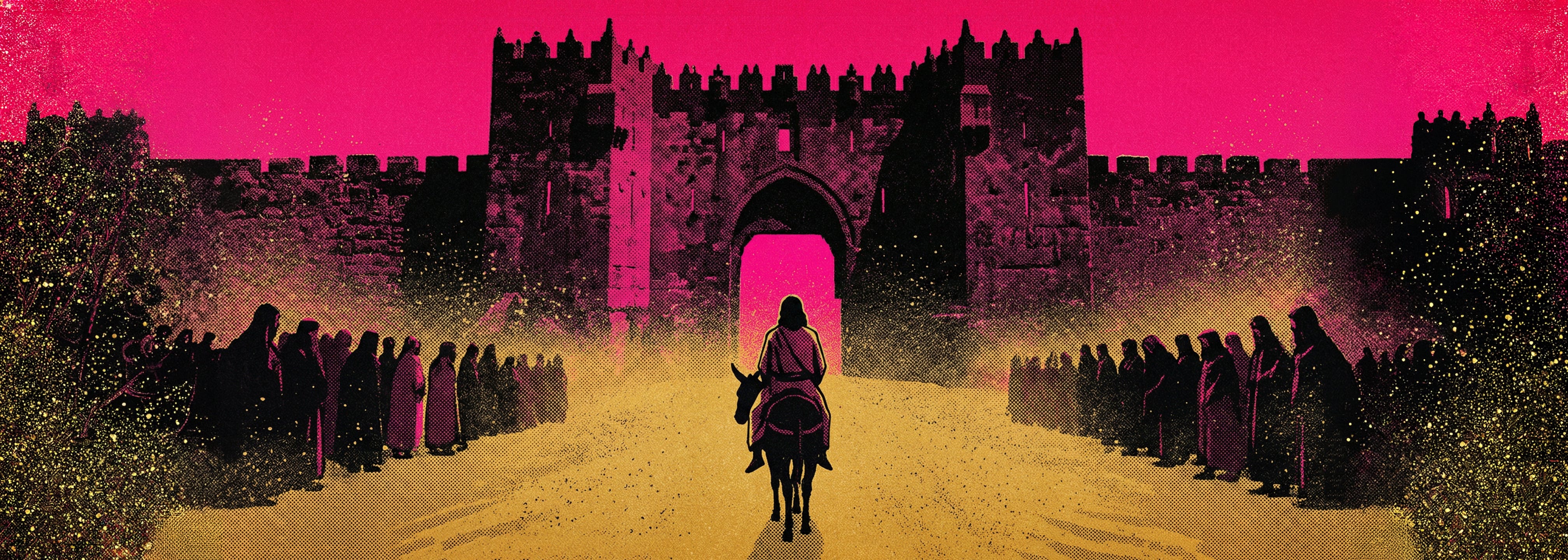
He mounted the donkey. Not a warhorse. A young animal that had never been ridden. His feet nearly dragged the ground.
The song caught before he reached the gate. Cloaks spread across the dust. Palm branches torn from the roadside, slapping together. “Hosanna to the Son of David!” The Pharisees shoved through the bodies.
“Teacher, rebuke your disciples!”
Dust on his face. Donkey shifting under his weight.
“If they keep quiet, the stones will cry out.”
The Court of the Gentiles smelled like a stockyard. Caged doves. Penned lambs. Currency changers at folding tables converting Roman coins to Tyrian shekels at rates they set themselves. The only currency the temple accepted for the tax. A monopoly so old nobody questioned it.
He picked up the nearest table and threw it.
Coins hit limestone and scattered. A currency changer scrambled after them on his knees. Jesus reached the dove cages and broke the latches. Birds erupted upward in a white explosion that reached the colonnades before the guards could move.
Table by table. The sound of wood cracking against stone. Money rolling into gutters. A lamb loose in the corridor, bleating, trailing its rope.
“My house will be called a house of prayer for all nations. But you have made it a den of robbers.”
The temple guards watched from the portico. Hands on weapons. The order never came. Too many pilgrims. Passover was two days away and the Roman garrison was already nervous.
They sent lawyers.
“Is it right to pay the imperial tax to Caesar?”
He held out his hand. “Show me a coin.”
One of the lawyers reached into his purse and produced a denarius. He held it up between two fingers so the crowd could see Caesar’s profile pressed into silver.
“Whose image is this?”
“Caesar’s.”
He set the coin on the lawyer’s open palm.
“Give back to Caesar what is Caesar’s. And to God what is God’s.”
The lawyer stood there holding the coin. The crowd was silent. The answer had walked past both walls of the trap and kept going.
Thursday night. A borrowed room above a street in the lower city. Doors locked. Oil lamp throwing shadows up the walls. The smell of roast lamb and something else. Fear.
He stood up from the table. Stripped off his outer garment. Took a linen towel and tied it around his waist. Picked up a pitcher of water and a copper basin.
Conversation died.
Slave work. The lowest task in the household. So menial that Jewish slaves were exempt. Reserved for Gentile bondsmen. And here was the man they called Master, kneeling on the floor, reaching for the first pair of feet.
He worked his way down the line. Splash. Scrub. Wipe. The sound loud in the silence.
He reached Judas.
The top of his head. Sweat on his neck. Calluses on his hands. He took Judas’s foot and washed the dust from his skin. Dust from the walk to Caiaphas that afternoon. Dust from the path to the garden where it would end tonight. His breath caught. A small sound. The kind a man makes when he touches something he is about to lose.
He stood. Picked up the bread with both hands and tore it. “This is my body.” Lifted the cup. Red wine catching the lamplight. “This is my blood of the covenant.”
He dipped a piece of bread into the bitter herbs and held it out to Judas. Their fingers brushed.
“What you are about to do, do quickly.”
Judas stood. Picked up his cloak from the bench. Walked to the door. Opened it. Stepped into the dark. The door closed behind him.
Nobody stopped him.
Friday morning. Judas stood in the temple precinct holding a leather bag. The bronze doors opened. A servant emerged. Low-level. Ink stains on his fingers.
“You’re the Iscariot?”
“I am waiting for the High Priest.”
“High Priest is busy. Managing an execution.”
Judas pulled the drawstring on the bag. He didn’t hand it back.
He threw it.
Silver exploded across the sanctuary floor. Clatter-spin-ring. Clatter-spin-ring. Clatter-spin-ring. Thirty individual impacts his accountant’s ear counted against his will.
The elders watched the coins settle.
“What is that to us? See to that yourself.”
Judas turned. Ran. Past the guards. Past the servant. Out of the temple. Shoving through pilgrims who were walking the other direction, walking north, toward the hill.
He walked south. Into the Valley of Hinnom. The city’s garbage dump. Down through the smoke of burning refuse until the valley walls rose around him and the sound was gone.
Then he heard it. From the northern hill, across the upper city.
The sound of hammers. Steady. Spaced.
The rhythm of men who knew their work.
<3 EKO
Six months ago I published The Jesus Frequency. My attempt to return to what he actually said, how he actually moved, the frequency the common people heard before the institution buried it under two thousand years of concrete.
I just updated it. New edition. If you already own it, thank you. This is the version to put in someone’s hands. And if you’ve been meaning to pick it up, this is the one I wanted you to have.
Thank you for being here. For reading. For supporting the mission.
I need to disappear into the desert for a few days, but know that I love you.


You are very courageous. Thank you.