What They Could Carry
Four moments from the early church that changed what we think we know.
The servant girl at the gate looked at him and said, you also were with him. He said, woman, I do not know him.
A second person came. You also are one of them. He said, man, I am not.
About an hour later another insisted. Truly this man also was with him, for he is a Galilean. He said, man, I do not know what you are saying.
And immediately, while he was still speaking, the cock crowed.
He went out and wept bitterly.
This is the man who, fifty days later, at Pentecost, will stand in the Temple courtyard and preach the first sermon of Christianity. Three thousand will be baptized that afternoon. The sermon will be about the resurrection. The sermon will not be about the kingdom within, the fatherhood of God, the parables, the woman at the well, or the washing of feet.
Peter preached what he could carry.
The rest stayed on the floor of the upper room.
She had bought the myrrh and the aloes. When she came to the tomb the stone was rolled away and the body was gone. She stood outside weeping. She stooped to look in.
She turned. The gardener was standing in the morning light.
He said her name.
She said, Rabboni.
She ran back to the upper room and told the eleven men hiding behind the bolted door. They did not believe her. Luke records the word they used: lēros. Idle tales. The talk of someone whose witness does not count.
She went out into the streets of Jerusalem and told anyone who would listen.
By the time Peter stood up in the Temple courtyard seven weeks later, the news had already been running through every kitchen in Jerusalem.
She saw him first. She told the men. The men dismissed her. She kept telling.
In the year 62, in the spring before the Passover crowds began arriving in Jerusalem, the high priest Ananus convened an illegal session of the Sanhedrin and brought a man up to the pinnacle of the Temple.
The man was the brother of the teacher. He had grown up in the same house. He had eaten at the same table for thirty years. During the public ministry he had not believed. After the resurrection he had seen the risen Lord, and he had never spoken of what passed between them.
He had run the Jerusalem church for 25 years. He never ate meat. He never drank wine. He never cut his hair. He wore only linen. He prayed for the forgiveness of his people on the Temple stone every day until the stone wore down his knees.
A second-century historian named Hegesippus would later report that when they prepared his body for burial, his knees were hard and calloused like the knees of a camel.
From the pinnacle, Ananus asked him in front of the gathered pilgrims to declare that his brother had been a false teacher.
He called out instead that his brother was the Son of Man seated at the right hand of the Power.
They threw him from the pinnacle. The fall did not kill him. He rose to his knees, bleeding, and prayed for his attackers, repeating the words his brother had spoken from the cross. A fuller standing nearby beat him to death with the wooden club he used for pressing cloth.
Eight years later Jerusalem itself fell. The Jewish-Christian community fled to Pella in the Transjordan. By the fourth century they had been declared heretics.
The Christianity that stayed closest to what the teacher actually taught was killed with its city. And its city was killed by Rome.
In the spring of the year 367, an old bishop sat down in Alexandria and wrote a letter. He had written one nearly every year for almost forty years. He was about to close the book.
He listed 27 titles. He said these were the fountains of salvation. He said in these alone was proclaimed the doctrine of godliness. He said let no man add to these and let no man take from them.
The letter went out. The twenty-seven books became the New Testament.
In the same season, in the monasteries of Upper Egypt that sat under the bishop’s oversight, a group of monks made a different kind of decision. They had a collection of books the letter had just declared outside the canon. Sayings of the teacher. Dialogues. Visions. The Gospel of Thomas.
They did not destroy them.
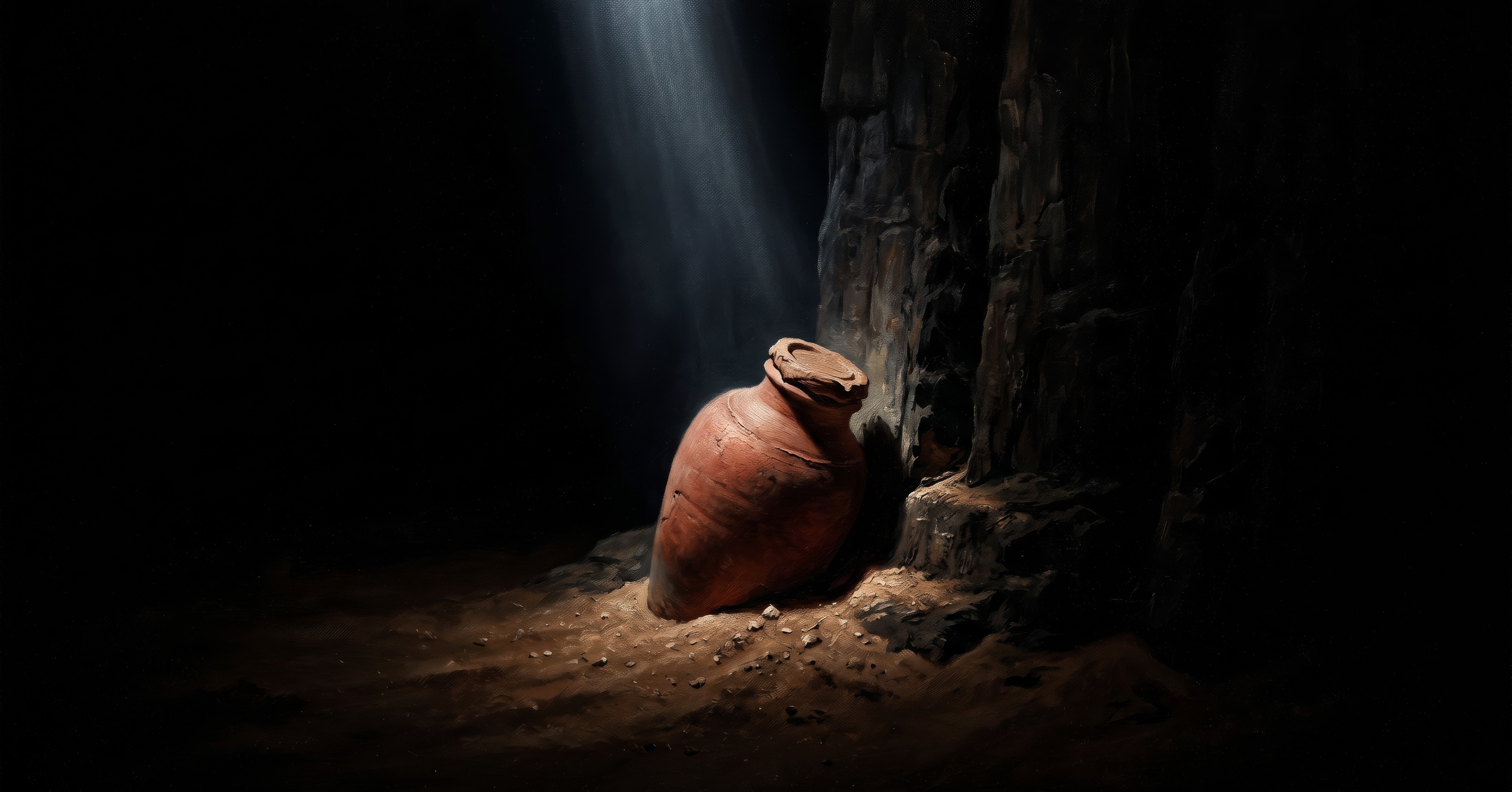
They put the books in a sealed jar of red clay, carried the jar out to the base of the cliffs of Jabal al-Tarif a few miles from their monastery, and buried it in the sand under a boulder.
The letter traveled and shaped Christian reading for sixteen hundred years. The jar waited.
In December of 1945, a peasant digging for nitrate fertilizer at the base of the same cliffs struck the boulder. He rolled it aside and found the jar. He broke it open hoping for gold. Inside were thirteen leather-bound codices containing fifty-two texts.
Athanasius said yes. The jar said no.
Both came down to us. Both are yours.
These are not villains. They were good people under impossible conditions. Each carried what they could carry. Each left something behind.
What got left is still on the floor. And that is what my new book is about.
After Jesus walks back through that first generation. Peter, Paul, James, Mary, John, Ignatius, Athanasius. It names what they carried, what they reframed, and what they left for us to pick up. This concludes my Kingdom Trilogy.
127 people have already downloaded the full PDF from my website.
But if you would prefer a physical copy, it is now available below.
Download for free. Support if you want. Either way, I want you to have this.
I love you.


