Who Would Still Salute?
In America’s faithless year, a famous cartoonist ran the flag up to see who still would. He got half the answer.
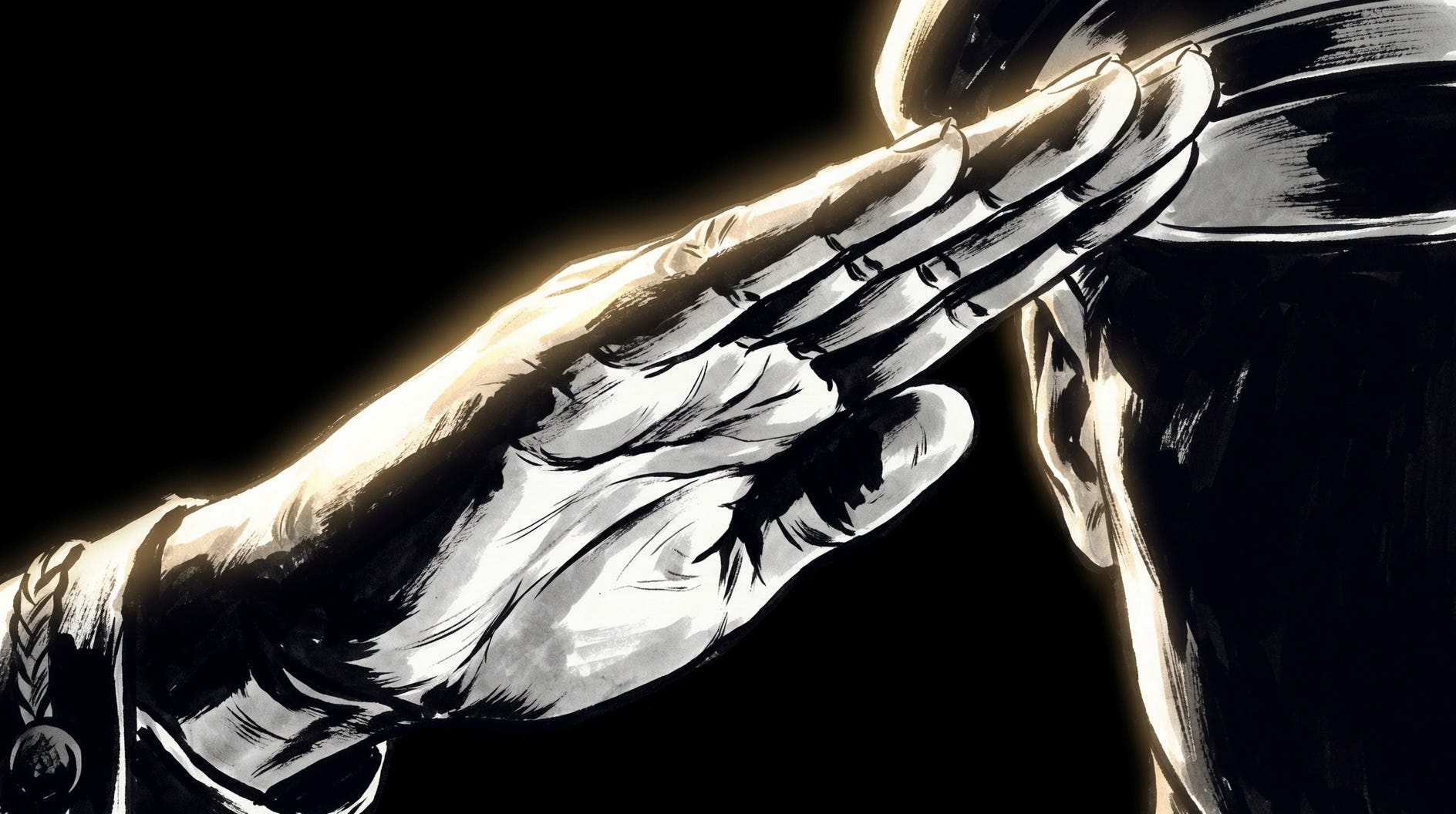
The year the country turned two hundred, a cartoonist made a strange little book about the flag.
His name was Milton Caniff. In his day he was as famous as anyone alive with a pen, the man who drew Steve Canyon and Terry and the Pirates, in a thousand papers every morning. He could have drawn a parade for the bicentennial. He drew a book instead, one that walked all the way around the flag and asked out loud whether it still deserved the salute.
It was a fair question for the year he asked it in. Most people my age think 1976 was peak Americana. It did not feel like that from the inside. Saigon had fallen the spring before, the first war the country ever lost outright. Nixon was two years gone, run out of office in disgrace. The Weather Underground had spent the decade setting off bombs inside the country’s own buildings, the Capitol, the Pentagon, the State Department.
The movies everyone lined up for said it back to them, All the President’s Men and Three Days of the Condor and The Parallax View and The Conversation, every one with the same message: the government is lying to you, and the men in the good suits are the ones to fear. The birthday landed on a country that was not sure it had earned one.
So Caniff did not dodge the hard part. The same nerve that makes a man charge a machine gun makes a mob. The loudest patriots are usually the last to see the lie. The man with something to hide reaches for the flag first, because it covers the most. Then he found the line worth keeping. The heart of it, he wrote, is the freedom to choose what you salute.
He was right. Then he stopped, one step short.
He turned that freedom into a warning. Be careful what you salute. Hold something back. It was the safe posture for 1976, to love the country with an asterisk. He gave a caution where the moment called for a decision.
That left two ways to do it, and the country has been choosing between them ever since. The blind salute, the one you give because the people around you are giving it, which never meant a thing. And the careful salute, the one that keeps a hand free and never fully commits, in case commitment turns out to be foolish. One is a reflex. The other is a hedge. Neither one costs you anything.
There is a third. It is the only one that ever counted.
You salute with your eyes open. You have seen what Caniff saw. The camps. The demagogues. The men who wrapped themselves in the flag and robbed the people behind it. You know every way the thing goes bad. And you look at the country, this one, right now, and you salute it because you decided to. Not out of habit, not because anyone is watching. Because you looked straight at it and chose it.
That salute is the one thing no power on earth has learned to fake. A government can force a salute. It can put a flag in every hand and jail the man who keeps his seat, and it has done exactly that, in every century, on every continent. What it has never once produced is the salute a free man gives on his own. That one comes from a place no government reaches. It was yours before there was a country, and it will outlast the country.
The forced version is worth nothing, and it never was. The Father never wanted the love He could compel out of a man, because a love you can compel is not love. A salute works the same way. The only one that counts is the one you could have refused and didn’t.
Caniff’s line was right. His advice was backward. Not be careful what you salute. Choose what you salute, and then salute it like you mean it.
This country is worth choosing. The real one, the whole record Caniff wrote down and every fight still running. It is the same thing you do with a person you love. You learn the worst about them and you stay. That is the salute nobody can take off you, because nobody handed it to you.
Caniff ran the flag up fifty years ago to see who would still salute. He thought the question was whether the flag had earned it. It never was. The question is whether there are still free people who will choose it on purpose.
There are. Run it up.
<3EKO
P.S. so many people asked for a preview of the Thomas manuscript that I decided to make it available, free, right now, before next week’s launch.
For ten years he sat at the end of the highest court in the country and did not ask a single question. The city read it as a man with nothing to say. It was the most misread silence in Washington.
His is the story of the boy from a house with no running water in Pin Point, Georgia, the grandfather who handed him one rule he would never lay down, the hearing that turned his name into a national fight, and the letter he carried, unopened, for forty years.
It shows you the man underneath the noise.
Take a look, tell me what lands and what doesn’t, and I’ll have it ready for launch next week.
I love you.


Thank you for this post; we are not blind; the corruption is real, deep and widespread.
However, there is still good to be fought for - that is what we choose to salute.
The battle for freedom, decency and the Kingdom of God is not over.
Who wants to be on the side of darkness and lies anyway?
Another awesome analysis and comment. I hadn’t realized I’d chosen the path of open-eyed patriotism. I went through the 60s/the Vietnam schism/Nixon and was disillusioned by the gap between the ideals of the nation and the boots on the ground reality. It took years, yet as I’ve matured, I’ve realized that striving for the ideal often falls short, that this Constitution and my country’s people are worth respect. Not blind patriotism, but solid love for this country despite its flaws and shortcomings. Like my family. Like me. We all need to grow and mature. I love America and what it stands for.