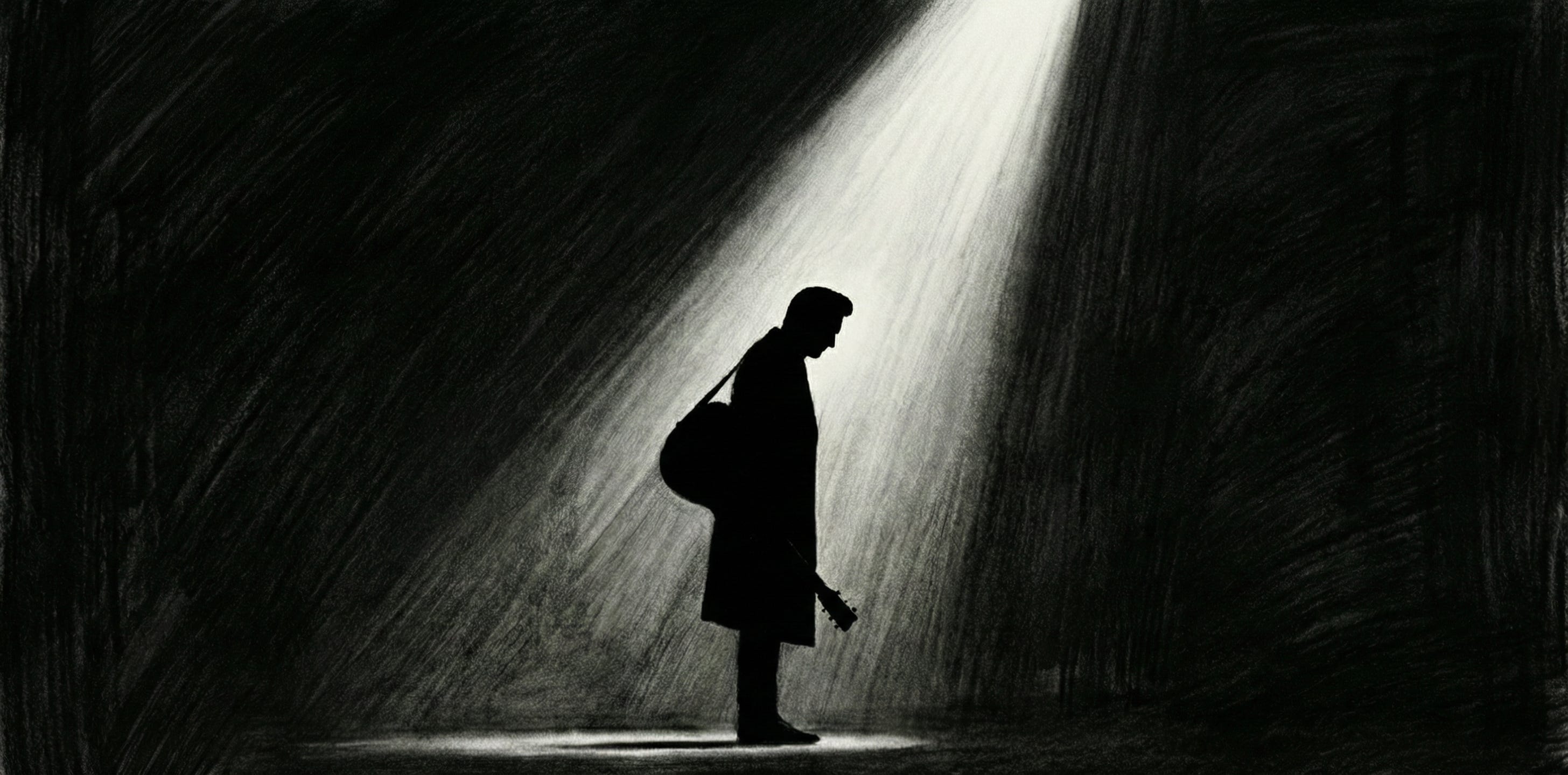
Johnny Cash: The Outlaw Who Came Home
He walked into a cave to die. He crawled out singing hymns. Then he spent the rest of his life telling anyone who would listen.
Born 1932 in Kingsland, Arkansas. Dirt poor. Flood country. The Baptist church was the center of everything.
His older brother Jack was the one headed for ministry. Johnny was the restless one. A voice too big for the church and a hunger the cotton couldn’t hold.
You know this part. The movie showed you the saw, the hospital bed, the angels. What it didn’t show you was that Cash heard them too. And spent the next forty years trying not to listen.
Fame came fast. Sun Records. “I Walk the Line.” The Tennessee Three. Then the road. Amphetamines to stay awake. Barbiturates to sleep. He married young, had kids, left them behind in motel rooms while he chased the next show.
By 1967 he was a shell. Divorced. Estranged from his children. Banned from the Grand Ole Opry. Arrested seven times. Skin and bones, a voice like gravel and regret.
He drove out to Nickajack Cave, a massive cavern in Tennessee where the Confederates had once mined saltpeter for gunpowder. He crawled into the darkness, miles deep, to lie down and let the earth swallow him.
He wanted to die.
Cash told the story differently depending on when you asked. The core never changed.
He lay in the dark, waiting for the end. Instead of death, he felt a presence. A certainty that he wasn’t supposed to die in that cave. That he wasn’t done yet.
He turned around. The cave was a maze, but he kept crawling, and he found the light. Emerged hours later, half-dead, blinking in the Tennessee sun.
His mother was at the mouth. She said she didn’t know why she’d driven out there. She just knew she needed to.
Cash got clean. Married June Carter, who’d loved him since 1962. She’d performed beside him while he was high, waited through the arrests and the years when he couldn’t look her in the eye. She didn’t rescue him. She stayed close enough that when he finally turned around, she was there.
He went to church because he’d met something in that cave and he refused to pretend he hadn’t.
He never preached from a pulpit. He wasn’t interested in denominations or picking sides. He just kept saying the same thing:
Jesus is real.
The door is open.
I’m proof.
The late career is where most people know him, even if they don’t realize it.
Rick Rubin, the producer behind the Beastie Boys and Run-DMC, called Cash out of semi-retirement in 1994. The result was the American Recordings series. Four albums of stripped-down covers and originals that reintroduced Cash to a generation, like me, who had never heard of him.
“Hurt,” the Nine Inch Nails cover, became his epitaph. The video was filmed in the House of Cash, his personal museum, flooded and fallen to ruin. He sits at a banquet table, hands shaking as he pours wine that spills across the white tablecloth. June watches from a doorway. The look on her face is the whole story — love that has survived everything and refuses to leave. When Trent Reznor saw it, he said the song wasn’t his anymore.
“The Man Comes Around.” Cash wrote it after a dream about Queen Elizabeth and the Day of Judgment. The lyrics are scripture set to a country shuffle.
Revelation, the pale horse, the voices of the martyrs under the altar.
A song about the end of the world that sounds like a lullaby. He sang it at concerts into his seventies, Bible in hand, voice like broken glass, telling packed rooms that Jesus was coming back and they’d better be ready.
And “God’s Gonna Cut You Down.” A traditional spiritual that Cash recorded for his final album. It’s a warning dressed as a hymn. You can run, you can work in the dark against your fellow man, but what’s done in the dark will be brought to the light. Cash doesn’t sing it as a judge. He sings it as a man who’d been cut down himself, in that cave, and who got back up only because something stronger than him said not yet. The music video, released after his death, featured dozens of famous faces staring into the camera while Cash’s voice delivered the verdict. The whole machine, performing his prophecy without knowing it.
Cash died in 2003, four months after June. He kept recording until the end.
The obituaries called him a legend. The bio-pics showed the drugs, the romance, the comeback. They played “Hurt” on VH1 and called him a tortured artist. They mentioned the cave and made it a metaphor for addiction. But the thing he actually crawled out of that cave believing, that Jesus was real, that the door was open, that he was proof, stayed in the footnotes. Too specific for the secular tributes. Too raw for the church bulletins. They wanted the Man in Black. Not the man on his knees.
Sixty years after Nickajack, a dude named Jelly Roll stood at the Grammy podium with a Bible in his hand and said something the music industry wasn’t ready for:
“Jesus is for everybody. Jesus is not owned by one political party. Jesus is not owned by any music label. Jesus is Jesus, and anybody can have a relationship with him.”
The cameras didn’t cut away. The audience didn’t boo.
He’s not the only one. Nicki Minaj has spoken publicly about satanic rituals in the industry. Justin Bieber has said Jesus restored his identity after years of being ground up by the machine that made him famous. The internet is split. Some people are grateful. Others call it a performance.
It’s not our job to sort the sincere from the strategic. That’s between each of them and God.
Cash would have had no patience for the cynics.
He’d been the rambler. The gambler. The man who crawled out of Nickajack Cave wasn’t interested in sorting the worthy from the unworthy. He’d been unworthy. That was the whole point.
Jesus chose twelve men. A tax collector, a zealot, a fisherman who denied him three times before the rooster crowed. He ate with sinners. He touched lepers. He turned Saul, the man who hunted Christians for a living, into Paul, the man who built the church. The door was never meant for the clean. It was meant for the ones crawling out of caves.
Jack said he could hear the angels singing. Cash spent forty years trying not to listen. In the cave, when he was finally quiet, the song was still there.
He crawled out and he never stopped singing it.
Pull up The Man Comes Around.
Listen to a dying man tell you what he heard in the dark. Then sit in the quiet and ask yourself what you’ve been running from.
<3 EKO
PS — This is #2 in The Lineage. Start below, more to come.
I love you.


EKO, as a huge Cash fan, I was beyond thrilled to see When the Man Comes Around given a place in your essay. It's a song that I have been playing over and over since its initial release. He captured a magic with that one that still makes me stop breathing. I love reading you. Thank you so much.
Eko,
You've here one French 🇫🇷
Christian friend who enjoyed listening to Johnny Cash's voice even when I couldn't even speak nor understand English.
And I've no word, just cries and tears at the time I just want to thank you because I never sought to know this story, this marvelous parable coming straight out of this cave !
Thank you for this powerful text which moves me so deeply and strongly while I'm crawling towards His Light !
🇫🇷💕🫂💕🇺🇲
💒🕊️💕 May God and Jesus bless and keep you and your loved ones!
💕🕊️💒