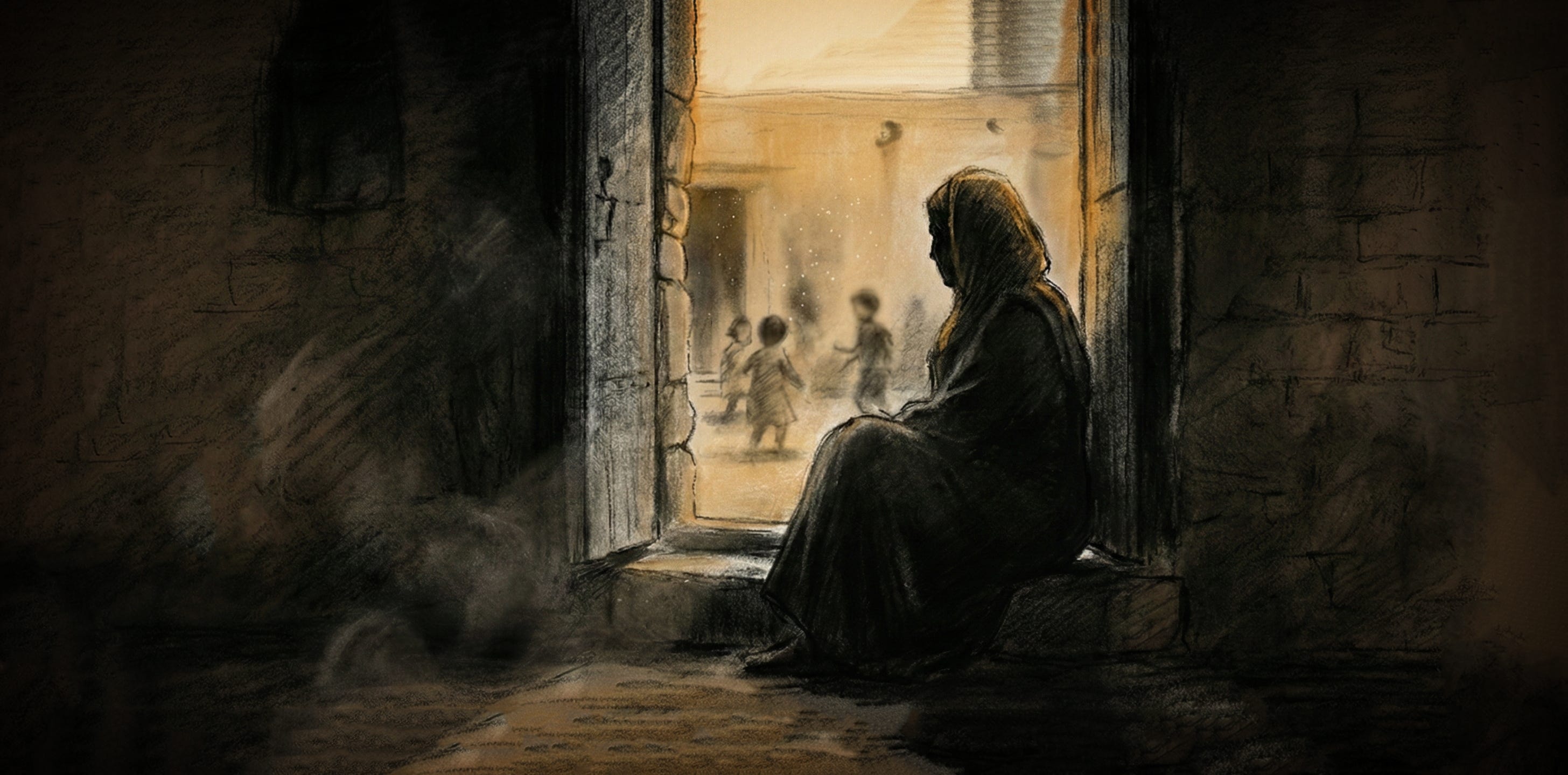
The other children called him Yeshu.
In the courtyard of their kinsman’s house, six of them played together most afternoons. Wrestling, chasing, building towers from broken pottery and watching them fall. Mary sat in the doorway. Always in the doorway.
He was two years old, then two and a half, then nearly three. A healthy child. A happy child. Quick to laugh, quick to share, quick to help a smaller boy who’d fallen. The Alexandrian mothers said he was unusually gentle.
Mary said nothing.
Joseph had told her she was holding too tight.
“If you shelter him like this, he’ll grow up strange. Self-conscious. Set apart.” Joseph spoke carefully, the way he always did when he disagreed with her. “Let him play. Let him be a child. That’s what he came here to be.”
She knew Joseph was right. She hated that he was right.
So she gave her assent. She let the child of promise grow up like any other child. But she stayed close. Not hovering. Just there.
Alexandria had been good to them.
They lived with Joseph’s relatives in the Jewish quarter, a crowded but comfortable house near the harbor. Joseph had found work within weeks. First as a carpenter, then foreman on a public building project. The pay was steady. The Greeks respected his craftsmanship. For the first time since Bethlehem, since the soldiers, since the flight across the desert with a newborn pressed against her chest, Mary could breathe.
The child grew normally. He learned to walk on these streets, to talk in this dialect, to play the games Egyptian children played. He knew the smell of the harbor, the sound of Greek in the marketplace, the taste of figs bought from vendors near the great colonnades.
This was the only home he remembered.
In the second year, visitors came.
Joseph’s relative had told friends in Memphis about the child. Descendants of the ancient Ikhnaton, believers who still watched for signs. Word spread quietly. A small group assembled at the home of Joseph’s benefactor.
Mary held the boy on her lap while strangers filed past. Alexandrian believers. Memphis mystics. Earnest men and women who looked at her son and wept.
She didn’t know what they saw.
She saw a child who’d gotten fig juice on his tunic that morning. A child who’d cried when his favorite playmate had gone home. A child who fell asleep against her shoulder now, oblivious to the reverence in the room.
An elderly woman knelt before them. Tears streamed down her weathered face.
“We have waited so long,” she whispered. “So many generations.”
Mary looked at her son. His small hand had found a loose thread on her sleeve and was tugging at it absently. His mouth hung slightly open. A thin line of drool caught the lamplight.
The hidden king. The hope of nations.
He hiccuped in his sleep.
The woman reached out to touch his foot with trembling fingers. Mary didn’t know whether to weep or laugh.
They presented a gift. A complete copy of the Hebrew scriptures in Greek. The law, the prophets, the psalms. One of only a few such manuscripts in existence.
“For him,” they said. “For when he’s ready.”
Joseph accepted it with trembling hands.
Then came the invitation.
“Stay,” they said. “Raise him here. Alexandria could shape him. Palestine would only limit him.”
Mary felt the pull. The great Library. The schools. Jews and Greeks and Egyptians mingling freely. Here, her son could learn from the finest minds in the world. Here, he would be safe from Herod’s shadow.
Joseph listened. Said he needed time.
For weeks, the invitation sat between them like an unopened letter. The believers kept asking. Mary kept hoping.
Then the news came.
“Herod is dead.”
Joseph stood in the doorway, still dusty from the construction site.
“When?”
“Days ago. Maybe weeks. Word just arrived.”
Mary sat down slowly. Herod. The name that had chased them across the desert. The king who had murdered children in Bethlehem, hunting for this one boy. Dead.
“The roads are opening,” Joseph said. “People are returning to Palestine.”
“We could stay.” Mary heard the plea in her own voice. “We have a life here. He has friends. You have work.”
Joseph crossed the room. Sat across from her. Didn’t take her hands.
“Mary. We can’t raise him in Alexandria.”
“Why not? He’s happy here. He’s safe.”
“He’s hidden here. That’s not the same as safe.”
The third week.
They had stopped speaking about it directly. The question sat between them at meals, in the workshop, in the bed they shared but no longer touched. Mary cooked. Joseph worked. The boy played in the courtyard, oblivious.
One evening, after the child was asleep, Joseph broke.
“Say it.” His voice was rough. “Whatever you’re thinking. Say it.”
Mary didn’t look up from the mending in her lap. “I’ve said everything.”
“You’ve said some things. There’s more.”
She set down the needle. When she met his eyes, her face had changed.
“You’re asking me to bury him in a village no one has ever heard of.”
“I’m asking you to keep him alive.”
“In Nazareth? When he could have the Library? The scholars?”
“The scholars who’d get him killed.” Joseph leaned forward. “Alexandria is Greek. Roman. Foreign. Whatever he’s meant to become, he can’t become it here.”
“He needs to know greatness.” Mary’s voice cracked. “The angel said he would sit on David’s throne. David was educated in courts. Not some carpenter’s hovel—”
“In a village like the one you grew up in?”
The words landed like a slap.
“I didn’t mean—” Joseph started.
“Yes you did.” She looked away. “I grew up in nothing. In nowhere. I was nothing until the angel came. And now you want to take my son and make him nothing again.”
“I want to take our son and let him become whatever God intends. Not whatever we force.”
“And if God intends a king? Kings aren’t raised in backwaters, Joseph.”
“Maybe this one is.”
She stared at him.
“Maybe that’s the whole of it,” he said. “Maybe he needs to know what ordinary people know. How they live. How they suffer. Maybe you can’t save people from above. Maybe you have to be one of them first.”
“That’s not—”
“What the angel said? What Simeon said?” Joseph’s jaw tightened. “Mary. Everyone who’s ever told us what this child would become has also said things we didn’t want to hear. Simeon said a sword would pierce your soul. The magi talked about suffering before glory. What if the backwater is part of it?”
She didn’t answer. Couldn’t.
“What if we raise him in Alexandria,” Joseph said quietly, “and he becomes exactly what the world calls great? A scholar in a library. A prince in a palace. Is that the promise?”
“I don’t know what the angel promised. I just know it wasn’t this.” She gestured at the small room, the mud walls, the lamp guttering on its last oil. “It wasn’t poverty. It wasn’t obscurity. It wasn’t raising the salvation of Israel in a town that smells like goat dung.”
Joseph almost laughed. “And yet.”
“And yet what?”
“And yet here we are. With a choice.” He reached for her hands. She let him take them, but her fingers stayed cold. “We can push him toward greatness. Position him. Train him. Or we can let him grow up like a normal child and trust that whatever’s inside him will find its way out.”
“What if it doesn’t?”
“Then we’ll have raised a good man in a safe place.”
“A carpenter.”
“Would that be so terrible?”
The question hung between them.
“I’m afraid,” Mary whispered.
“I know.”
“I’m afraid we’ll waste him.”
“I know.” He pulled her closer. “I’m afraid too. But I’d rather waste a destiny than destroy a childhood trying to force one.”
She leaned into him. The first time in weeks.
“Nazareth,” she said finally.
“Nazareth.”
They both knew that once they left, they wouldn’t come back.
But neither said it aloud.
By the first of October, they were ready.
Five of Joseph’s kinsmen refused to let them travel alone. So they set out. Mary and the boy on a newly-purchased donkey, Joseph and five men on foot. They took the sea route first, then landed at Joppa and traveled overland, avoiding Jerusalem entirely.
The boy handled the journey well. He watched everything. The sea, the strange towns, the hills growing greener as they went north. He asked questions Joseph couldn’t always answer. Why is the water salty? Why do those men wear different clothes? Where do the birds go at night?
Three years and two months old. Curious. Healthy. Unafraid.
They arrived in Nazareth unannounced.
Joseph’s brother, who had been living in their house for three years, nearly dropped his cup when he opened the door. Within a day, he had moved his family out. Within a week, Joseph had found work. Within a month, they had settled into something that felt like permanence.
The boy ran through the small house with what Mary could only call glee. His own room. His own garden. His own space to explore. He discovered the workshop, the animals, the stone stairs leading up to the roof. He claimed every corner as if he’d been waiting for this place his whole life.
But some evenings, she found him sitting alone. Quiet. Looking south.
“What are you thinking about?” she asked once.
“My friends,” he said. “I miss them.”
She gathered him into her arms. This extraordinary child who was still just a child. Who missed his playmates from Alexandria. Who cried when he scraped his knee. Who fell asleep listening to her sing.
The Egypt years were over. Nazareth had begun.
Joseph found work quickly.
The Romans were rebuilding Sepphoris, four miles north. Massive construction — new buildings, new roads, new everything. They needed craftsmen. They paid well. Joseph came home exhausted but satisfied, his hands rougher each week, his savings growing.
“It’s good work,” he told her. “Honest work. Foreman says I might supervise a crew next year.”
Mary watched him eat his dinner. Watched him play with the boy before bed. Watched him climb the stairs to the roof some nights, looking out at the town he’d chosen for them.
He was happy here. Happier than he’d been in Alexandria, though he’d never say so.
She didn’t know yet about the questions her son would ask. The teachers he would confound. The moment in a distant Temple when her twelve-year-old would look at her with ancient eyes and speak of his Father’s business.
She didn’t know that in eleven years, she would stand at the edge of a construction site in Sepphoris, that same site where Joseph now worked and smiled and planned their future, watching them carry her husband’s broken body down from the scaffolding.
She didn’t know that the boy in the next room would become the man of the house at fourteen.
End Episode 2
Next Monday: Episode 3 — The Ridge
<3 EKO
The Nazarene Saga tells the story of Jesus nobody showed you. If this landed, you might also love One Whale. A parable about what we carry and why we sing. Subscribe to receive new episodes every Monday.
Mary wanted Alexandria. Joseph chose Nazareth. Sometimes the obscure path is the path.
Missed the beginning? Read Episode 1:


The writing is so well done that it is easy to imagine the conversations, thoughts and interactions were just as described.....
Regarding the decision to return from Egypt, Matthew 2:19-20 says that after Herod died, an angel of the Lord appeared in a dream to Joseph in Egypt and said, “Get up, take the child and his mother and go to the land of Israel, for those who were trying to take the child’s life are dead.” Assuming they still respected the angel's directions as they did previously, this does not seem to leave room for controversy about the decision.