In January of 1777 a woman named Mary Katherine Goddard ran a printing press in Baltimore.
The Continental Congress handed her the Declaration of Independence and asked her to print it as a broadside, with every signer’s name on it, so that the document could travel into the colonies and the men who signed it could not pretend they had not signed it. She did the work. Then she did something none of the other printers had done. She added her own name at the bottom.
Printed by Mary Katherine Goddard, Baltimore.
She knew what the document could cost her.
If the rebellion failed, every name on that page was a hanging name, including hers. She put it on anyway. The Goddard Broadside is the first printed edition of the Declaration with the full signatories. It is also the first state document in American history with a woman’s name on it.
The story most of us were told about this country is that the postwar century was the American summit and that what we are living through now is the slow erosion of a once-great civilization. The story is upside down. The postwar century was the empty interlude between two iterations of the actual country. What is rising now is the country returning to its own face.
A country is a kind of soul. The land and the laws are the body.
Underneath them lives a shared understanding of what the people are for and Who they answer to. When that understanding holds, the body holds. When it frays, everything downstream settles and cracks.
The country went sixty years without it. The buildings of that period were the most honest architecture the country ever produced. They were made by people who believed in nothing and they looked like it. A republic that has stopped believing in the Father does not build columns. Columns are sky-pointing. Pediments are theological. Classical proportions are mathematical reflections of a cosmos believed to be ordered by an Author. Drain the theology and the form becomes either dead imitation or honest brutalism. The country, for sixty years, was honest.
Sir John Glubb spent the back end of his life documenting why empires fall. He published a small book in 1976 called The Fate of Empires and noted that the great civilizations he had measured ran for roughly two and a half centuries before they decomposed. The Persian Empire ran 208 years. The Assyrian, 247. The Roman Republic, 233. The Spanish, 250. The Ottoman, 250.
By Glubb’s cycle, America should have fallen this year.
America was due. The script said collapse.
But the script got flipped.
The script did not account for an experiment built on covenant rather than conquest. The Romans named the gods of their household, then named the gods of the state, then named the emperor as god, and on the day they did the last thing they were no longer Rome. The American founders did the opposite. They named the Father in the Northwest Ordinance of 1787.
They named Him in the second sentence of the Declaration. They wrote the religion clauses of the First Amendment to keep the space open for the relationship. They were building a republic that would refuse to become an empire, and they understood that a republic without affection would not survive two centuries.
Washington studied Palladio. Jefferson designed the University of Virginia himself, every column proportion, every brick pattern. They built a capital on the model of Athens and Rome because they were attempting something untested in the modern world.
A republic that would last had to be loved, and a citizen does not love what is ugly. Monarchies could afford ugliness because monarchies were obeyed. Empires could afford ugliness because empires were feared. A republic had to inspire affection in the citizens who lived inside it or the citizens would eventually wander away.
The central religious building of the United States is the National Mall.
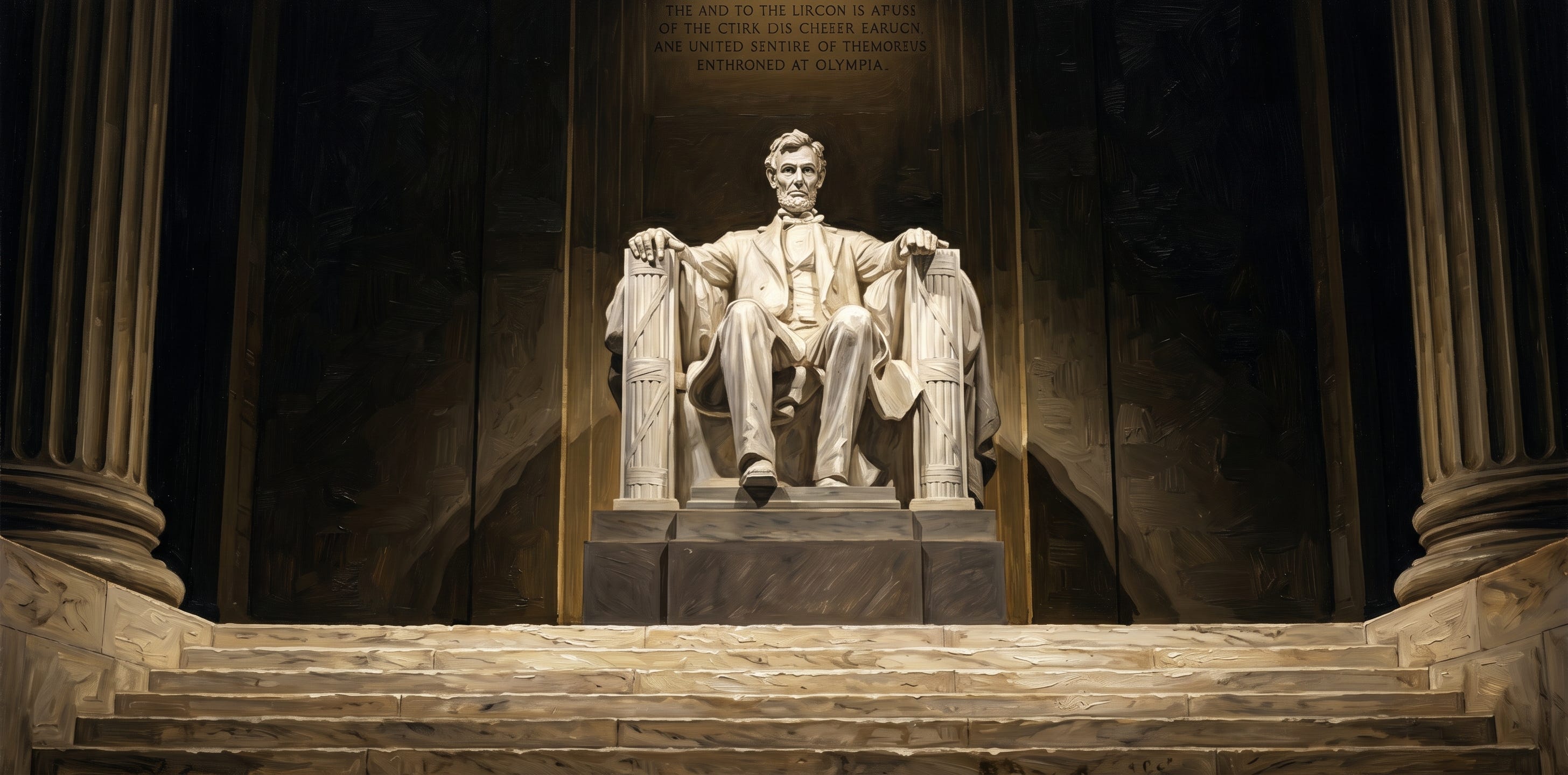
Most Americans have never noticed because the Mall has no roof. The Lincoln Memorial is a Greek temple, and Lincoln himself sits inside it the way Zeus once sat at Olympia. The Jefferson Memorial is a Pantheon. The Washington Monument is an obelisk pointing at the sky the founders believed authored the cosmos. The Reflecting Pool is a long stripe of baptismal water aligned to the axis. The architects who composed the Mall under the 1901 McMillan Plan, Olmsted and Burnham and McKim and Saint-Gaudens, were not designing monuments. They were composing a basilica without a ceiling.
You have seen pictures your whole life. You have never read what was built.
This is the long view.
The Mall was not laid out for any single generation that would walk it. It was laid out for the citizens who would walk it in 1950 and 2050 and 2150 and 2250. The McMillan team operated on a horizon their own lives would not see. They believed the republic would still be standing in two to three centuries, and they believed it had to be standing under a sky their grandchildren could read.
After the McMillan team finished, the tradition went quiet for nearly a century. Then it found its way back into the hands of a Luxembourgish architect named Léon Krier, who spent the second half of the twentieth century arguing in print and on paper that the modernist break had been a civilizational mistake. Krier designed the master plan for Poundbury in England with the then Prince of Wales. He designed Guatemala’s Cayalá.
He wrote that a city should be small enough for a citizen to walk to everything that mattered to him within ten minutes, by his own choosing, with the buildings he passed looking like buildings he would defend if a foreign army came. Krier was dismissed by the academy for thirty years.
He died last year, with the tradition rebuilding itself in stone around him. The federal architecture executive order that restored classical and traditional architecture as the preferred and default register for federal civic buildings in the District of Columbia is downstream of Krier’s argument.
The arch on Columbia Island is downstream of Krier’s argument. Every classical revival currently underway in American urbanism is downstream of Krier holding the line for forty years while almost no one was listening.
My daughter is in kindergarten.
She told me a few nights ago that history is her favorite subject. She likes Roosevelt and Jefferson best. One drew the parks of the nation. One drew the buildings of its capital. Both drew for the long view. This summer I am taking her to the Reflecting Pool. I want her to stand at the center of the long axis and look both ways. The temple of the Republic on one side. The obelisk pointing past the city to the cosmos that authored its proportions on the other. I want her to be able to say afterward that she has seen the cathedral.
You can see the reversion in the fountains starting up again on federal plazas where they had been dry for thirty years. You can see it in the classical orders returning to the federal architecture register.
You can see it in a 250-foot arch rising at Memorial Circle on Columbia Island, directly across the Potomac from the Lincoln Memorial, one foot of height for every year of the Republic, topped not by Liberty but by a figure closer to Roman Victory, the words One Nation Under God set in gold letters tall enough to read from a quarter mile away.
The phrase is older than the War.
Lincoln said it at Gettysburg when America was dying and needed to be reborn.
A country in covenant with the Father inscribes His Name on its gates. A country that has forgotten Him cannot. The country is reading what is written on the gate again.
The reversion has builders. Cyrus the Great did not worship the God of Israel and yet was called the anointed by Isaiah because he was the one who restored what the empire had broken. Solomon built the temple his father David was forbidden to build.
The arch on Columbia Island, the EO returning classical architecture to the federal register, the rededication of the capital to its founding aesthetic, none of this would be happening without President Trump.
He is the instrument of the reversion at this hour, in the way Cyrus was. The source is older and larger than him. Someone has to lay the cornerstone. Someone has to sign the order. Someone has to want the columns back.
What did the postwar century forget? Beauty matters.
A nation surrounded by ugliness becomes worse at being itself. A nation surrounded by beauty becomes better at it. The Father authored a cosmos of order and proportion and light. Architecture that reflects His authorship trains the citizens who live among it. A republic that builds its courthouses out of parking-structure concrete teaches its citizens that justice has no proportion. A republic that builds its arches with Roman Victory and gold letters teaches its citizens that the things they live among are worth defending. Beauty is not decoration. Beauty is curriculum. The Father is not indifferent to what we build. He authored the proportions Himself.
The reversion is larger than any one administration. It is working its way through the political body the way a healing bone works through soft tissue. The architecture is the visible layer. Underneath it, a quieter and slower change is happening in millions of houses on millions of mornings. One pattern reassembling. Not five trends running in parallel. One pattern.
A republic must be loved or it will be lost. America was built to be loved.
Now it is being loved again.
If you can, take yourself and your family to DC this year. Walk down the long axis. Stand at the Reflecting Pool. Touch the white stone. Remember what was built and Who it was built under. Because the inheritance is real.
The Name is returning to the gate in gold.
And we are alive for it.
<3EKO
After Jesus, the closing book of the Kingdom Within trilogy, launched seven days ago. It’s still sitting at #1 New Release in Christology on Amazon with 60+ five-star reviews. One reader wrote:
I wept during the entire eighth chapter.
I feel so fortunate to be here, now, with you, opening the door.
If someone you love left the building but kept the Savior, the book (and the series) is for them too. Send a copy. Tell them you were thinking of them.
I love you.


Thanks for this - agree with your insights. Never had heard the Goddard story - fantastic bit of history that should be widely taught, but of course given the lack of historical knowledge today I guess we are fortunate that at least the 1691 Project was debunked and never widely taught.
Leon Krier was a personal friend of mine. . . he was godfather of the New Urbanism movement, the still ongoing campaign to remedy the suburban fiasco in America. He was a great man and deserves more attention. His last book, "The Architecture of Community," explains it all beautifully.