The Office That Eats Men Alive
What Presidents’ Day actually celebrates and the three tests nobody talks about
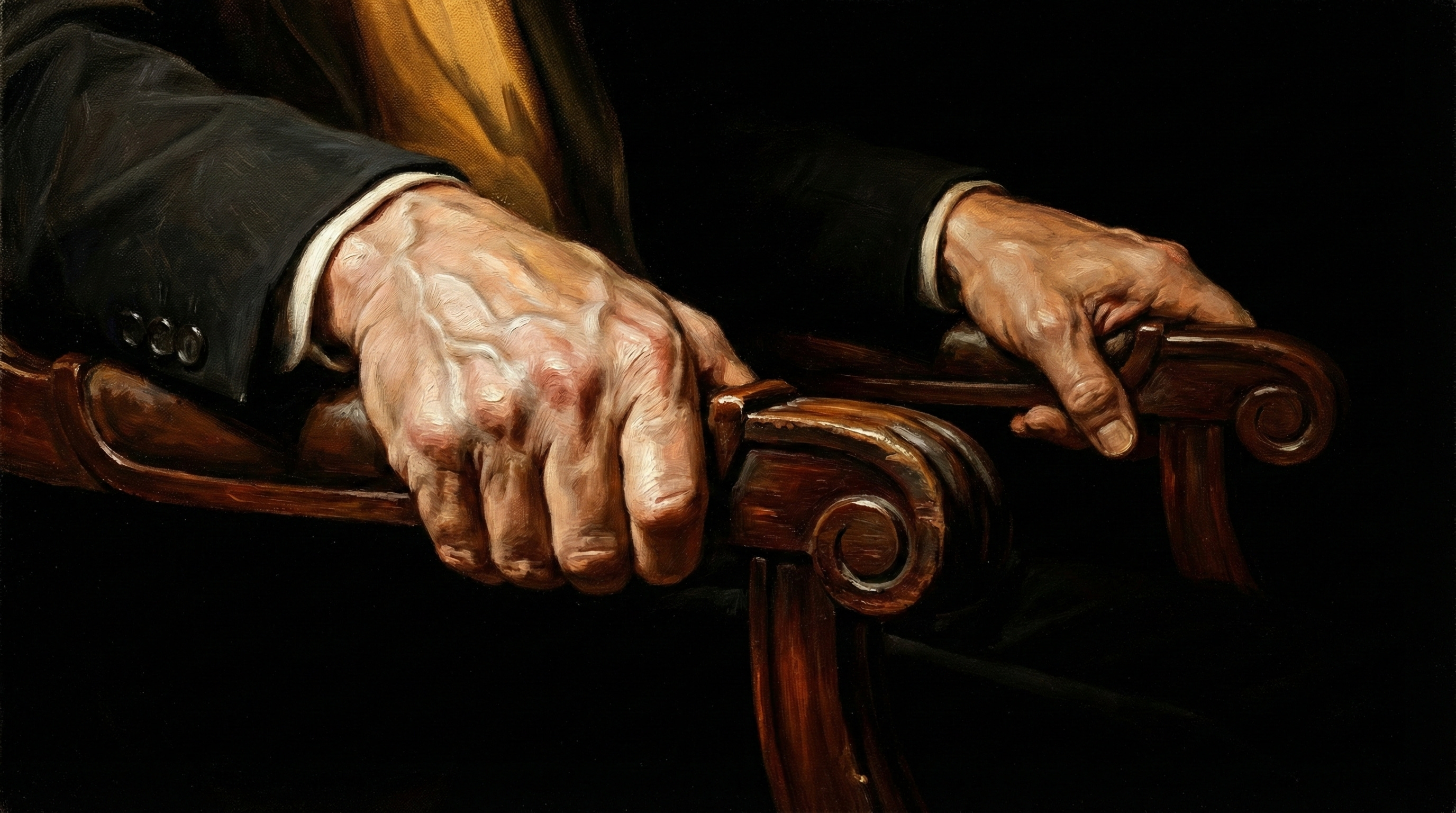
The American presidency was not designed to make men powerful. It was designed to answer a question nobody had answered in five thousand years of civilization.
Can a man hold absolute power and then give it back voluntarily?
That’s the experiment. Whether the man in the chair is bigger than the thing it represents.
Forty-five men have sat in it. Most are forgotten. A few are carved into mountains. And a handful discovered something about the office that changed them permanently.
I wrote three books about three of them. Not because they were the greatest. Because each one walked into the office and found something inside it that the textbook will never show you.
WASHINGTON: He Who Refused the Crown
They teach the humble farmer, called to serve, reluctantly accepted.
The truth is bigger. And stranger.
By 1783, Washington had just won a war with an army that hadn’t been paid. The soldiers were furious. The officers were plotting to march on Congress. A colonel named Lewis Nicola wrote him a letter proposing he be made king. Not metaphorically. Crown. Throne. Dynasty.
The army would have followed him. The republic was six weeks old and already fracturing. The man with the guns makes the rules. That’s how it had worked on every continent for five thousand years.
He said no.
Washington walked into a room full of mutinous officers at Newburgh. Hard men ready to overthrow the infant government. He pulled out a letter to read to them. They weren’t moved. Then he reached into his coat pocket for something none of them had ever seen him use: reading glasses. His hands trembled. He looked at the paper, then at them.
“Gentlemen, you will permit me to put on my spectacles, for I have not only grown gray but almost blind in the service of my country.”
Hardened soldiers wept. The coup dissolved. Not because of a speech. Because a man who had survived bullets through his coat at the Monongahela, a miraculous fog at Brooklyn, starvation at Valley Forge. A man who had been preserved through things that don’t have rational explanations. He showed them what preservation costs. It costs your body. Your eyes. Your years. And then you hand back the thing you bled for.
King George III said it made Washington “the greatest man in the world.”
Not because he was humble. Because he understood something no one in power had understood before: the most dangerous act available to a human being is the voluntary refusal of power. Not the seizure. The return.
The office didn’t make Washington. Washington made the office. By proving it could be given back.
That was the first test.
JACKSON: He Who Killed the Bank
They’ll tell you Jackson was a brute. An Indian killer. A populist demagogue who played the common man while serving himself.
You know better.
Andrew Jackson was a man with a bullet lodged against his heart from a duel he walked into standing sideways so his opponent would fire first. He carried that lead for twenty-nine years. It never moved. It never killed him. And it never let him forget what it felt like to put everything on the line and still be standing when the smoke cleared.
That bullet was his compass.
When Jackson looked at the Second Bank of the United States, he saw a private monopoly with more power than the government. A machine that controlled the money supply, bought congressmen like livestock, and answered to European creditors, not American citizens. Nicholas Biddle, the bank’s president, openly bragged that he could crash the economy whenever he wanted. And when Jackson moved against him, Biddle did exactly that. Contracted credit. Strangled businesses. Manufactured a recession and told the newspapers it was Jackson’s fault.
The entire establishment told Jackson to back down. Press, Congress, banking class. All of them.
He didn’t back down. He never backed down.
When an assassin pointed two pistols at his chest in the Capitol Rotunda and both misfired, odds of one in 125,000, Jackson charged the man and beat him with his hickory cane. Then he asked the only question that mattered: Who sent you?
The answer: the Bank.
On January 8, 1835, the United States national debt reached zero. The only time in American history. Zero dollars. Zero cents. The monster was dead. And the man who killed it was a frontier orphan with no formal education, a bullet next to his heart, and a will that bent the entire machinery of institutional finance until it broke.
Jackson didn’t fight the system from outside. He walked into the most powerful office in the world and used it as a weapon against the one institution that thought it was bigger than the presidency. And he won.
That’s a war story. The man who won it is buried at the Hermitage with the bullet still in his chest.
That was the second test.
KENNEDY: He Who Opened the Wrong Door
Sixty-three years of JFK books have given you the grassy knoll, the magic bullet, Oswald, Ruby, the mob, the CIA. An endless loop of whodunit that never resolves because it was never designed to resolve. The question “who killed Kennedy?” is a hamster wheel. It keeps you running. It keeps you looking at Dallas.
Stop looking at Dallas.
The scope of what Kennedy walked into makes Dallas itself a footnote. The system’s receipt, not the story.
A presidency that discovered something the office was never supposed to access. Something that predates the Cold War, predates the intelligence apparatus, predates the modern presidency itself. Something so far beyond the normal scope of “classified” that the men who controlled it had already removed one Secretary of Defense through a window and sidelined the most decorated general in Europe to keep it contained.
Kennedy didn’t stumble into it. He ran for president specifically to reach it. He’d caught the edge of it years before. A young naval intelligence officer in the wrong room at the wrong time. He spent the next fifteen years climbing toward the clearance level that would let him see the full picture.
When he got there, he made a decision that sealed his fate: he tried to open the door. Share what was behind it with the one entity the gatekeepers feared most. The public.
Dallas wasn’t a conspiracy. It was an autoimmune response. The system identified a president who intended to make the biggest disclosure in human history, and it did what immune systems do: it eliminated the threat. In broad daylight. With a hundred cameras rolling. The visibility wasn’t a mistake. It was the message.
The question was never who killed Kennedy. The question is what did Kennedy find that was worth dying for. And who decided you’re not allowed to know?
That’s the book. That’s what Shadow Clearance lays out.
That was the third test. The chair broke something.
Three tests. Three answers. Same chair.
Washington proved the office could be surrendered. Jackson proved it could be weaponized against the forces that try to own it. Kennedy proved it has a ceiling. And the penalty for reaching it is paid in daylight.
The office doesn’t make great men. It reveals what was already inside them. Like a silversmith holding metal to the flame until only the real thing remains.
How does the silversmith know when the work is finished?
He sees his reflection in it.
There’s a book written in 1896 by Ingersoll Lockwood called The Last President. Or maybe it was planted in the archives by the CIA. Either way, it describes a political outsider elected from Fifth Avenue in New York City whose victory sets off protests and panic in the streets. The establishment convulses. The institutions resist. The story isn’t about whether this president is good or orange man bad.
The story is about whether the office itself survives him.
It was written 130 years ago. It reads like tomorrow’s newspaper.
Is the man bigger than the office, or is the office bigger than the man?
We’re about to find out. Again.
I wrote the full story on each of these three presidents. Today I packaged all three into one bundle.
The trilogy includes:
George: The Unseen War
Jackson: Blood Veto
Kennedy: Shadow Clearance
Three books. One bundle. It’s yours.
Pay what you want. Instant delivery.
Patton drops next week. Hit reply if you want a free preview of the book.
And tell me which president you want me to write about next.
History isn’t a fairy tale. It’s a crime scene.


Amazing EKO. I can't wait to read Patton, I know his Grandson.
I just finished reading the Magi this morning - the dust of the roads is still stirred up by my feet - it's still resonating like a struck bell in my heart - Thank You for bringing that story to life for my understanding -