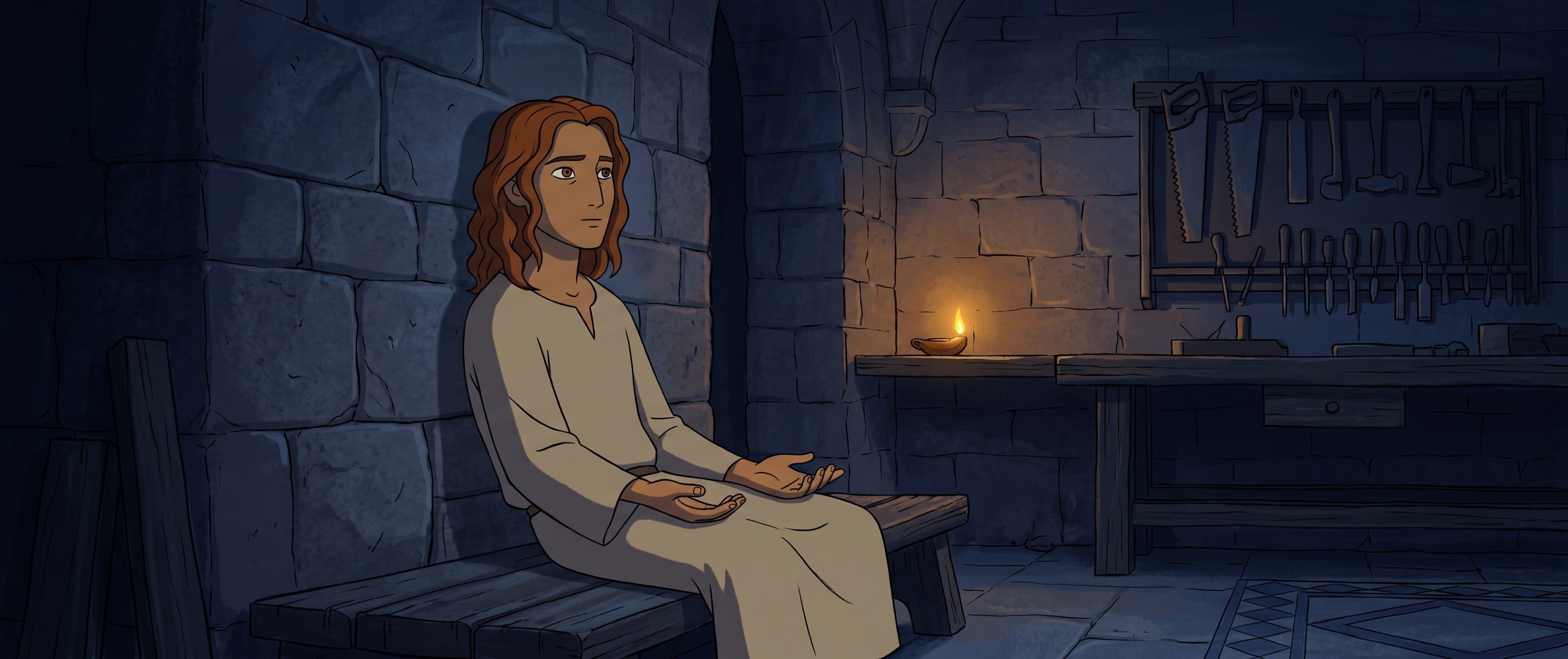
Half the room stood up. He didn’t.
The recruiters had come to Nazareth in the spring of his seventeenth year.
They arrived with the caravans, as such men always did, traveling as merchants, speaking quietly in corners, identifying the young men most likely to listen. The message spread through the village like fire finding dry grass: Rome could be resisted. Rome must be resisted.
Yeshua heard them out.
He sat in the back of the gathering, listening as they spoke of the tax collectors who took twice, of soldiers who took what they wanted, of a people ground under the heel of pagans. They quoted the prophets. They invoked the Maccabees. They painted pictures of a restored Israel, free and proud.
The young men around him leaned forward.
When they asked who would join, half the room stood up.
Yeshua stayed seated.
“You didn’t stand.”
James found him in the workshop that evening, cleaning tools by lamplight. Fifteen now. Arms crossed. Face tight.
“No.”
“Everyone saw. Everyone noticed.”
“I know.”
“They’re talking about you. Saying you’re a coward. Saying Joseph’s son has no spine.”
Yeshua set down the plane he was oiling. Looked at his brother.
“What do you think?”
“I think we’ve been pushed around long enough. I think someone has to do something.” He stopped. Swallowed. “I think Father would have wanted us to fight.”
“Father wanted us to survive.”
“Then we just sit here? We just take it?”
“We have seven siblings depending on us.”
James’s fists clenched at his sides. “That’s always your answer. The family. The responsibility.”
“You didn’t have to ask. It was given.”
“By who?”
The workshop went quiet. Outside, Martha was calling the younger ones in for supper.
“The recruiters are coming back tomorrow,” James said. “They want to talk to you specifically. They think you could lead something.”
“Lead what?”
“The moderates. The ones who want to resist but aren’t ready for violence. They need someone who can talk, who can think.” His hand cut the air between them. “Who can do what you do.”
“And if I say no?”
“Then they’ll find someone else. And that someone might be me.”
Isaac the moneylender came to the workshop on a Tuesday afternoon.
He walked through the door without knocking. Surveyed the workspace. Sat down on a stool without being invited.
But he didn’t start with a proposition. He sat there for a full minute, watching Yeshua work. His left hand opened and closed on his knee, a habit, or a wound.
“My son worked stone in Sepphoris,” he said. He paused. “Two years ago. A Roman patrol accused him of stealing. They...” His left hand opened and closed on his knee. “They beat him in the street. He died three days later. No one was punished. No one was named.”
A long quiet.
“His name was —”
The hand closed.
“I haven’t said it out loud since.”
Yeshua’s hands stopped on the wood.
“I’ve been watching you since then.”
Yeshua kept planing.
“Every week I hear something new. The merchant from Tyre who says you argued Torah with him in Greek and won. The widow whose roof you fixed for free. The creditor you stared down when you were fifteen.” Isaac leaned forward. “You’re the only person in this village I can’t predict.”
“I’m a carpenter.”
“You’re a carpenter the way David was a shepherd.” He leaned closer. “I’ve been lending money for thirty years. I know men. I know the ones who are what they seem and the ones who aren’t. You’re not what you seem.”
Yeshua set down the plane. Turned.
“What do you want, Isaac?”
“Your family is drowning. I know the numbers. Eight children, one income, a mother who can barely hold herself together. You’re behind on taxes. You sold your father’s share of the shop.” Isaac’s hands were gripping his knees. “I can make all of that go away. Debts cleared. Education funded. Your siblings set for a generation.”
“In exchange for what?”
“The moderate patriots need a voice. Someone young enough to inspire. Someone like you.”
“You want to buy me.”
“I want to invest in the only person in this village worth investing in. I don’t say this. I’ve never said this.”
Yeshua looked at the moneylender. The man’s hands were still gripping his knees. His eyes were bright.
“Your mother supports this,” Isaac said. “Your uncle Simon has already pledged his backing. Even James...”
“You’ve spoken to my family?”
“I’ve spoken to everyone.”
“I need time.”
“Of course.” Isaac stood. At the door he turned back. “I’ve waited two years. I can wait a few more days.”
He left. Yeshua stood alone in the workshop, surrounded by his father’s tools.
His mother cornered him that evening.
“Isaac told me about his offer.” Mary’s voice was careful. “It’s generous.”
“It’s a bribe.”
“It’s an opportunity. For you. For all of us.”
“Mother. You know what you told me. About my birth. About the angel.”
Her face went still. They rarely spoke of this.
“That’s exactly why you should do this. You’re meant to lead Israel. The angel said you would sit on David’s throne. What better way to begin than...”
“That’s not what the angel meant.”
“How do you know?”
“I don’t. Not entirely. But I know it’s not this.”
“Then what? What are you waiting for?”
The lamp guttered.
“You don’t know.” Her voice cracked. “Seventeen years, Yeshua. Seventeen years I’ve been waiting. Watching. And you don’t know.”
“I’m sorry.”
“Your father believed too. He gave up everything. His plans. His chance at a normal life. He raised you like you were precious. And now he’s gone, and I’m alone, and you tell me you don’t know?”
The tears came. She didn’t try to stop them.
Yeshua crossed the room. Held her. He felt her hands clutch the back of his tunic. Small. He had forgotten his mother had small hands.
“I’m sorry I can’t be what you want me to be. Not yet.”
“Then what will you be?”
He held her tighter.
He worked through the next two days. Ezra’s plow handle. The doorframe for the mason. The stools for the inn. His hands moved. The decisions did not.
On the second night he climbed the ridge alone. He sat for a long time. He did not pray. He listened.
There was no answer. He heard the wind in the olive trees and a dog somewhere down the lane.
Before dawn he walked back.
The citizens’ committee came three days later.
Fifteen men in the largest home in the village. The radicals. The moderates. The cautious. Isaac in the front row. Uncle Simon with the nationalists. James in the back.
Yeshua stood before them.
“You’ve asked me to lead. I can’t.”
The murmur started immediately.
“Hear me out.”
The room quieted.
“My father is dead. My mother is widowed. I have seven brothers and sisters, the youngest still a child. If I take up this cause, I put all of them at risk. Rome doesn’t negotiate with rebels. Rome crucifies them. And Rome doesn’t stop at the rebel.”
“We would protect...” Isaac started.
“You can’t promise that.” He pressed his hands flat against his legs. “I won’t gamble my siblings’ lives. That’s the duty my father left me and I haven’t finished it.”
“So you’ll do nothing?” A voice from the radical faction.
“I didn’t say that.”
“Then what will you do?”
He opened his mouth. Closed it.
“I don’t know,” he said. “I know it’s not this. I know it’s not politics and it’s not an army.”
He looked at Isaac. “Your offer is generous. But I won’t be bought.”
His eyes found James.
“My brother James will speak for the family.”
James walked to the front of the room. Stood beside Yeshua. Looked out at faces he’d known his whole life.
“My brother is right,” he said. The words came slowly. “Our family can’t afford for him to become a target. Whether you agree with his reasons or not, he’s the one who kept us fed after our father died. He’s earned the right to make this choice.”
The room was silent.
“I wish he’d chosen differently. I won’t pretend otherwise. But he’s the head of our family, and I stand with him.”
Yeshua looked at his brother.
You didn’t have to do that.
Yes I did. You’re still my brother.
The committee disbanded. The radicals went muttering. The moderates drifted off.
Isaac stopped at the door. He looked back at Yeshua. Not with anger. With something older.
“I understand,” he said. “But I’ll be watching. I’ve been watching a long time.”
He left.
Simon caught Yeshua outside.
“You’ve made a mistake.”
“Maybe.”
“You’ll regret this. You think you won’t but you will.”
“Maybe.”
“Your father would have...”
“Don’t.” Yeshua’s voice went cold. “Don’t tell me what my father would have done. You didn’t raise me. He did.”
Simon looked at him for a long moment. Then he turned and walked down the dusty path, past the olive press, into the dim of the village evening.
That night, James found Yeshua on the ridge.
“You could have led them,” James said. “They would have followed you anywhere.”
“I know.”
“And you just... walked away.”
“Yes.”
“Why?”
Yeshua was quiet. When he spoke, his voice was smaller. Rougher.
“Do you remember what Father used to say about wood? How you have to let it tell you what it wants to become?”
“I remember.”
“That’s what I’m doing. Listening. Waiting.” He looked at his brother. “It’s not a revolution, James. Beyond that I don’t have words.”
“That’s not an answer.”
Yeshua said nothing for a moment.
“I know.”
James sat down beside him.
“I still think you’re wrong,” James said.
“I know.”
“But I’ll stop pushing. For now.”
“Thank you.”
They sat. The stars turned. Somewhere a dog barked.
“The family’s going to be alright,” James said. “I’ll help more. Joseph too. We’ll figure it out.”
Yeshua nodded.
James stood. Brushed the dirt from his tunic. His hand moved toward his brother’s shoulder, stopped halfway, fell back. He walked down the path toward the village.
Yeshua stayed on the ridge. The cold came. He didn’t move.
When he finally stood, the village was dark.
He walked down the hill with one hand on the low stone wall.
His father’s walk.
<3EKO
After Jesus has been the surprise of spring. To everyone who’s read it or sent a personal note, thank you. To those of you getting your paperbacks this week, I’d love to hear what lands.
A few of you have asked if these Nazarene episodes will ever become a book. I’ve been thinking about it. If you’d want the Nazarene series bound and sitting on a shelf or in someone’s hands as a gift, tell me. I’m listening.
Big week ahead.
I love you.
Previously:


EKO, your stories are so relatable. It makes reading them a joy.
“I’m sorry I can’t be what you want me to be. Not yet.”
How often do I say this to God. Just give me more time. I need to finish being me, before I can be the person you want me to be.
EKO - Though Jesus has been with me from my childhood - I never gave a thought to HIS childhood - and now through your words I can relate how His life was and how He came to His mission for His father. It like all the words you pen open pages in my mind to think deeply about and I thank you for this gift.